Sergei Sobyanin: Fiztekh station on Lyublinsko-Dmitrovskaya line has opened
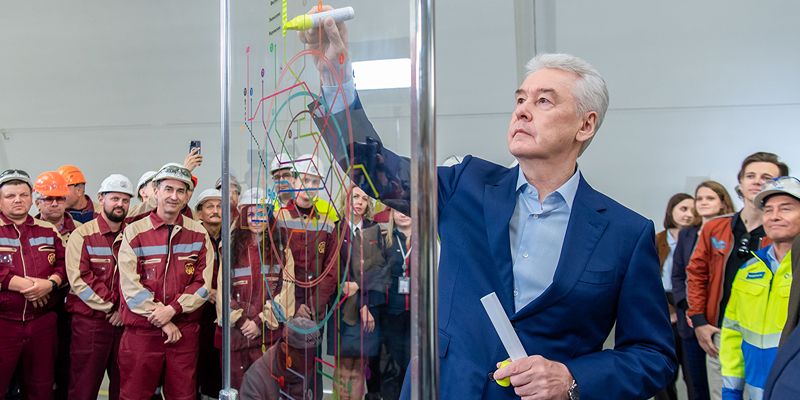
The new section of the Lyublinsko-Dmitrovskaya line has opened. Sergei Sobyanin has launched the trains. The Moscow Mayor, together with Oleg Toni, RZD’s Deputy Director General, have also opened the new Lianozovo station of the first Moscow Central Diameter (D1) after reconstruction.
“The Lyublinsko-Dmitrovskaya line has almost doubled, totaling 43 kilometers and including more than 20 stations. Now we are launching three more metro stations on the northern radial section. Moscow Institute of Physics and Technology students say that back in 1996, its KVN team drew a metro station near their university. This dream came true, and the metro station has been built. Prior to this, a special bus route with two stops nearby has been arranged,” said the Moscow Mayor.
Lyublinsko-Dmitrovskaya line
Until 2011, the Lyublinsko-Dmitrovskaya line had 14 stations with the Maryino – Maryina Roscha section covering 23.6 kilometers. In 2011, another 4.2 kilometers were built, including Borisovo, Shipilovskaya and Zyablikovo stations.
In 2016, Butyrskaya, Fonvizinskaya and Petrovsko-Razumovskaya stations opened (the section length was 5.51 kilometers). In 2018, the extension added another 6.24 kilometers north to Seligerskaya station. The section also included Okruzhnaya and Verkhniye Likhobory stations with the Likhobory train depot put into operation.
After the commissioning of the Seligerskaya – Fiztekh section, the Lyublinsko-Dmitrovskaya line now has 26 stations, and its length has exceeded 43 kilometers. It became the longest Moscow Metro radial line after the Arbatsko-Pokrovskaya line.
The 27th station, Yuzhny Port, is expected to be built between Kozhukhovskaya and Pechatniki stations.
Seligerskaya – Fiztekh section
The expansion of the Lyublinsko-Dmitrovskaya line to cover the Lianozovo and Severny districts was approved by Sergei Sobyanin and supported by Muscovites during the Active Citizen project voting. 199,332 people took part in it, with 84 per cent of the voters in support of the decision.
Construction began in 2019 and was completed in September 2023. The route of the Seligerskaya – Fiztekh section is 5.8 kilometers long and runs along Dmitrovskoye Motorway. The new Yakhromskaya station is at the intersection of Dmitrovskoye Motorway and 800-Letiya Moskvy Street; Lianozovo station is located at the intersection of Dmitrovskoye Motorway and Dubninskaya Street, and Fiztekh station is north of Akademika Landau Boulevard. The stations offer modern passenger services in line with Moscow transport standards, including a unified, clear navigation, elevators, vending machines, ticket machines, new turnstiles with bank card and biometric payment systems. In addition, citizens can use services of the Passenger Mobility Center.
This involves an arrangement of two 6-meter single-track tunnels as is typical of the Moscow Metro. The geological exploration under the Dmitrovskoye Motorway, along the roadway, under the Moscow Ring Road and the D1 tracks (Savyolovsky railway line) was challenging.
Specialists used a number of unique technologies. Two Lianozovo – Fiztekh sections were constructed simultaneously. For the first time in the history of the Moscow Metro construction, two tunnel boring machines reached the pit at the same time. In November 2021, the construction of three running tunnels was completed on the northern section of the line - two tunnel boring machines reached the pit of Fiztekh station and one tunnel boring machine reached the pit of Lianozovo station.
It was expected that part of the line beyond the Moscow Ring Road would run above ground. However, in early 2020, Sergei Sobyanin adjusted the project, and the Lianozovo – Fiztekh section was built underground. This reduces the amount of work to reconstruct and reroute utilities, including main water pipelines, main gas pipelines and power lines, to minimize road closures during the construction and reduce noise and vibration impacts on nearby residential buildings. In addition, the weather influence on the line operation is eliminated, which will ensure uninterrupted traffic and reduced costs in the future.
The new metro section has improved transport service for more than 500,000 people - residents of the Beskudnikovsky, Vostochnoye Degunino, Dmitrovsky, Lianozovo, Severny districts, as well as the city of Dolgoprudny in the Moscow region. For the first time, about 130,000 people got a metro station near their home.
The Petrovsko-Razumovskaya – Fiztekh section headway is now 1.6 minutes. Trains used to run from Petrovsko-Razumovskaya to Seligerskaya every 2.2 minutes.
For ease of travel to the new metro stations, 10 bus routes have been adjusted and one new route has been launched. In addition, 11 modern bus shelters have been installed.
City residents will be able to save up to 40 minutes on their daily commutes. For example, the travel time from the Phystechpark technopark to Sretensky Bulvar station has been reduced from 55 to 35 minutes. Passengers can now get from Angarskie Prudy Park (Dmitrovsky District) to Petrovsko-Razumovskaya station and from Severny village to Okruzhnaya station twice as fast (20 minutes instead of 40).
The opening of the new stations will reduce the congestion of Altufyevo station of the Serpukhovsko-Timiryazevskaya line (up to 50 per cent) and of Seligerskaya station of the Lyublinsko-Dmitrovskaya line (up to 36 per cent), and will also reduce the intensity of traffic on Dmitrovskoye Motorway (up to 13 per cent), Altufyevskoye Motorway (up to 10 per cent) and the local road network.
Yakhromskaya station
The Yakhromskaya station of the Lyublinsko-Dmitrovskaya line is located at the intersection of Dmitrovskoye Motorway and 800-Letiya Moskvy Street. It is shallow, with an island platform and two underground lobbies facing both sides of Dmitrovskoye Motorway, 800-Letiya Moskvy Street, residential and public buildings and bus stops.
With the opening of the Yakhromskaya station, about 80,000 people got a metro station within a walking distance of their homes. The travel time to the nearest Maryina Roscha station of the Big Circle Line (BCL) has been reduced to 18 minutes. The journey to the nearest Okruzhnaya station of the Moscow Central Circle (MCC) will now take only 8 minutes.
Thanks to the opening of the Yakhromskaya station, the congestion of Seligerskaya metro station will be reduced by more than a third. The adjacent road network will also relieve congestion of Dmitrovskoe Motorway and 800-Letiya Moskvy Street.
According to the architects, the design of the platform part of the Yakhromskaya station is an asymmetrical red and white color scheme. The aluminum panels of the white tunnel wall are decorated with dye-sublimation printing dedicated to the celebration of the 800th anniversary of Moscow in 1947. The composition, with an area of 815 square meters, spans the entire length of the platform. The author is People's Artist of Russia Alexander Rukavishnikov. The opposite tunnel wall is red.


Asymmetrical lighting complements the station color scheme. The lamps of the white side hall are directed towards the panel, and the lamps of the opposite red hall are hidden behind the lowered middle part of the ceiling.
The design of the lobbies is also inspired by Moscow’s architectural symbols. The rhombic ceiling elements with built-in lamps resemble the decor of the onion domes of St. Basil's Cathedral.
The new station is expected to be used by 15,500 passengers daily, and by 2030, its passenger traffic will increase to 19,500 people per day.
The improvement concept for the adjacent area encompasses landscaping, granite paving, asphalt refreshing as well as installing bus stops and modern hardscape.
Sergei Sobyanin told about the design of the Yakhromskaya station of the light green metro lineFinishing, installation and upgrade: works underway in Moscow Metro
Lianozovo metro station and D1 station of the same name
The Lianozovo metro station is located at the intersection of Dmitrovskoye Motorway and D1. It is shallow, with two lobbies facing Dmitrovskoye Motorway and Dubninskaya Street.
“Congratulations on the opening of the new railroad station! We have moved it from the old platform to a new location, built a station and a transfer to Lianozovo metro station, which we are opening today. It is a complex, very important and essential transport hub. I would like to express my gratitude to the railway workers who completed their work on time, some of which will continue - additional exits and an underground passage are being built. But in general, the station will operate starting from today, just like the metro line,” said the Moscow Mayor.
The neighborhoods of Lianozovo, Vostochnoye Degunino and Dmitrovsky District, where about 30,000 people live, are within a walking distance of the station. They will no longer have to get to Altufyevo station to take the metro. Travel time to the city center will be reduced to 30 minutes. For example, passengers can now get to Maryina Roscha station using the BCL without transfers in just 21 minutes. Previously, this journey by bus used to take 36 minutes. Passengers can also get to the MCC twice as fast: travel time has been reduced to 11 minutes.
Thanks to the opening of Lianozovo metro station, the congestion of the Serpukhovsko-Timiryazevskaya line station will be reduced (up to 26 per cent), as well as of the adjacent road network, including Dmitrovskoye Motorway (up to six per cent) and Cherepovetskaya Street (up to 11 per cent).
According to the architects, the design of Lianozovo station includes restrained colors - dark gray and beige. The columns, ceiling and tunnel walls are decorated with metal panels, the floor is covered with polished slabs of light gray granite and gabbro-diabase. The ground pavilions are decorated with light green panels - green is the color of the Lyublinsko-Dmitrovskaya line on the Moscow Metro map.


Along with the station, the Moscow Lianozovo D1 station opened. It was moved 350 meters closer to the metro, which reduced the transfer time by four times.
“In addition, a railway station was built in Lianozovo, which was moved and combined with a metro station. Now two districts - Dmitrovsky and Lianozovo - have a common connection through this railway station with access to the metro. Usually, a railway separates regions, but in our case it connects them. Congratulations on the big event!” - added Sergei Sobyanin.
As part of the project first stage, two new passenger platforms and a northern underground vestibule integrated with the metro station and the underground passage through Lianozovsky Proyezd have been built. The lobby has been outfitted with four elevators and eight escalators.
As part of the second stage, the construction of a southern underground lobby is underway, which will be integrated with the existing underground pedestrian crossing through Lianozovsky Proyezd and the underground pedestrian crossing under construction across Dubninskaya Street. It will be outfitted with three elevators and three escalators. The facility is 65 per cent complete.
It is expected that in 2023 the total passenger flow of the transport hub (metro, MCD, buses) will be 66,100 people per day, and by 2030 it will be used by 87,000 people per day.
How Lianozovo station of Lyublinsko-Dmitrovskaya metro line will be designed
Fiztekh station
The Fiztekh station is located along Dmitrovskoye Motorway north of Akademika Landau Boulevard. It is shallow, with two lobbies facing Dmitrovskoye Motorway, residential and public buildings, as well as bus stops.
The opening of Fiztekh station has improved transport service for 175,000 residents of the Severny District and the city of Dolgoprudny near Moscow. 18,000 people now have a metro station within a walking distance of their homes. In addition, students and professors of the Moscow Institute of Physics and Technology, as well as employees of the Phystechpark technopark, can use this station. To connect the station with Moscow Institute of Physics and Technology, bus route No. 746 has been expanded with a stop 200 meters closer to the metro station.
According to Sergei Sobyanin, the remote Severny District can also be integrated into the city’s transport system thanks to the opening of the new station. To make this happen, experts have built 10 metro stations, starting from Maryina Roscha.
“This metro line offers further transfers to D1, D2, D3, D4, the BCL, so the entire transport infrastructure of Moscow is available to you,” added Sergei Sobyanin.
Now passengers can get to the metro without using buses, which will save up to 40 minutes a day. For example, the travel time to the nearest Maryina Roscha station on the BCL was reduced from 48 to 24 minutes. The journey to the Lianozovo D1 station has become five times faster. Passengers can get there in 3 minutes instead of 15 minutes. It has also become easier to get to the MCC: travel time was reduced threefold - from 42 to 14 minutes.
The main feature of Fiztekh station is the light columns in the center of the platform and wide round benches between them. The station floor is light granite with contrasting black stripes highlighting the benches. The ground pavilion is surrounded on three sides by a colonnade.


The new station is expected to be used by 10,000 passengers daily, and by 2030, its passenger traffic will increase to 15,000 people per day.
The improvement concept for the adjacent area encompasses landscaping, granite paving, asphalt refreshing and modern hardscape installing. Specialists will provide convenient access to the station from both sides of Dmitrovskoye Motorway.
Moscow Metro program outcomes
Since 2011, the Moscow Government has built or reconstructed 236 kilometers of lines, 114 stations, 4 extra station lobbies and 11 train depots to increase the Moscow Metro network 1.6 times.
On top of that, together with RZD, they have launched D1, D2 and D3 above-ground metro lines spanning 217 kilometers and including 100 stations.
New Moscow Metro, MCC and MCD stations
Lyublinsko-Dmitrovskaya line:
- Maryino – Zyablikovo section (3 stations);
- Maryina Roscha – Seligerskaya section (6 stations);
- Seligerskaya – Fiztekh section (3 stations);
- 2nd lobby (exit) for Maryina Roscha station;
- 2nd lobby for Petrovsko-Razumovskaya station;
- 2nd lobby for Okruzhnaya station.
Kalininskaya and Solntsevskaya lines:
- Novogireevo – Novokosino section (1 station);
- Delovoy Tsentr – Vnukovo Airport section (14 stations).
Zamoskvoretskaya line:
- Krasnogvardeyskaya – Alma-Atinskaya section (1 station);
- Tekhnopark station;
- Rechnoy Vokzal – Khovrino section (2 stations).
Arbatsko-Pokrovskaya line:
- Mitino – Pyatnitskoye Shosse section (1 station).
Tagansko-Krasnopresnenskaya line:
- Vykhino – Kotelniki section (3 stations);
- Spartak station.
Butovskaya line:
- Ulitsa Starokachalovskaya – Bitsevsky Park section (2 stations).
Sokolnicheskaya line:
- Yugo-Zapadnaya – Kommunarka section (7 stations).
Nekrasovskaya line:
- seven stations.
Big Circle Line:
- 31 stations.
Filyovskaya line:
- 2nd lobby for Mezhdunarodnaya station.
Moscow Central Circle:
- 31 stations.
Moscow Central Diameters (D1, D2, D3):
- 100 stations, of which 34 stations are transfers to Moscow Metro, MCC and MCD lines.
Train depots (including reconstruction):
Mitino, Brateevo, Pechatniki, Vykhino, Planernoye, Nizhegorodskoye, Likhobory, Solntsevo, Vladykino, Rudnevo, Sokol.
Sergei Sobyanin on Moscow Metro growth in 2023Modern underground city: transformation of Moscow Metro