Sergei Sobyanin announces plans to develop the Moscow tram network
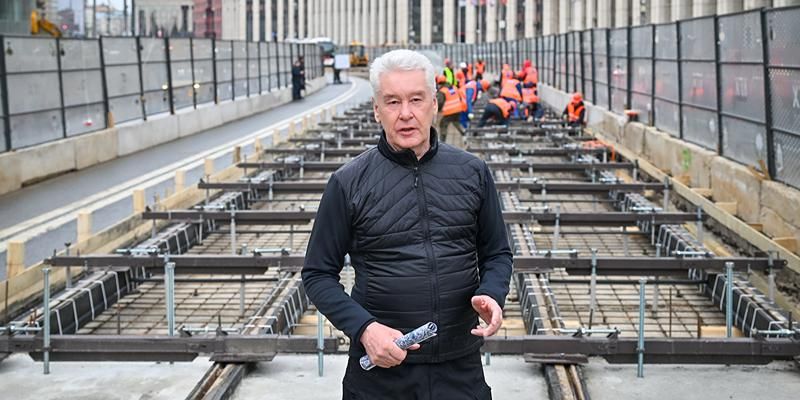
Sergei Sobyanin inspected the tram line under construction on Prospekt Akademika Sakharova. The work is scheduled to be completed by the end of this year.
“We continue to develop Moscow’s tram network. We have started a large complex project: tram tracks are being laid on Prospekt Akademika Sakharova, which will connect the large tram networks in the south, center, northeast and east of Moscow. The new tram routes will cover 19 districts of Moscow and will make transportation accessibility much better for residents. There will be new routes. There will be a tram tracks connecting Three Station Square with Paveletskiy railway station,” said the Mayor of Moscow.
Sergei Sobyanin added that the city is creating a serious transport infrastructure, in fact, new tram diameters, similar to the central diameters on the railroad, which were made earlier.
“The tram continues to revitalize and provide new and different transportation options. It is comfortable, fast and practically silent,” concluded the Mayor of Moscow.
Tram line on Prospekt Akademika Sakharova
The new line on Prospekt Akademika Sakharova will connect the existing tram tracks.It will create two diametrical tram routes with a total length of about 59 kilometers:
— Route No. 39 from Universitet metro station to Novogireevo station on the Fourth Moscow Central Diameter, with a length of 30.9 kilometers. The route will be created by combining two existing routes, No. 37 and No. 39;
— Route No. 3 from Chertanovskaya metro station to the Metrogorodok district, with a length of is 27.8 kilometers. It will be created by combining routes No. 3 and No. 13.
Passengers on the new routes will be carried by modern three-section Vityaz-Moskva type carriages, as well as new generation single-section carriages. The trams running on the section will be battery powered, so there will be no overhead power line. The crossing of the Garden Ring will not require any changes to the existing traffic lights.
Thanks to the new routes, about two million residents of the Southwestern, Southern, Eastern and Central Administrative Districts will have more convenient and faster options for their daily travel. For them journey times will be reduced by up to 1.5 times.
In addition, commuting to work will be made more convenient for about 40,000 employees of numerous administrative and financial institutions, as well as business structures located in the area of Prospekt Akademika Sakharov. These include the Russian Government Analytical Center, the Commercial Court of Moscow Region, the Central Customs Administration, the Ministry of Agriculture of Russia, the Federal Antimonopoly Service, Rosimushchestvo, Rosfinmonitoring, and Rosgranstroy FSBE.
The construction of the new tram line on Prospekt Akademika Sakharova is a complex engineering project being implemented in a densely built up area with heavy traffic. The construction technology will involve the laying of seamless track without joints on a reinforced poured concrete base, and special vibration-damping mats will be used. Thanks to this technology the trams will move quietly and smoothly.
The new tracks are being created on a detached right-of-way. They will be separate from the road which will ensure the trams run without interruptions.
During the work, the nearby road network will be reconstructed, including in the area of Masha Poryvaeva Street, which joins Kalanchevskaya Street and Komsomolskaya Square, near the intersection of Prospekt Akademika Sakharova with Sretensky Boulevard (Turgenevskaya Square). The sidewalks will be widened from three to six meters and the existing sidewalk will be repaired. The asphalt road surface will also be renewed.
To improve lighting on the streets being reconstructed, 308 lamp posts with modern energy-saving bulbs will be installed. There are also plans to instal benches, litter bins, bicycle parking racks and navigation displays along the route. In addition, about 200 trees will be planted and 13,700 square meters of lawns will be laid.
On Prospekt Akademika Sakharova and Masha Poryvaeva Street there will be 16 tram stops, 11 of them completely new, and five of them renovated with elevated platforms and modern waiting pavilions. In addition, six ground-level controlled crosswalks and six traffic light junctions will be organized.
After the commissioning of new tram tracks, there will be three lanes in each direction for road traffic on Prospekt Akademika Sakharov.
Currently 200 people and 41 units of equipment are working at the site. The renovation and reconstruction of underground utilities has been largely completed. Specialists have started laying the tram line support layer.
Sergei Sobyanin: Moscow’s public transport has won a record number of prestigious awards


Development of the tram network
Moscow has about 430 kilometers of tram lines, which 82 percent are separated from highways and are on a separate right-of-way.
In 2010, new trams accounted for just four percent of the rolling stock in operation. Today, 97 percent of the fleet has been replaced. The average age of the rolling stock does not exceed six years — putting Moscow not only ahead of any other city in Russia, but of any major city in the world.
“The tram remains one of the most popular forms of public transport among Moscow residents. We are expanding the network, restoring historic routes. For example, we plan to resume traffic on Trifonovskaya Street to Rizhskaya Square. In the next two years 100 more new generation single-section cars will be delivered to the refurbished P.L. Apakov depot, and the renewal of the city’s tram fleet will be 100 percent complete“, Sergei Sobyanin wrote in a post on his Telegram channel.
Source: Sergei Sobyanin’s Telegram channel @mos_sobyanin
Now there are 5 tram routes operating in the capital operates 35 routes, and passengers make about 750,000 trips a day on the network, a 20 percent increase on 2023. Among the most popular routes are No. 17: Medvedkovo — Ostankino (more than 52,000 trips a day), No. 6:Bratsevo — Sokol Metro station (38,000 trips a day) and No. 12: Eastern Izmailovo - Dubrovka (more than 33,000 trips a day).
In 2024, a new double-track tram line was opened on Sergia Radonezhsky Street with a length of more than 860 meters. This made it possible to organize a new route for tram No. 2: 3rd Vladimirskaya Street — Kursky Station. The interval between trams is 10 minutes. More convenient and faster options for daily trips were provided to about 700,000 residents of the South-Eastern Administrative District, Eastern Administrative District and Central Administrative District. More than 300,000 citizens from the eastern districts, Lefortovo, Sokolinaya Gora and Perovo, now have a direct transportation link to Kursky Station.
Simultaneously with the opening of the new line on Sergei Radonezhsky Street, and the circulation of trams No. 12, 38 and 46 was restored on the section between Aviamotornaya metro station and Abelmanovskaya Zastava square. That section of the tram network had been closed during the construction of the Moscow Central Diameters railway overpass. Tram No. 12 once again runs between the Vostochnoe Izmailovo district and Dubrovka station on the Moscow Central Ring. Route No. 38 runs from the Cheremushki district to the Aviamotornaya metro station and the Kompressor House of Culture, and tram No. 46 runs from the Metrogorodok district to Novokonnaya Square.
As a result, passenger traffic on tram routes in the area of Ploshchad Ilyicha metro station has increased almost 1.5 times - from 628,000 to 92,800 passengers per working day.
In April the renovated P.L. Apakov tram depot on Shabolovka Street was opened after a large-scale reconstruction. It is the oldest operating electric transportation facility in the capital, having existed since 1909. After the renovation, the depot has become modern and innovative. It can now serve the new generation of trams currently operating in the capital. The depot has a capacity of 77 carriages, including single-section and three-section models.
The plans to expand Moscow’s tram network include the construction of a new line on Prospekt Akademika Sakharova from Komsomolskaya Square to Chistoprudny Boulevard and the restoration of the tram line on Trifonovskaya Street to Rizhskaya Square. The new lines will enable the creation of additional tram routes and increase the popularity of this mode of transport.
In 2025-2026, the city fleet will receive another 100 modern single-section new generation trams. All of them will be delivered to the reconstructed P.L. Apakov depot. This will complete the renewal of Moscow’s tram fleet. The new carriages will be equipped with everything necessary for comfortable travel: low floor, climate control system, multimedia screens and sockets for charging mobile devices. The trams will be equipped with extended capacity batteries, enabling them to travel at least four kilometers without an overhead power network.
In addition, Sergei Sobyanin has issued instructions for the modernization of the tram depots. There are plans to reconstruct four depots by 2030, and to repurpose the former seventh trolleybus depot on Nagatinskaya Street into a new tram depot, Nagatinskoye. As a result, all seven depots in Moscow will meet modern standards for servicing the latest generation of trams.
Launch of the first unmanned tram in Russia
In 2023, Center for Advanced Development of Moscow Transport began working on the practical solution of the challenge set by to Sergei Sobyanin to organizing the circulation of unmanned trams.
The launch of Russia’s first unmanned tram is being carried out in three stages. The first phase, which began in May 2024, tested innovative transportation on city streets without passengers, with a driver and a system for duplicating his actions. The automated system controlled the tram’s movements, but the final decisions were left to the human driver. During the first stage, the tram traveled more than 800 kilometers along route No. 10 (Shchukinskaya metro station — Ulitsa Kulakova without violating traffic rules once.
At the end of August 2024, the second phase of testing began. All systems were checked and the tram and its software were fully prepared for the first test rides with passengers. The second phase was made possible after the Russian Government established an experimental legal regime (ELR) in Moscow for the launch of unmanned public transport. The document was prepared by the Russian Ministry of Economic Development on the basis of an initiative proposal by the Moscow Metro. For the first time in Russia, the capital city initiated the adoption of an ELR for the introduction of unmanned urban transport.
In the second phase, the unmanned tram traveled along the route both with and without passengers. The unmanned driving system was responsible for controlling the tram and all decision-making functions, and the driver was there simply to oversee its actions.
The tram runs on a special schedule. There is a large screen in the cabin to display the key performance indicators of the various technical systems. It also evaluates how the tram sees its surroundings through its machine vision system.
In the third and final phase, at the end of 2025, it is planned that a fully unmanned tram with passengers will be launched. In this case, an employee, either with or without a mandatory license to drive the tram, may be present in the body of the tram or cabin in order to visually monitor the traffic situation or perform other functions.
The software for the tram is being created by Moscow Metro employees without involving third-party companies. The driverless technology is owned by the Moscow City Government. The Russian capital has become the European leader in the development of unmanned trams. Moscow’s development of driverless public transport has no equal anywhere in the world. It functions more reliably and stably than foreign equivalents and is able to control a tram in a major capital city with the help of artificial intelligence.
Sergei Sobyanin has approved the priorities for the development of Moscow’s public transport sector