Sergei Sobyanin launches Botkin Hospital flagship center
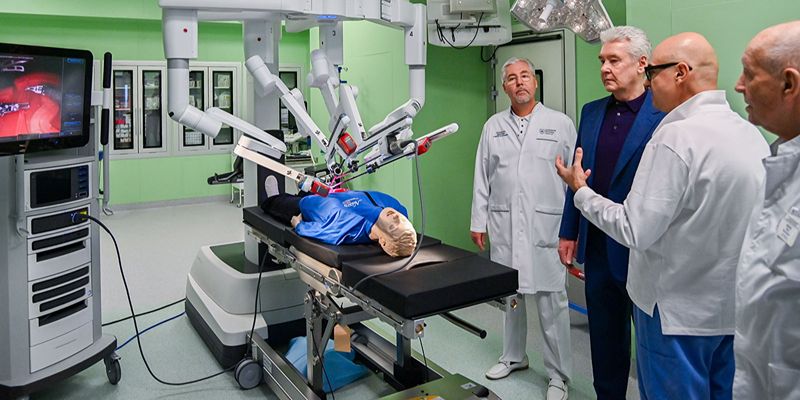
Sergei Sobyanin has launched a new flagship center in the Botkin Hospital. The capital’s largest healthcare facility also accommodates the Moscow Urological Center.
“Today we are launching two healthcare centers at once, both at the Botkin Hospital. This is a flagship center that will primarily treat emergency patients. I hope it will radically change the situation to improve the quality of care for such patients and increase capabilities of the Botkin Hospital in general. And the second project is a urological center. In fact, the Botkin Hospital is getting not just one center, but rather a cluster, because all its capabilities, the excellent technologies of the urological center, together, will give great synergy, indeed. I congratulate Muscovites who will receive high-quality healthcare, and, of course, the staff of the Botkin Hospital, who will have new opportunities for comfortable cutting-edge work environment,” said Moscow Mayor.
Botkin Hospital flagship center
Construction of a seven-story 16,400 m2 flagship center at the Botkin Hospital began in June 2020 and ended in December 2023. It employs 795 people, including 288 doctors and 325 nurses, most of them from other Botkin Hospital departments.
In addition, the hospital also welcomed employees of public service centers, psychologists and social coordinators —70 people in total. They will accompany patients, advise on non-medical issues, provide social assistance, take care of their emotional well-being and also help family members.
The building will be able to admit up to 200 emergency patients per day to provide a full range of necessary care, including testing, surgery and intensive care, on the first day of hospitalization. Patients will be further discharged home or transferred to specialized departments, depending on their condition.
Doctors make use of 9 ultra-modern operating rooms, including hybrid, angiographic, 5 general surgery and two smaller ORs.
“First of all, this is a new healthcare standard. This is bringing help closer to patients. These are accurate and quick diagnostics and low-traumatic treatment methods. The Botkin Hospital’s center is not just nice walls, but rather technology,” says Alexei Shabunin, Chief Medical Officer of the Botkin Hospital.
The emergency unit located on the first floor is based on the triage system (from the French triage meaning “sorting, selection”). Arriving patients are distributed in the order of priority for providing first aid care, including red patients who need resuscitation or emergency surgery, yellow patients who are for priority examination, and green, that is everyone else.
Red category patients are instantly moved to the diagnostics unit or to the operating room. Yellow and green patients are provided doctor-to-patient care, i.e., after they are registered in the admission unit as quickly as possible, they are placed on a bed and all further examinations and most of the procedures are performed on them while in bed. Healthcare professionals provide comprehensive diagnostics on the spot, including tests, bandaging or electrocardiogram.
For complex tests or surgery, patients are taken to an adjacent room under the supervision of medical personnel. If necessary, patients with vascular diseases can be quickly transported inside the building with a CT room and angiographic operating room for them on the first floor.
On the second floor there is a smaller operating room, an emergency department (examination rooms for green patients) and a diagnostic block with CT, ultrasound and x-ray rooms.
Another smaller operating room, procedural endoscopies (i.e., gastroscopy, colonoscopy and bronchoscopy) and a diagnostic department with wards for patients requiring further examination are arranged on the third floor.
The intensive care unit is located on the fourth floor.
The fifth floor accommodates 6 operating rooms (one hybrid and five general surgery ORs) with recovery rooms for patients emerging from anesthesia, plus a laboratory block.


The flagship center has a cozy environment for patients’ family members or friends and for staff to work and rest comfortably.
The new building of the Botkin Hospital is equipped with state-of-the-art equipment, including one MRT and two CT scans, an X-ray system, a C-arm and an angiograph machines. For the convenience of doctors and patients, there are computers connected to EMIAS, personnel calling, video surveillance, ventilation, air conditioning and fire alarm systems.
The flagship center has introduced the digital clinic standards, including electronic medical records (EMRs) for medical workers to have shared round-the-clock online access to patients’ medical data, including through mobile devices, such as tablets for doctors and nurses. Process automation helps them focus on patients by freeing up time that was previously spent on paperwork.
To transport patients by air ambulance, there is a helipad on the roof. Medical vehicles can approach the building along a one-way driveway; for unloading patients, the flagship center has a heated vestibule designed for simultaneous entry of four cars. In case of an emergency it can accommodate six cars at a time. The adjacent area has been landscaped nicely.
The Botkin Hospital flagship center admitted its first patients on December 13.
Moscow Urological Center (building 20)
The comprehensive reconstruction of seven-story 9,500 m2 building 20 began in March 2022 and ended in November 2023. Built in 1966, its façade and roof were repaired, the electrical, water supply, heating and sewerage systems, elevators, windows, doors and partitions were replaced. The façade architectural solution echoes the stylistic features of the new flagship center adjacent to building 20.
Designers applied the latest and safe materials in interior finishing choosing a neutral, light pastel palette, colored plexiglass with contour lighting used as accent surfaces.
After reconstruction, building 20 turned into the Moscow Urological Center, Russia’s largest robotic urology clinic for 174 beds, including 13 ICU beds.
“The Moscow Urological Center is a synergy of several teams, such as the Botkin Hospital team, the team of Hospital No. 50, two university departments and three academic groups. The quality that we will show is worthy of our patients,” said Dmitry Pushkar, head of the Moscow Urological Center at the Botkin Hospital.
For surgical interventions, it has 7 operating rooms, including robotic ORs, which are the gold standard of contemporary urology. Most operations will be performed using minimally invasive methods for patients to recover faster and return to their normal lifestyle.
The building will allow for up to 17,000 urological operations per year, including up to 1,500 robotic and more than 11,000 endourological/laparoscopic interventions.
The Moscow Urological Center has cutting-edge equipment, including angiographic and therapeutic X-ray systems, ultrasound machines, endoscopic stands, fiber cysto-urethroscopes, video cystoscopes, lithotripter, C-arm systems and laser surgery devices.
On the first floor there is a clinical diagnostic unit for outpatient treatment, providing up to 16,000 consultations per year, and a small operating room.
On floors 2-6, there are departments of general urology and oncourology , and special intensive care wards. In addition these floors accommodate cystoscopy and ultrasound rooms with expert class equipment, rooms for urodynamic studies and examination of patients with diseases of the urinary tract, bladder and prostate gland.
6 operating rooms, including those equipped with Da Vinci robotic surgical systems sharing a common electronic algorithm, are located on the seventh floor. There is also a room for remote lithotripsy (low-traumatic treatment of urolithiasis, including the destruction of hardened formations).
“We have created a special program for using robotic systems. Next year, seven more systems of this kind will be delivered to Moscow in addition to the existing four systems. This will be the largest robotic center in our country — at the Botkin Hospital, the Loginov Center, and some other hospitals. This requires systematic work, such as setting up a compulsory health insurance system and organizing the work of doctors,” added Sergei Sobyanin.
To accommodate patients, there are double and triple wards with individual bathrooms and everything necessary for a comfortable stay. The multifunctional beds have anti-decubitus mattresses and an electric drive enabling vertical or horizontal position in bed.
Employing 227 people, including 47 doctors, it has brought together the best specialists to treat the whole spectrum of urological diseases, including common malignant conditions, such as kidney, prostate and bladder cancers. If necessary, specialists from other Botkin Hospital departments, including gynecologists, oncologists, hematologists, and nephrologists, may be involved as well.
The Botkin Hospital will get an urological cluster with departments of emergency, elective urological and oncourological care, a special ICU, a consultative and diagnostic department and a short-stay hospital with a well-built logistics chain, including early diagnosis, timely treatment and follow-up.
In addition to treating patients, its specialists will be engaged in research, the new institution to be a major staff training platform. For educational purposes, it will use the capacity of other Botkin Hospital departments, such as the simulation center and histomorphological lab, and will apply expertise accumulated under the city projects of Moscow School of Urology and Moscow School of Oncourology.
The Moscow Urological Center at the Botkin Hospital admitted its first patients on December 13.
New emergency care standard
The construction of flagship centers is a key component of the program to improve the efficiency and quality of care for emergency patients. Flagship centers will appear in six hospitals in central Moscow (N.V. Sklifosofsky Research Institute for Emergency Medicine, Botkin Hospital and Pirogov City Clinical Hospital No. 1), in the east (Filatov City Clinical Hospital No. 15), in the south (Buyanov City Clinical Hospital) and in the north (Veresaev State Clinical Hospital). They will offer more than 600 state-of-the-art emergency care beds in all, a significant portion of them launched in 2023.
Four centers at the N.V. Sklifosofsky Research Institute for Emergency Medicine, Filatov City Clinical Hospital, Botkin Hospital and Veresaev State Clinical Hospital have been put into operation to date.
The facilities were chosen so as to minimize the time of emergency patients delivery from any district of Moscow. They have or will have, in the near future, helipads for receiving air ambulances.
Each center is a full-blow hospital with an admission unit, ORs, ICUs and a vast array of state-of-the-art devices. Patients will spend no more than 24 hours there to have medical examination, to be diagnosed and to get first aid, including surgery where necessary; afterwards, depending on their condition, they may be either taken to a specialized ward or discharged.
According to experts, the new centers will provide effective and timely care to more than 500,000 people a year (or one in two emergency patients).
The flagship centers are custom-built. Specialists take into account the current architectural appearance of the hospitals, which provide emergency care in line with common modern standards.
Phase 2 of emergency care modernization will cover the reconstruction of 12 admission units in 11 city hospitals, including Konchalovsky City Clinical Hospital, Bauman Hospital No. 29, hospitals No. 13, 24 named after Zhadkevich and Inozemtsev, Bashlyaeva Children’s City Clinical Hospital, Filatov Children’s City Clinical Hospital, Speransky Hospital No. 9, Morozov Children’s City Clinical Hospital, and Emergency Children's Surgery and Traumatology Research Institute. In some hospitals, such as Kommunarka Multi-Purpose Clinical Center, Yudin City Clinical Hospital, Vorokhobov City Clinical Hospital No.67, Eramishantsev City Clinical Hospital, Davydovsky City Clinical Hospital and Savelyeva City Clinical Hospital No. 31, the novel emergency care standard will be implemented based on the existing infrastructure.
After construction of the flagship centers and transformation of existing admission units, the new standard will cover about 85 per cent of emergency cases, which will be a big step towards better treatment of Muscovites.
The new emergency care standard will be based on the following pillars:
- 1. Unified medical algorithms. Practitioners and experts have developed 87 special algorithms covering more than 96 per cent of emergency cases and referring to the roles of each medical worker from the moment the patient is delivered to the admission unit until the start of emergency surgery, including the timing and sequence of diagnostics and emergency procedures. Unified algorithms will enable employees to join in the work as soon as possible.
- 2. Great expertise and teamwork skills. Medical workers at the flagship centers are required to meet the highest possible standards of professional competence. So, the related training standards will include development and improvement of teamwork skills, as well as communication skills in relation to patients, their family members and colleagues. A sense of community, mutual assistance and support are key to the successful work of each flagship center team.
- 3. Single equipping standard. The flagship centers will get over 10,000 units of the latest medical equipment, including expert class CT and MRI scans, angiography systems, hybrid complexes designed for operating rooms, expert-class ultrasound systems, navigation systems, ICU, endoscopic and laboratory equipment. There will also be about 60 high-tech surgery rooms, some of them are unique hybrid surgery rooms unrivaled in Russia. The capacities for most complex traumatological, surgical, neuro- and cardiac surgical interventions will grow several times.
- 4. Modern standards for medical care provision. The flagship centers’ admission departments will apply a triage system to route patients in the order of priority (red, yellow and green patients) to ultimately provide health care services two-times sooner.
Red category patients are immediately transferred to the intensive care unit or operating room. Yellow and green patients are serviced in a doctor-to-patient manner meaning that after the fastest possible admission they are examined and treated at bed. For complex diagnostic examination or surgery, the patient is transported to an adjacent room under the supervision of medical personnel. No more walking from office to office, let alone waiting at the door, as it used to be before.
A convenient and friendly navigation system helps ambulance crews, patients, their family members and staff to navigate easily.
The doctor-to-patient care has been piloted in admission units of a number of city hospitals, showing very good results.
- 5. Advanced digital solutions. The flagship centers will operate in a paperless digital environment as doctors will have access to patients' medical records in electronic form even before the ambulance crew arrives. To make clinical decisions, they will be able to use the digital assistant, a system based on artificial intelligence technologies. In complicated cases, a telemedicine consultation with leading resuscitators invited can be organized by the center for critical conditions of the Puchkov Ambulance and Emergency Medical Care Station. The doctor, being next to the patient, puts on a special AR headset that creates a participation effect. Consultants see the patient and can remotely assist their colleagues. These technologies have also been tested in the Moscow healthcare system, including in COVID-19 hospitals during the pandemic.
- 6. Patient-centric system. Emergency hospital admission is very stressful for a patient and their family members, that is why minimizing the patient’s pain, anxiety and fear is as important for getting better soon as qualified medical care. For the first time ever, social coordinators will become part of an inpatient facility team. They will take care of non-medical issues, which used to be concern of doctors and nurses, and will deal with many suddenly arising problems, for example, picking up the patient’s children from school or call family members at work. Social coordinators will collect relevant information about a patient (place of residence, phone numbers of relatives) and determine if there is a need in social care after dismissal. This mostly concerns homeless, lonely, senior, disabled people, people having many children, single mothers, foreigners, and other potentially vulnerable categories. If necessary, information about such patients will be transmitted to Glinka Social Adaptation Center, Pension Fund, social welfare authorities, embassies of foreign countries, as well as other authorities and bodies that take care of these people’s issues.
Social coordinators will also call a taxi on the day of discharge from an inpatient facility, if necessary, or will be the first to provide moral support in the most psychologically traumatizing situations that a patient and their relatives are facing. If needed, professional psychologists, social service specialists, will come to help.
Many non-medical issues can also be handled by employees of public service centers who will meet patients and their relatives, register and show them the way to the doctor’s office, invite a doctor to provide an initial consultation or make a decision on hospitalization, or will help patients in handling non-standard situations.
- 7. A cozy environment. Commodious and truly accessible spaces, soft diffused lighting, calm colors and landscaping, every design element is intended to make the stay in the flagship centers for people under stress as comfortable as possible. For the first time, Moscow healthcare will arrange an environment for patients’ family members and friends who will be able to enjoy comfortable waiting rooms, psychological support offices and cafes. Family members will be able to get the fullest information concerning a patient’s condition, scheduled interventions, prognosed discharge or transfer to other wards anytime. Social welfare authorities will undertake the functions of special contact centers’ operators.
Eventually, the new flagship centers will become the patient routing center and the heart of their hospitals. With the opening of the flagship centers, the emergency and routine care will reach new heights.
Sergei Sobyanin: First heart transplantation performed in Botkin HospitalMoscow’s hospitals get assistive robot cats
Upgrading the Botkin Hospital
With more than 1,500 beds , including more than 100 ICU beds and 11 special-focus centers, the Botkin Hospital is the largest multidisciplinary healthcare facility in Moscow and Russia as a whole.
It employs Moscow’s record hospital team of 4,600 people, including 5 full members of the Russian Academy of Sciences, 16 honored doctors of the Russian Federation, more than 100 doctors and 275 candidates of medicine.
The Botkin Hospital accounts for more than one million outpatient appointments per year and admits around 100,000 patients. Its doctors perform over 70,000 operations, including approximately 20 per cent high-tech surgery. It in fact has got more than 13,000 cutting-edge medical machines and devices over the past few years.
Comprehensive modernization of the Botkin Hospital is a key project to improve inpatient care for Moscow residents. Moscow’s major healthcare institution will turn into a comfortable modern hospital providing almost all types of medical services, as a result. The project has been implemented since 2015, when the clinic opened Europe’s biggest Medical Simulation Center offering 230 programs and 50 majors, and boasting about 90,000 alumni.
In 2016, the Botkin Hospital got the Moscow Transplant Coordination Center cooperating with all medical institutions, including federal ones, which perform organ and tissue transplantation.
In 2017, workers reconstructed building 21 to accommodate the Regional Vascular Center that saves more than 2,000 stroke patients and about 1,000 patients with heart attack every year.
In 2019, the Botkin Hospital launched the Moscow City Ophthalmology Center, which treated more than 25,000 patients and performed over 15,000 operations in 2022, with more than 40,000 patients admitted at the emergency department.
After a major overhaul of autopsy building 33, it accommodates a state-of-the-art Pathomorphological and Molecular Biological Laboratory , which tested 63,000 specimens in 2022.
The reconstruction of hematology building 1 was completed in 2020 to combine under one roof departments for treating patients with blood diseases, in particular, providing chemotherapy, immunotherapy, targeted therapy, and bone marrow transplantation. Every year, it provides services to up to 6,000 people, which is almost a third more than before the reconstruction. Its doctors perform over 150 life-saving operations.
In 2021, builders completed the overhaul of building 11 to house the Interdistrict Nephrology Center with a full cycle of kidney patient care from advice to surgery to follow-up and up to 31,500 hemodialysis procedures performed annually.
The reconstruction of building 7 has also been completed to arrange the Department of Purulent Traumatology, which has performed more than 1,000 operations to date, and a short-stay surgical hospital accounting for about 9,000 operations as well.
The renovated catering unit (building 8) accommodates an advanced tablet nutrition line, which can provide 1,800 patients with six meals a day.
An Outpatient Cancer Care Center for patients of the Western Administrative District was opened in building 28 to annually offer approximately 200,000 oncology consultations and more than 22,000 courses of chemotherapy.
The first-ever high-flow Endoscopy Center in Russia and Europe was launched in building 22 with over 150 daily endoscopic examinations in patients with suspected or diagnosed cancer of the gastrointestinal tract. More than 67,000 tests have been carried out there over the past year.
After the renovation in 2022, building 6 got a palliative care department offering a comfortable environment for patients with spacious rooms, lifts for moving patients with reduced mobility and anti-decubitus mattresses.
In 2023, workers completed repair and restoration in surgery building 9 and building 20 housing the Moscow Urological Center. Builders have also completed another flagship center of the Botkin Hospital.
Specialists are now reconstructing building 2 and building 8, which will house a number of departments, including therapeutic one, and scientific and academic building 10 to accommodate 24 departments of medical centers and universities, which are based at Botkin Hospital.