Glass columns, pergola and Tyutchev's poems. Stations of the first Troitskaya Line section in detail
In September, the Moscow Metro map got the new 16th line, Troitskaya (emerald). It is expected to be one of the longest radial lines and the largest radial line outside the Moscow Ring Road (MKAD). The line, more than 43 kilometers long, with 17 stations, will run from ZIL to Troitsk.
The first section, including Novatorskaya, Universitet Druzhby Narodov, Generala Tyuleneva and Tyutchevskaya stations, is now open. Traditionally, each Moscow Metro station looks unique. A mos.ru reporter asked the architects about design solutions and technologies used for the first time in the history of the Moscow Metro construction.
Moscow windows on Novatorskaya
Located on Leninsky Prospekt near the intersection of Udaltsova and Novatorov streets, the Novatorskaya station has a transfer to the station of the same name on the Big Circle Line. Inspired by the rich orange design of its neighbor, t still looks quite different. In the era of record-breaking construction of the Moscow Metro, design of each new station is challenging. Searching for ideas, designers reflect on the past and present of the area. Sometimes they are inspired by the architecture of the surroundings, as was the case with the radial Novatorskaya station.
“The area around the station is lit up with a multitude of lights from the windows of tall residential buildings in the evenings. We have decided to play with the idea of Moscow windows symbolized by LEDs in the orange coffer niches at the stations. Similar elements can be found in temple architecture: small windows with their slopes turned to let in more light. Covered with aluminum honeycomb panels and anodized in orange and light gray, the track walls in the upper part reproduce the ceiling pattern. This is a new solution for the Moscow Metro; for the first time, we have compositionally connected the ceiling and walls. By the way, anodizing not only gives aluminum color but also preserves its metallic shine. We stand for honesty in architecture, highlighting the properties of the material instead of imitating any other,” shares Sergei Karetnikov, Chief Architect of the Underground Construction Division at the Mosinzhproekt Design Institute.

Play of forms and magic of color: architects speak about concepts, ideas and secrets of the most beautiful new BCL stationsMaterials unique for metro construction are used to decorate BCL stations
Philosophy garden on Universitet Druzhby Narodov
In early days of the construction, the second station of the launch section had the name Ulitsa Akademika Oparina in honor of the namesake street on which it is located. The first design reflected the academic nature of the area accommodating Peoples' Friendship University of Russia, Russian State Geological Prospecting University, Institute of Bioorganic Chemistry of the Russian Academy of Sciences, Pushkin Russian Language Institute and Kulakov Research Center for Obstetrics, Gynecology and Perinatology.
“The design is inspired by education and science. We have created an image of a philosophy garden: in Classical Athens, philosophers walked with their students under pergolas with greenery, discussing perennial issues. The station resembles a pergola with columns supporting the canopy and the coffers of different sizes on the ceiling used as its sections. The coffers are painted in light grey, light green and blue, as if daylight shines through the plants and a clear sky is visible. When the station was renamed Universitet Druzhby Narodov, the project did not undergo any major changes: the science walk theme did not contradict the student theme,” notes Sergei Karetnikov.
The station has used the experimental idea of Novatoskaya: the upper part of the track walls supports the ceiling pattern covered with multi-sized aluminum honeycomb panels. The wall features blue panels at the car level and gabbro-diabase below. The columns are faced with grey marble, while the floor - with grey granite.


The Universitet Druzhby Narodov station boasts two mosaics made of art glass (smalt). The first one, which is above the escalator run, depicts students from different countries. The girl in the center is holding the sun that symbolizes the light of knowledge. The composition in the pedestrian crossing is dedicated to the cities that have become educational centers of the world. The mosaic features their symbols: the Kremlin, Kotelnicheskaya Embankment Building and Ostankino Tower in Moscow, Bronze Horseman, St. Isaac's Cathedral and Palace Bridge in St. Petersburg, Forbidden City in Beijing, Notre-Dame de Paris and Eiffel Tower in Paris, Christ the Redeemer in Rio de Janeiro and Tower Bridge in London. Both panels were created by artist Maxim Kozlov, who won the 2023 Moscow Architecture Prize for his Nagatinsky Zaton station mosaic solution.
Underground city's mythology: insightful facts about Moscow metro stations' designingAthletes, parades and the spirit of festivity: how architects created the 800 th anniversary of Moscow panels at Yakhromskaya metro station
St. George's ribbon at Generala Tyuleneva station
Ivan Tyulenev - a military leader under whose command the Soviet army defended the Caucasus and liberated part of Kuban during the Great Patriotic War - is immortalized in Tyoply Stan with one of the streets named after him. Since the station of the Troitskaya Line was right on it, specialists immediately came up with the name - Generala Tyuleneva.


To decipher the station design, one should explore the biography of the commander. He began his service in the Imperial Russian Army, then distinguished himself in World War I (and was awarded four St. George crosses) and participated in the Civil War on the side of the Reds. He was awarded the title of Hero of the Soviet Union for his achievements in the Great Patriotic War. His story is reflected in the station's color scheme.
“The station is painted in the colors of the St. George ribbon. The ribbon emerged as part of the Order of St. George established in 1769 as a symbol of military prowess and Victory Day. The ceiling and track walls are covered with triangular light grey aluminum panels cut by oblique black and orange lines. The floor is made of grey granite and gabbro-diabase, laid diagonally, so that the oblique lines of the ceiling, walls and floor echo each other. The round columns are also faced with gabbro. The station looks asymmetrical and dynamic, which is associated, among other things, with the travel speed and development of the Moscow Metro,” says Aleksandr Vigdorov, Deputy Head of the Underground Construction Division at the Mosinzhproekt Design Institute.

Above the escalator rises a stained glass window divided into six panels, also created by artist Maxim Kozlov. The canvases have a common theme: the continuity of the national army. They depict a warrior on horseback during the Civil War, soldiers during the Great Patriotic War, a German bomber shot down by a Soviet fighter and a modern officer as the heir to the victories of the Russian army, and, of course, General Tyulenev.
Tyutchevskaya expression
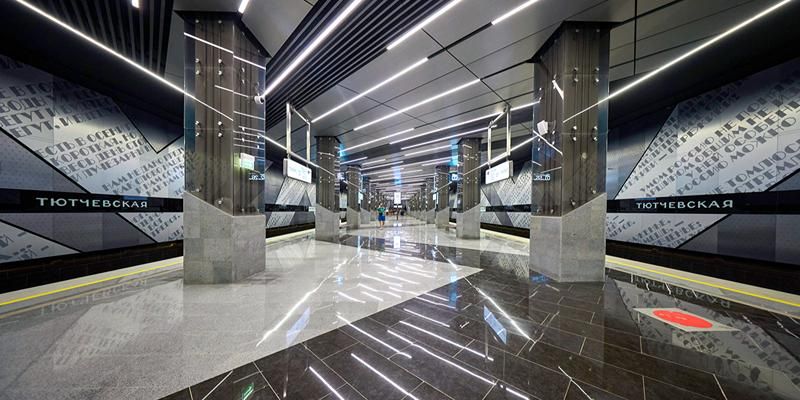
The next station is inspired by Russian poetry. Originally designed in the village of Mosrentgen (TiNAO), it was called Slavyansky Mir (Slavic World). That is why the folk design was chosen: Russian ornaments, images of fairy animals, but the residents asked to rename it Tyutchevskaya, since it is next to the Troitskoye estate, which belonged to the father of poet Fyodor Tyutchev in the 19th century. The project changed: it was given expressionism aesthetics.


“Expressionism (comes from the Latin word ‘expressio’) is characterized by the feelings of the author. The station design contrasts glass and metal with natural stone. The floor is decorated with inclined lines of gabbro-diabase. The same lines are on the walls: a dark gray background is crossed by light aluminum panels with scattered lines from famous poems by Tyutchev. For the first time in the Moscow Metro construction, the columns have been faced with glass, bringing ethereality to the design (characteristic of the poet’s work). Behind the glass are pipes with cables running inside them to remind passengers that the metro is a technically complex structure. “We sought to draw a parallel between the innovation of Tyutchev’s poetry and architectural innovation,” emphasizes Vladimir Buturlintsev, Head of the Underground Construction Division at the Mosinzhproekt Design Institute.

Underground palaces. What is unique about Circle Line stations