Moscow’s 4 commuter terminals to be HSR stops
The municipality will arrange four stopping points for the first high-speed railway (HSR-1) for passengers to transfer to metro stations and the Moscow Central Diameters (MCDs), as announced by Vladimir Yefimov, Deputy Moscow Mayor for Urban Planning Policy and Construction.
“The HSR-1 within the capital will be 25.2 kilometers long. Four stopping points will be set within the city boundaries; so it will be more convenient and faster to transfer to some metro stations and the Moscow Central Diameters at Leningradsky Station, Moscow’s Rizhskaya, Petrovsko-Razumovskaya and Zelenograd — Kryukovo. At present, experts of the Moscow Committee for Architecture and Urban Planning, with the involvement of the Moscow General Plan Institute, are integrating the high-speed railway into the capital’s transport infrastructure and developing urban planning documentation,” said Vladimir Yefimov.
The HSR-1 Contract involves building high-speed rail infrastructure between Moscow and St. Petersburg, purchasing and exploiting high-speed trains, with the use of Russia-made technology and equipment.
The first high-speed train route is to increase railway throughput, relieve airports, promote domestic tourism and drive business activity.
“With the HSR-1 launch, passengers will be able to get from Zelenograd to Moscow’s center in just 14 minutes, and in 39 minutes from Tver. The project will give a significant impetus to domestic mechanical engineering, technologies, intelligent systems, and passenger rail services. However, the main thing is that it will improve the quality of life in the regions it will run through. We are carrying out the necessary work in the capital to modernize the transport infrastructure for the HSR-1, as ordered by Sergei Sobyanin,” added Maxim Liksutov, Deputy Moscow Mayor for Transport.
As a result, not only will it be possible to take fast and comfortable trips from one city to another; it will also help create an intermodal transport framework (with all means of transport working as a whole).
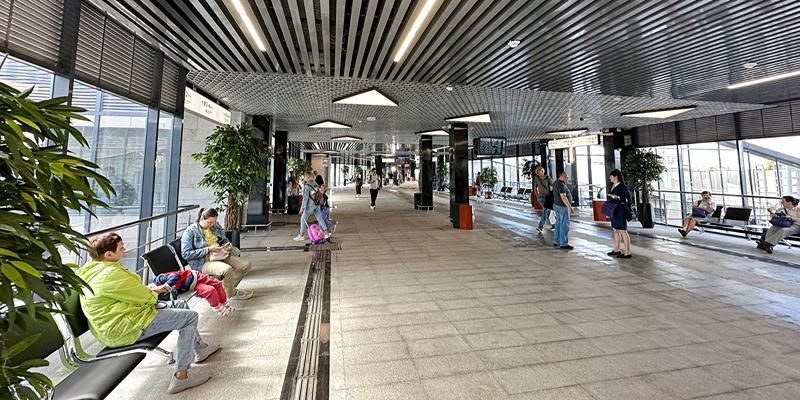
The Zelenograd — Kryukovo commuter terminal will be the northern MCD-3 terminus and also Moscow’s first HSR-1 stop en route from St. Petersburg, while it has already become a genuine transport hub with more than 30 ground transport through routes. For the convenience of passengers, the adjacent area has been designed so that the journey from the bus to MCD-3 takes only one to two minutes, says Yuliana Knyazhevskaya, Chairperson of the Moscow Committee for Architecture and Urban Planning.
The Petrovsko-Razumovskaya and Rizhskaya commuter terminals and Leningradsky Railway Station will also be made HSR-1 stopping points in the capital. At Petrovsko-Razumovskaya, passengers will be able to transfer to MCD-1, MCD-3, Serpukhovsko-Timiryazevskaya and Lyublinsko-Dmitrovskaya lines. At Rizhskaya, you can change to MCD-2, MCD-3, MCD-4, the Kaluzhsko-Rizhskaya line and BCL, while Leningradsky Railway Station can be used to move to MCD-2, MCD-4, Sokolnicheskaya and Koltsevaya metro lines.
All the stations are therefore to act as transfer points, underground and overground concourses to make transfers smoother and to connect Moscow’s districts. Experts should increase the accessibility and safety of the stopping points, says Igor Bakhirev, First Deputy Director of the Moscow General Plan Institute.
The HSR-1 will run through six constituent entities of Russia and will connect the Central and North-Western transport hubs, with more than 40 million residents, or almost 30 per cent of the country’s total population. After the HSR-1 is built, passenger traffic between Moscow and St. Petersburg is projected to increase by 4.2 times,
travel time between the country’s two largest cities to be shorter — 2 hours and 15 minutes. Earlier, Sergei Sobyanin said that the capital had allocated RUB 34.1 billion for the HSR-1 project.