Sergei Sobyanin: Moscow to get 4 St. Petersburg HSR stops
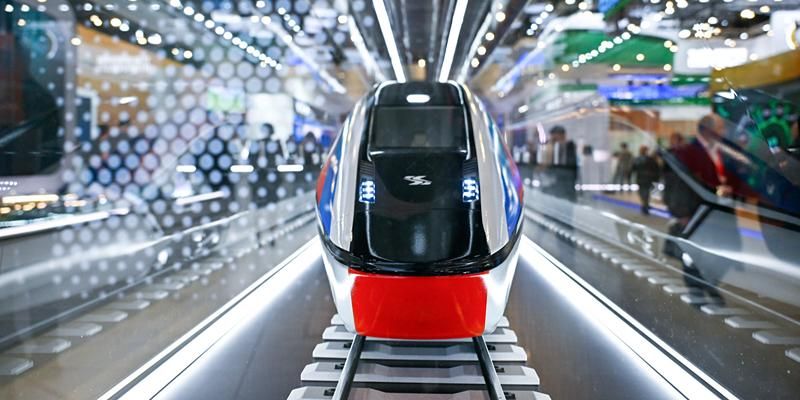
The city allocated RUB 34.1 billion for building the Moscow — Tver — Veliky Novgorod — St. Petersburg high-speed rail route (HSR-1), the corresponding decree was signed by Sergei Sobyanin.
The route will be 679 kilometers long. Therefore, travel time between Moscow and St. Petersburg will be almost halved, as it will take 2 hours and 15 minutes (versus 4 hours and 5 minutes) for passengers to reach the destination point, while they can reach the Northern capital from Zelenograd in about 2 hours. HSR-1 will connect Russia’s largest urban agglomerations and economic centers, which are home to about 40.2 million people, or 27 per cent of the country’s population.
The decision to build HSR-1 was made by Russian President Vladimir Putin and made public in his address to the Federal Assembly in February 2024.
“The thorniest piece of work is the construction of the Leningradsky Station — Alabushevo section. It will run in restrained urban conditions without stopping the train traffic,” Sergei Sobyanin writes on his Telegram channel.
Source: Sergei Sobyanin’s Telegram channel @mos_sobyanin
The reconstruction of the four HSR-1 terminals in Moscow is of paramount importance for the project. Zelenograd — Kryukovo will be the first stop for high-speed trains running from St. Petersburg, their passengers to transfer to D3 trains to further travel with free transfers along the entire rail frame of Moscow agglomeration. The terminal was completely reconstructed in 2021–2023, and they also plan to build another facility with two platforms to further integrate it with the existing D3 lobby on a ‘dry feet’ basis so that passengers do not need to go outside for interchange. Zelenograd — Kryukovo HSR-1 terminal is expected to be used by more than 260,000 Zelenograd residents and over 1.1 million Moscow region residents who live in Khimki, Solnechnogorsk, Istra, Dolgoprudny, Krasnogorsk, and Lobnya.
Another terminal is Petrovsko-Razumovskaya, which will be used to transfer to D3, D1, Lyublinsko-Dmitrovskaya and Serpukhovsko-Timiryazevskaya metro lines, and to ground public transport. It will have three canopied rainproof platforms, its new surface lobby to be integrated with the metro and D1 with a pedestrian passageway, which will also be used to get from Dmitrovskoye Motorway to Komdiv Orlov Street.
The third station is Rizhskaya with a change to D2, D3, D4, BCL and Kaluzhsko-Rizhskaya metro lines, or to ground public transport. They will reconstruct the four D2 and D3 platforms there and build an integrated surface lobby for transfers between D2, D3, and D4. They also plan to make a transit crossing across the railway tracks between Vodoprovodny Pereulok and 2 nd Mytishchinskaya Street, design and removal of engineering systems being underway at the moment.
Leningradsky station is the fourth HSR-1 stop. This is the final point and an integral part of the largest Three Stations Square transport hub with transfers to D2 and D4, the Circle and Sokolnicheskaya metro lines and two central stations (Kazansky and Yaroslavsky). It also features passageways to ground public transport.
A new passenger lobby will be built there; the existing station facilities, which the Moscow Government has leased from Russian Railways for a long term, will be reconstructed. The surrounding areas will be improved to look nicer, too.
All together, the four HSR-1 terminals will provide transfers to 14 metro / MCD points and to ground public transport.
The project’s thorniest and most painstaking section is between Leningradsky Station and Alabushevo as the construction will be carried out in dense urban and suburban areas, while trains are expected to continue to run at the Oktyabrskaya Railway, including D3, commuter, long-distance and freight trains.
Builders are going to build the fifth and sixth tracks on the Moscow (Leningradsky Station) — Alabushevo section, reconstruct — or rather create anew — the passenger infrastructure at Firsanovskaya, Skhodnya, Podrezkovo, Novopodrezkovo, Molzhaninovo, Khimki, Levoberezhnaya, Khovrino, and Ostankino; all to be new in-city commuter terminals meeting MCD standards.
In addition, the municipality will reconstruct the road overpass on Repina Street in Khimki and build six bridges across the Moscow Canal, the Likhoborka and Skhodnya rivers, three more to cross some streams. They are also going to arrange five railway viaducts — near the Alabushevo stopping point, in the 3 rd Nizhnelikhoborsky Proyezd, at Khovrino station and in the vicinity of the Khimki terminal (a tunnel-type passageway). The latter will cross the railway tracks near the Radishchevo stopping point.
Currently, Russian Railways is building bridges across the Moscow Canal and the Likhoborka River, railway viaduct of the Alabushevo stopping point, at Khovrino station and at the intersection with Bolshaya Akademicheskaya Street, relocating utility lines and setting up temporary passenger infrastructure to be accessible during reconstruction. The work began at the same time when they were preparing to launch the D3.
On top of that, the Moscow Government is reconstructing two road overpasses of Dmitrovsky and Leningradsky so that builders can lay the HSR-1 backbone tracks.