Legendary pavilion and birthday arches. Exploring iconic VDNKh attractions to mark exhibition’s 85 th anniversary
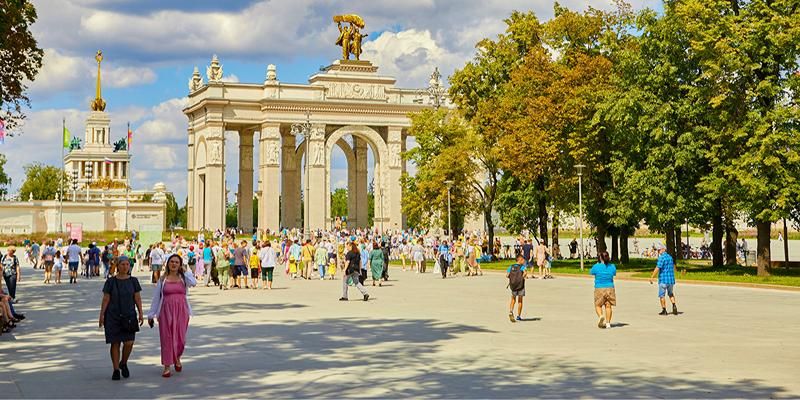
Rows of pavilions and sculptures, legendary monuments and a rich history dating back to the previous century-this is VDNKh that visitors know today. This year, the country’s main exhibition is celebrating its 85 th anniversary. The year 2024 also marked the anniversary of three VDNKh iconic buddings: Pavilion No. 1 Central and the arches of the main and northern entrances. All of them have been announced cultural heritage sites of federal significance.
Northern entrance arch. First and oldest
The northern entrance arch, the oldest building on the exhibition grounds, celebrated its 85 th anniversary on the first day of August, along with VDNKh. The triumphal three-span arch facing Sergei Eisenstein Street used to serve as the main entrance to the All-Union Agricultural Exhibition (VSKhV), which was later given the name VDNKh familiar to modern visitors.
The northern (formerly main) entrance was the starting point for the tour with tram, trolleybus and bus terminal stops as well as a minibus stop nearby. There was no metro station in the area around the exhibition at that time. After passing under the arches, visitors found themselves on Administrative Square and walked towards the main pavilion along the Central Alley.

The arch was erected for the opening of the exhibition, which took place on August 1, 1939. The monumental architecture was designed by Leonid Polyakov. The arch features a three-part composition; its central part consists of two high square-section arches placed one after the other. Plaster moldings of the central arches and the decoration inside the domes inspired by abundance art with garlands of fruits, ears, bunches of grapes with leaves and ribbons have been preserved.
The arch used to serve as the main entrance to the exhibition from its opening until 1954. In those years, the entrance to VSKhV consisted of the Triumphal Arch and service buildings, which have not survived.


Restoration of the northern entrance arch began in September 2016, and it was reopened in June 2017. Over the course of six months, experts have restored the walls, roof, and supporting metal structures of the frame, plaster moldings and decor, and have repaired the granite base.
Now the arch looks as close as possible to the image that Muscovites witnessed 85 years ago and that was captured in old Soviet films. The building appeared in the films The Foundling (1939), Tanya (1940), They Met in Moscow (1941) and The House I Live In (1957).

History on the outside, future on the inside: VDNKh transformation in the last eight years
Main entrance arch. Imperial architecture and VDNKh symbol
In the post-war years, it was decided to reconstruct VSKhV. It was then that the central entrance was dubbed the northern entrance, and another arch appeared on the exhibition grounds. It was supposed to be the main entrance and the most monumental portal.
The new entrance was built by the Soviet architect Innokenty Melchakov. He designed a Stalinist arch but made it five-span and attached side wings and arched bodies (circumferences) to it, enabling the main entrance buildings to stretch for more than 300 meters in width. Monumentality was also visible in other architectural concepts. The height of the main entrance gate allows the entire Pavilion No. 1 Central to be seen when approaching it through the central arched span. The portal was supposed to welcome 100,000 people per day.

The arch was inspired by Ancient Roman architecture. An eight-meter concrete sculpture, Tractor Driver and Kolkhoz Woman, was installed on top, giving the entrance an even more monumental look. The figures are lifting an allegorical sheaf to a height of 32 meters, which personifies the achievements of the Soviet people: heavy industry and agriculture. To make the sculpture look grand, it was covered with gold smalt, and the sheaf was made of brass.

The construction of the new main entrance was completed to coincide with the second opening of VSKhV in 1954, and this year the building is celebrating its 70 th anniversary. Over the course of time, the main entrance arch has become one of the main VDNKh symbols. It also decorates the exhibition’s logo.
Carried out in 2017, restoration work has preserved the original look of the monumental building. The arch has restored bas-reliefs depicting agricultural workers. The figures of the tractor driver and the kolkhoz woman have also been restored to their former glory. Experts have restored the lost fragments of gold smalt covering the sculpture and renewed the gilding of the sheaf.
Today, the VDNKh museum is in the right wing of the main entrance arch, and the flagship information center, family hub, souvenir shop and Moscow Longevity Center are in the left wing.


Pavilion Central. Keeper of heritage and history
This year, Pavilion No. 1 Central, one of the most monumental exhibition buildings, is also celebrating its 70 th anniversary. It rises 97 meters above the ground and immediately amazes visitors with its grandeur.
Designed by architects Georgy Shchuko and Evgeny Stolyarov, the building was erected in 1950–1954 to replace the previous wooden structure. It did not fit into the new VDNKh architectural composition in the 1950 s, so it was redesigned. Inspired by the Stalinist architecture, the new pavilion has got a spire with a star on top and the USSR coat of arms and 16 medallions featuring the coats of arms of the union republics on the façades on each side. Until 1963, the pavilion was called the Main Pavilion.

Its history lives in the building’s exterior and interior. The pavilion has nine thematic halls: one central hall and eight exhibition halls connected to it. During construction, all rooms were covered with artificial marble and decorated with pieces of art. The October Revolution Hall features The Storming of the Winter Palace by the artist Pavel Sokolov-Skalya, while the Constitution Hall houses four panels by different artists dedicated to the happy life of Soviet citizens. Only two of the four paintings have survived to this day.

In the 1990 s, the exhibition halls were divided into two floors by mezzanines, and the entire pavilion space was packed with kiosks. In 2000, they opened a cultural center, the House of the Peoples of Russia, with a museum. The exhibitions were housed in the building until 2014. In the same year, the pavilion kiosks were being removed. At that time, the experts discovered a plaster high relief “Glory to the Standard Bearer of Peace, the Soviet People!”, a great work by the sculptor Yevgeny Vuchetich, on the wall in the Hall of the Victory of the Soviet Union in the Great Patriotic War. The work had been considered irretrievably lost for 40 years. It took about a year to restore it to its former grandeur. The lost fragments have been recreated using old photographs. The 90 square meter high relief depicts more than 1,500 people, life-size figures of workers, scientists and pioneers.


In September 2014, experts made another discovery. On the basement floor of the building, experts discovered a painting entitled “The Second All-Union Congress of Collective Farmers and Shock Workers of 1935”, which was also considered lost. It is another monumental work: the canvas size is 6.75 X 11 meters. The painting was created by a group of artists led by Aleksandr Gerasimov in 1953. Other discoveries include a 1958 fresco depicting agricultural work.
In 2017, the work started to restore Pavilion No. 1 Central. The specialists have repaired the spire and the golden star crowning it, tinted the capitals, the coats of arms and ribbons on the façade to make them look like gold, and restored the original doors. They have also carried out a large-scale work inside the pavilion. In the central hall, they have discovered and cleared decorative semicircular arches hidden under a layer of plaster for more than 40 years. The experts have restored the ceiling lights, the columns made of scagliola and the parquet floors.
The unknown Tsentralny: secrets of VDNKh Pavilion No. 1


