The unknown Tsentralny: secrets of VDNKh Pavilion No.1
A man in a striped beach suit stands on the Back Sea shore, smiling happily, Nazarali Niyazov, Hero of Socialist Labor, carries a cotton flower. Those are all characters you can see inside VDNKh Pavilion No.1 Tsentralny. During restoration, specialists discovered some rare and obscure pieces of 1950s art. Some of them have already been restored; others are still works in progress.
VDNKh Pavilion No.1 Tsentralny opened temporarily for Muscovites and tourists on Moscow Day. They could enjoy free guided tours and appreciate magnificent interiors of the building. Mos.ru reporters joined them to learn what inspired the creator of Storm of the Winter Palace and how the map of machine and tractor stations ended up on the wall.
Lenin and the Winter Palace
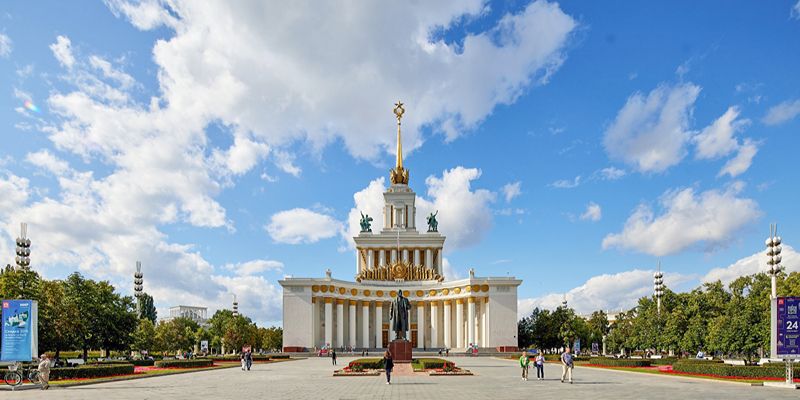
Pavilion No.1 Tsentralny, white as sugar, with gold-glazed bas-relief statues, pillar heads and the star on its spire, is clearly visible even from afar. It is the main feature of VDNKh and one of its most recognizable pavilions.
“The pavilion was built in 1954 in the Stalinist Empire style. ‘Stalinist’ in that case means the construction period and the term ‘Empire’ refers us back to the French architecture of the late classicist time or Napoleonic ‘Empire’ style: grand, pompous, but prim at the same time. Pavilion No.1 was built as a tower, with three levels topped by a spire. Rising 97 meters, it’s the tallest building at VDNKh,” says Kseniya Morabito, senior tour guide, welcoming us at the entrance.

Walls in the first, entrance-adjacent room are lined with cherry-colored marble panels. Their color symbolizes struggle. Massive wooden doors and a glass plafond that lets in light from the ceiling make the entrance hall even grander. It is the October Revolution Hall focused on the initial years of the Soviet government.


On the left-side wall, framed in gold, is Storm of the Winter Palace, a painting by a 1950s artist Pavel Sokolov-Skal. It returned on its rightful place after restoration. It depicts agitated soldiers and sailors bursting onto Palace Square with rifles and machine guns. One has his head bandaged, another one fell down, while a female nurse is looking on the crowd desperately, pleading for help. But the soldiers are focused on the Winter Palace, the symbol of Imperial power. It stands, immovable, in the background, with its windows alight. Who is inside?
“When the Winter Palace was stormed, the Royal family was not there. Nicolas II abdicated back in March 1917. But the Provisional Government led by Alexander Kerensky was still inside,” says the tour guide.

Historical research says the storming was not nearly as spectacular and fierce as Sokolov-Skal painted it to be.
“The artist was likely inspired not only by the storming itself, but also by later events. In 1920, to celebrate 3 years of the October Revolution, workers organized a mass reenactment show at the former Palace Square (renamed to Uritsky Square at the time). There were about 3,000 people involved. Quite possibly, film director Sergey Eisenstein used that reenactment as the basis for his iconic film October. Later, its plot and imagery started getting replicated by other Soviet artists, including Sokolov-Skal,” says our host.
On the right side of the October Revolution Hall, there is another painting by the same artist. It is called Lenin Proclaims Soviet Power at the 2nd Congress of the Soviets. It also returned to its original spot. The painting shows factory workers listening intently to the Soviet leader. Some of them applaud, others look up in surprise, as if asking, “Could that all be true?” Lenin is not in the center of the painting, but everyone is looking at him. That was the painter’s way of showing that Lenin was indeed the main person there.
“Those two pieces were the pinnacle of Sokolov-Skal’s artistic career,” says Ms. Morabito.

Work and recreation
We move to the Stalin’s Constitution Hall made in pastel colors: cream and blue. It has a caisson-embossed dome with a gold star in the middle. The hall is dedicated to the happy future that revolutionaries were fighting for and that is already here.
“This hall, nearly 30 meters tall, reminds us of the Roman Pantheon. As is proper for buildings of that kind, it has an oculus on its ceiling. It’s a type of a ceiling aperture that made people able to see the sun and gods to see the worshippers. Here, the oculus is not unobstructed, but instead has a star in it, a symbol of Soviet rule,” says the tour guide.
Under the dome, along it circumference, the first lines of the Soviet anthem are written in gold: “United forever in friendship and labor, Our mighty republics will ever endure.” Below it are coats of arms of the 16 Soviet republics, including the Karelo-Finnish republic that still existed in 1950s.


There used to be painted panels depicting happy lives of Soviet citizens at the four sides of the hall. Only two of them survived. The first one, made by artists’ collective led by Alexander Gerasimov, shows students of all nationalities leaving Lomonosov Moscow State University (MSU) at Leninskiye (now Vorobyovy) Gory with books and briefcases and walking as if toward the audience, engaged in lively discussion among themselves. The high-rise University building was finished in 1953, one year before Pavilion No.1 opened to the public, and was instantly captured on the painting. It is like the people on it are alive and about to step down from the wall.

On the second panel by Sergey Otroshchenko smiling girls in colorful dresses and men in white linen or striped beach suits (fashionable at the time) are strolling along the Black Sea shore, among cypress trees and palaces with white colonnades.

“The paintings explain the rights that Stalin’s Constitution of 1936 granted to Soviet citizens. It was considered the most progressive one in the world. It established rights to work, rest, education, etc.,” says Ms. Morabito.
Copies of the two panels that have been lost can be found on information displays. One of them, by Alexander Gerasimov, shows the launch of the Volga-Don canal: Soviet workers greet the first boat passing under the Triumph Arch surrounded by boundless fields that have to be tended and sowed. The other one, by Stepan Kirichenko, is called The Supreme Soviet Deputies in the Kremlin. On it, a crowd of men and women talk solemnly to each other while the background shows Ivan the Great’s bell tower and a Stalin era high-rise: symbols of the past and the present.


Nazarali and Stalin
Next in our tour is the hall dedicated to Victory of the Soviet people in the Great Patriotic War and the struggle for peace. There, we come to a high-relief sculpture group made of gypsum and painted bronze: Glory to the Soviet People, Flag-Bearer of Peace! It was made by Evgeny Vuchetich and his team of sculptors. It was covered by a faux wall in the 1960s, and simply bricked over later.


So restoration architects got a surprise. Life-sized figures: workers, scientists, young pioneers, seem to descend to the audience from a Stalin-era high-rise building, a water power station, the Shukhov tower, main landmarks of that time.
“When they found it, sculptures were in a sad state, many pieces had been damaged. They had to be recreated based on old photographs. We think now that those characters were modelled after real people. For instance, the Uzbek man on the right, wearing a national robe and a skullcap is Nazarali Niyazov, Hero of Socialist Labor. He invented a new cotton field irrigation method. Vuchetich had made a chest-high sculpture of him before the high relief project commenced and later used that as a base for a full-height sculpture,” explains the tour guide.

This version of the sculpture is different from the one created in 1954. Back then, there used to be portraits of Lenin, Stalin, Marx and Engels on the flag; after the de-Stalinization, however, only Lenin’s profile was left. The man and the woman up front used to hold the USSR coat of arms which was later replaced by a baby holding a dove, the symbol of peace. Specialists decided to restore the later variant.
Evgeny Vuchetich, by the way, on top of his high-relief work, was also the chief art designer of the entire exhibition.
Cows and cabbages
Photographs illustrating the Tsentralny Pavilion history and its restoration are displayed in adjacent rooms. One of them captures the building with a makeshift second level, filled entirely with trade stalls. That is how the pavilion used to look in the 1990s. On another picture, restoration architects clear layers of plasterwork off with spatulas.


In the hall known as Collective Farms, Soviet Farms — MTS, restoration artists were able to uncover a painting niche framed in creamy-white bas-reliefs: cabbages, corncobs, apples, bunches of grapes, apricots, other vegetables and fruits around the edges with cows, horses and sheep in the middle and farming machinery on top. Such bas-reliefs, probably used to decorate other walls as well, but were lost.


Dairy and Meat Farming in the USSR, a painting by Boris Shcherbakov, returned to that room after being restored. The oil-on-canvas painting depicts a herd of cattle grazing by the river, surrounded by milkmaids and farmers, barns and power lines. On top of it, there is now a recreated slogan that used to be there in 1958: “We will catch up to the USA in per capita production of meat, milk and butter in the coming years.”

“Shcherbakov painted it for the Tsentralny Pavilion, but it was moved to the Equestrian Manege Pavilion in the 1960s,” says Ms. Morabito.
There is another farming-themed panel by unknown painter on the wall there. It is a map of the USSR machine and tractor stations (MTSs) with landscapes, fields and combine harvesters in the corners.
“The map was later replaced with a more modern electronic one where lights were going on,” says the tour guide.
The electronic parts of the map were lost, so they just left the outline of the USSR on the panel.


The initial plan was to put the giant painting by Alexander Gerasimov, called Stalin Pronounces the Union-Wide Agricultural Exhibition Open at the 2nd Congress of Kolkhoz Workers and Exceptional Employees, up there. The painting is currently being restored.
“That painting is important for our history. The Union-Wide Agricultural Exhibition was established after the Congress, in 1939, and new pavilions were built. But the audience has never seen the painting because it was removed right after Stalin’s death, before the pavilion opened. People believed it was lost. But in 2014, it was discovered in the basement, wrapped around a roller. Now it is undergoing a restoration. I hope they will find a good place for it,” finished the tour guide.