Umka, melted snow and ecological station: Great Arctic Expedition 2024
In the vast expanses of the Arctic, a snowdrift can turn out to be a polar bear; its whiteout makes expedition participants rely on their sense of touch to move and often sleep on the ice of a frozen sea. These are some of the memories shared by the students participating in the Great Arctic Expedition 2024, which ended on April 30. Two teams have explored the Far North for about two weeks, following the pioneers’ path, tested the smart house and strengthened their willpower.
Who are participants of such expeditions, how do schoolchildren help environmentalists and whether can you get a tan on a polar day, these are the topics covered in the mos.ru article.
How to get to the Arctic
The Great Arctic Expedition is held annually. It is organized by Travel Lab, a center for extracurricular activities headed by honored polar explorer Matvey Shparo, the son of Dmitry Shparo, the famous Soviet explorer who reached the North Pole on skis in 1979 for the first time in history. The expedition was created to inspire the next generation of polar explorers to solve environmental, social and economic issues of the region.


This year, two teams of seven people each went to the Arctic. The Pioneers team, consisting of high school students, had the objective to ski in the footsteps of Eduard Toll, the leader of the Russian Polar Expedition undertaken in the early 20th century, and Soviet scientist Ivan Papanin. The route ran along the coast of Taimyr Island through the Laptev Sea to Cape Chelyuskin, the northernmost point of the Eurasian continent. The Moscow Professionals team, comprising students of vocational schools, faced an equally difficult task of building a mobile station town on Cape Chelyuskin.
Future polar explorers were selected very meticulously. Some children applied for the expedition a year ago but then did not pass all the tests. Among them was Elena Voinova, an 11th grade student at School No. 1241 on Krasnaya Presnya. The girl, who was passionate about tourism, sought to join the Pioneers team and finally achieved her goal.


The first selection round had hundreds of applicants complete an Arctic dictation to demonstrate their knowledge of the region and participate in skiing competitions. Almost 40 winners went to a six-day training camp in Karelia, in conditions close to the Arctic, where instructors tested their physical, technical and mental readiness. Then Matvey Shparo talked with 16 candidates who completed the course and selected only seven of them. Finally, instructors taught us for a week on how to pitch a tent, properly equip ourselves and how to stay safe around bears 
Nikolay Belkov, a second-year student at Hospitality Industry and Management School No. 23, also dreamed of conquering the north on skis, but it was not meant to be. But he eventually joined the Moscow Professionals team.
I am studying to be a heating and ventilation engineer, and such specialists are needed for an Arctic station construction project. During the first qualifying round, the applicants were tasked with making a structure according to the drawing and an electrical circuit. 30 students were selected to spend three days in a forest camp near Moscow to test their ability to work as a team in an extreme environment. Participants took the GTO test and answered 200 psychological questions. Only 13 people passed the tests, of which Matvey Shparo chose seven 
Local school students travel to the Far North — Moscow MayorMoscow schoolchildren set off on the Great Arctic Expedition
Skis, sleeping bags and whiteout
The expedition members flew from Moscow to Krasnoyarsk and then to Khatanga, home to the northernmost civilian airport. Young polar explorers were divided into two groups. A helicopter dropped the Pioneers team at Cape Lasinius, while the Moscow Professionals team landed at Cape Chelyuskin.
“The Arctic treated us harshly. When we disembarked from the helicopter, a strong wind was blowing, and we had zero visibility because of the snowstorm. At first we thought rotating blades caused it. But the helicopter flew away, and nothing changed. Our team plunged into the snowy sour cream. The glasses fogged up, and we could not take them off. There was no turning back. We went skiing. Each of us had a sleigh with a bag containing spare things and eight kilograms of food. Only the GPS satellite system guided us,” recalls Elena Voinova.
The group of skiers was led by Matvey Shparo. Even this experienced traveler admitted that the weather was too challenging. The young polar explorers faced the force of northern nature, a whiteout, when the sky and earth almost merged and people could not see those standing next to them. A cold wind was blowing hard all the time.
We had to walk 104 kilometers. This journey was much more challenging than a year ago. Every day we fought the wind. We felt tension in our bodies. Physical activity burned calories and generated heat, and the wind immediately blew it out. The journey seemed endless 
Even layered clothing did not help: the explorers put on two sets of thermal underwear, fleece pants, special windproof trousers, down jackets and windbreakers on top. Every 45 minutes, the travelers took a five-minute break, drank tea from thermoses and ate instant foods - oatmeal, dry soups and noodles.


The tent - one for everyone - was set up only for the night. The pegs were screwed into the ice of the Laptev Sea with drills. The walls were pulled tight, holding different ends on all sides; otherwise, the wind could tear off the covering. After building a shelter for the night, the explorers lit primus stoves and melted snow on them to get drinking water. When they went to bed, the stoves were turned off - there was no heating. Sleeping bags kept people warm. Three sticks driven into the ice and a rug between them were used as a toilet. The air temperature reached -20°C.
Papanin's hut and polar bears
Despite the extreme weather, the explorers were very cheerful. “To beat the blues, we entertained ourselves. For every word we came up with a song and sang it together,” Elena Voinova smiles.
The travelers made geographical notes along the way. They found the Papanin’s hut one day, excavated, measured and photographed it for future restoration.
One day the schoolchildren saw two snowdrifts standing out on the coastal plain. Suddenly the snow mounds began to move and turned into a polar bear and a bear cub. “In previous expeditions, we also saw these animals, but not 100 meters from us. The children rejoiced and shouted, ‘Umka has come to us!’ But the adults knew very well that they had better skip the festivities,” recalls Matvey Shparo.

When you see a polar bear, you should crowd together and not panic, and let the one with the weapon go ahead. Matvey Shparo, noticing that the animals were getting closer from the leeward side, from which they usually hunt, fired upward several times using the Osa non-lethal handgun, and then made a shot with his gun. After that the animals retreated.
Talking about the expedition, Elena Voinova assures that it is hard to convey all her feelings. To feel the Arctic, you need to experience the snow drifts, winds and walk through the endless frozen sea, with no mobile phones working, no people and where nature seems to have rebelled against you. “On this journey you realize who you are, rethink your life, learn to overcome difficulties and never give up,” shares the high school student. She has already decided to pursue a career in tourism and be a guide to take groups into hard-to-reach areas.
Smart plugs, radars and electric fences
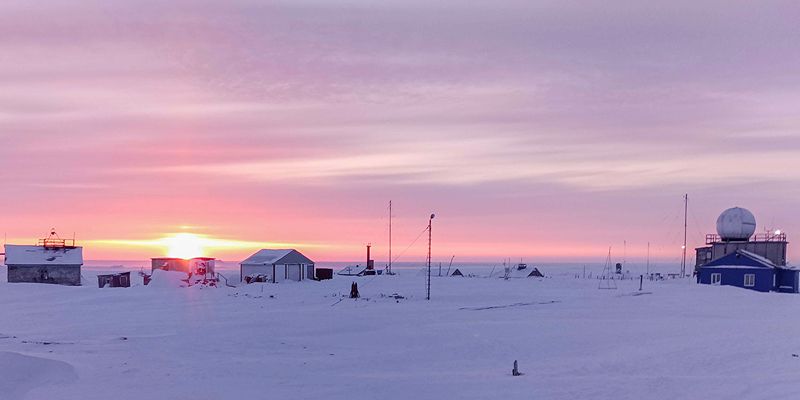
When Nikolay Belkov and his fellow companions, led by traveler Vladimir Melnik, arrived at Cape Chelyuskin, they found only the debris of Soviet sheds and a meteorologists’ barracks. All buildings were covered with snow. Time was just a drop in the bucket. They urgently needed to find material for the flooring of the future Arctic town.
“As soon as we landed, we began to dig up these sheds and demolish them to make flooring from the surviving boards. We warmed ourselves in the barracks. We worked from 7 a.m. until 2 a.m experiencing a bitterly cold wind. On the third day, we began setting up a mobile tent, a smart house developed by Travel Lab. It was equipped with satellite Internet, a kitchen hood and sockets that can be controlled from a computer. I was responsible for installing the ventilation system: my system ensures an inflow and outflow of air, unlike an air conditioner, which circulates air,” explains Nikolay Belkov, a student at Hospitality Industry and Management School No. 23.


Before traveling to the Arctic, the students studied the mobile town in Moscow, checked the drawings and made adjustments. After arriving, they had to test the radar to detect polar bears at a distance of one and a half kilometers.
“And sure enough, the equipment spotted the predator several times. We were convinced of that when he came closer and the dogs of our border guard neighbors began to bark,” Nikolay Belkov laughs. However, the animal would still not be able to enter the camp: the builders installed an electric fence with high voltage (12,000 V) to keep wild animals out.
In addition, the Moscow Professionals team tested a solar cell. As expected, it would replace a diesel generator and protect the environment. Although the sky was overcast, the experiment was a success. After all, it is a polar day in the Arctic now, the sun is always above the horizon and shines strongly - the expedition members even got tanned. “It was hard to sleep because of the endless day. We had dusk only for a couple of hours,” admits Nikolay.
When leaving, the explorers dismantled the camp and left equipment for the next shift of polar explorers. This is the idea: a tent and fence can be easily put up in a couple of hours anywhere in the world without harming the environment. In September 2024, the structure will be tested by environmental volunteers who will work at Cape Chelyuskin.
“The Great Arctic Expedition turned the children into real travelers and deep thinkers. I handed out cards with philosophical questions in the mornings, for example, ‘What would you do if there were 25 hours in a day?’ All day long they thought about it and in the evenings we discussed our ideas,” notes Matvey Shparo.
In his opinion, such expeditions unite people and the planet forming a single ecosystem.

Arctic expedition docu wins International Film FestivalCape Chelyuskin, polar bears and midnight sun. Young Muscovites talk about participating in the Great Arctic Expedition