Sergei Sobyanin relaunches revamped Leningradsky Railway Station

Moscow Mayor Sergei Sobyanin and Oleg Belozyorov, Chief Executive Officer & Chairman of the Board, Russian Railways, reopened the revamped Leningradsky Railway Station, the large-scale renovation was part of the federal project for the Central Transport Hub and inherent of the Infrastructure for Life national project.
“The Three Stations Square is the largest transport hub in our country as now it serves 350,000 passengers, including metro stations, Moscow Central Diameters, commuter, long-distance and Sapsan trains, surface transport, trams, and so on. Therefore, we certainly need to pay close attention to it, especially considering that we will soon start building the Moscow-St. Petersburg HSR terminal, and the number of passengers passing through the hub will increase to almost 500,000,” the Moscow Mayor said.
In this respect, the Moscow Government resolved to gradually upgrade the transport hub in conjunction with Russian Railways.
“We started with the oldest and most significant railway station-Leningradsky, which, unfortunately, was degraded and obsolete. We have done a comprehensive reconstruction. Essentially, it is now a new railway station with new services, a new level of comfort for employees and, of course, first and foremost, for passengers,” Sergei Sobyanin emphasized.
The next goal is to reconstruct Yaroslavsky Railway Station and to create a seamless transfer point for passengers to be able to change one mode of transport to another.
“It is a big goal. I am positive we will achieve it. Well, today, in fact, is a great day for everyone who uses rail transport. I thank you for your assistance, for the collaboration, for the projects we are implementing together,” said the Moscow Mayor.
Oleg Belozyorov, CEO and Chairman of Russian Railways, noted that the 175-year-old Leningradsky Railway Station was Russia’s oldest rail terminal, which was made a cutting-edge transport hub after the renovation.
“Compared to what it was just a year ago, the space available to passengers has increased threefold. There are also one and a half times more seats. More than a thousand people will be able to receive services or find accommodation here, at the railway station, at the same time. The station now features new baby care rooms and even a Soyuzmultfilm children’s club for our youngest visitors,” explained Oleg Belozyorov.
Moreover, the station has got the latest rail transport digital developments, he said, state-of-the-art electronic systems providing passengers with information, e. g., live train tracker options, train departure charts, plus metro and municipal services. In addition, the station has been redesigned.
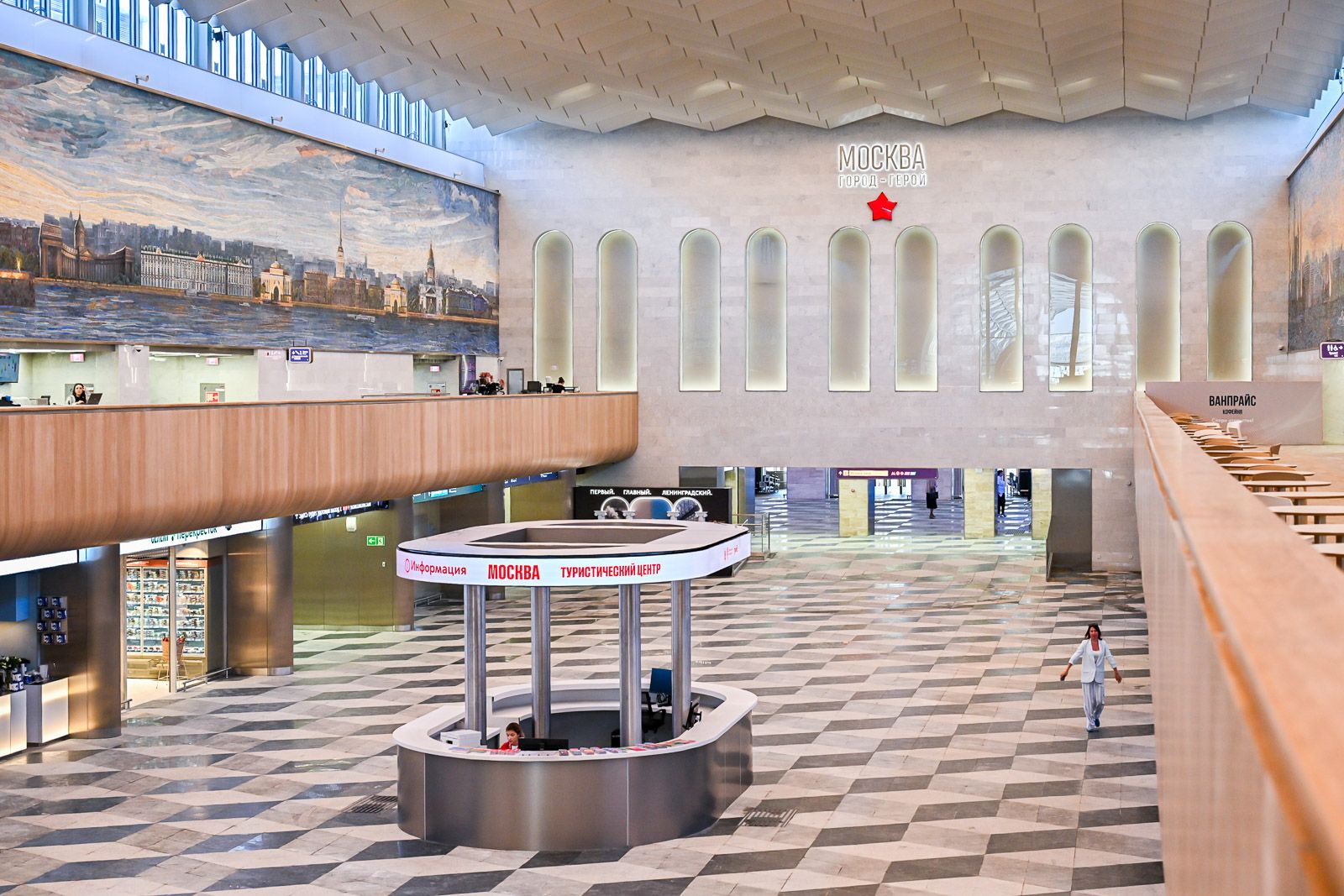
“The station’s original interiors designed by architect Konstantin Ton were restored during the reconstruction, but we have also created new, absolutely unique mosaic panels spanning more than 800 square meters and depicting Moscow and Saint Petersburg,” said Oleg Belozyorov.
He thanked the Moscow Mayor and his team for the collaboration and approach to reconstructing Leningradsky Railway Station and emphasized that the project involved all the latest global solutions.
Located on Komsomolskaya Square, Leningradsky Railway Station is in fact one of Moscow’s transport pillars with arriving and departing Sapsans, Lastochkas and other long-distance and commuter trains from and to St. Petersburg, Murmansk, Vyborg, Veliky Novgorod, Tver, Klin, Bologoye, Likhoslavl, Konakovo, etc.,
therefore making it Russia’s number one in terms of tourist flows. It is part of the capital’s largest transport hub, Three Stations Square, which is used by over 350,000 passengers daily. In addition to three central railway stations — Leningradsky, Yaroslavsky, and Kazansky — the hub comprises Sokolnicheskaya and Circle metro lines, two Moscow Central Diameters (MCDs), namely MCD-2 and MCD-4, plus surface public transport, including electric and conventional buses, tram services, and the Moscow Tram Diameters.
By 2040, with the expanding MCDs and the launch of the Moscow-St. Petersburg high-speed railway (HSR-1), the total passenger traffic at the transport hub is expected to grow by 40 per cent to reach approximately 500,000 passengers per day.


Comprehensive modernization of Leningradsky Railway Station
Kicked off in August 2024, the comprehensive project to modernize Leningradsky Railway Station included the closer integration into the city’s common transport framework, new exits and entrances, a one hundred per cent renewed engineering equipment, as well as roof and façade repairs. Moreover, they broadened passenger space and built a brand new environment meeting Moscow’s transport standards with an expanded range of services, trendy retail formats, and catering facilities.
The project involved a few stages, train departing and arriving at the station as usual.
The project’s general designer and general contractor, Mosinzhproekt JSC, utilized a digital information model and 3D SLAM scanners enabling visualization of the available structures and planning of utility lines with maximum preservation of existing shafts and canals.
“The station building has been reconstructed many times throughout its history. The current modernization is definitely a heavily passenger-oriented project. The designers have preserved key elements of the station’s historical exterior. Later layers of finishing were removed, and the original color schemes and architectural elements were restored in accordance with the original design,” the Moscow Mayor wrote on his Max channel.
Source: Sergei Sobyanin’s Max channel
Indeed, the historic part of the building was preserved and restored in accordance with the original design of architect Konstantin Ton. Key changes affected the interiors to render the railway station trendy, stylish and comfortable. They demolished some of the overabundant retail outlets, thus significantly increasing the space for passengers and those seeing them off.
A particular focus was however placed on transfer points and entrances. The station now has five entrances as a result; three of them are already accessible, with two more to come soon. The new entrance layout has boosted the station’s capacity, ensuring an even distribution of passenger flows.
In particular, the entrance through Level 0 (Krasnoprudnaya Street), which had been unused for more than 30 years, was reopened to passengers. Transfers between the metro, commuter and long-distance trains and surface transport are set as a warm, seamless, ‘dry-feet’ journey with sixfold shorter transfer time — just one minute versus six minutes before.
They also installed canopies and renovated the distribution area; as a result, the station features a unified architectural arrangement with a stylish, soaring-roof passenger platform combining an impressive design and high functionality. The space has been made brighter and safer, as the 15-meter-high canopy over the platforms will protect passengers from rain and snow, the heating system to ensure smooth and more effective services in winter time.
In fact, the total area of the canopy over the long-distance train gates and platform covers is 6,900 square meters. Exits No. 7 and 8 of the Komsomolskaya metro station in front of the main façade of Leningradsky Railway Station have been canopied, too, the lightweight glass structures echoing the historic building’s architectural features and are smoothly integrated into the surroundings.
Canopies are also set along the façade on the parking side of the Komsomolskaya Square passage and arranged a protected, comfortable pedestrian route network within the station.
As part of the comprehensive modernization project, they completely renewed the engineering systems, in particular both the utility lines within the building and the systems connecting the station to the municipal infrastructure, including the energy and utility networks.
Great attention was paid to ensuring a comfortable microclimate as in summer and winter the temperature inside the station building will be maintained at +22 to +25 degrees Celsius, even if the temperature outside rises above plus 40 degrees or drops below minus 40 degrees.
The station’s ventilation capacity has been doubled. Before the renovation, Level 0 had no air conditioning system, which led to stagnant air and made staying there extremely uncomfortable, especially during the hot season. During the project, the ventilation system was upgraded so that each area of the station would be provided with sufficient fresh air.
The illumination capacity has been doubled, too, increasing up to 300 lux. The eleven-window ticket hall is decorated with a cutting-edge coffered ceiling with built-in lamps.
The functional distribution of floors was also changed.
Enabling quick access to the platforms, Level 1 features key services, such as a family-oriented space, Soyuzmultfilm children’s club, which is the first to open at a Russian railway terminal, a first aid station, a business lounge, a Moscow transport info desk, a Moscow tourist center, and long-distance ticket offices.
Level 2 and Level 3 have been made comfortable for long waits, with a relaxation area, cafeterias, and restaurants.
The largest hall is located on Level 2 in close proximity to the train gates and welcomes all categories of passengers, including military personnel, while passengers can take advantage of a meeting room.
On Level 2 there is also a separate pet-friendly lounge; Level 0 has a pet care room, too.
The area of the business lounge has been doubled to span both Level 1 and Level 2.
More than 40 well-known Russian companies are presented at the station, offering a wide range of catering, retail, and related services; there are also vending machines and ATMs.
Their pricing policies meet Moscow’s standards in fact as the pricing levels are consistent with those offered by similar network operators outside the station, thus excluding cost overruns and creating an accessible environment for passengers.
Level 0 features a retail space and luggage lockers. Unlike previous stationary storage lockers, the new automated lockers can accommodate luggage of various sizes, including large items, while meeting all of the safety regulations.
In the family room, passengers with children under seven years of age can sleep, change or feed babies.
The functionality of the first aid station has been significantly expanded for passengers to receive emergency assistance, and they can take basic medical tests, ultrasounds and a comprehensive check-ups or to receive mental health support, if they wish.
On top of that, the station has got sevenfold more restrooms.
In fact, Leningradsky Railway Station is Russia’s digitalization trailblazer with more than 220 digital navigation and information signs, including 23 train departure and arrival boards, navigation signs, information screens, and digital signage. The smart digital navigation system informs passengers about schedule or platform changes in real time, suggesting the shortest routes within the station.
Elaborated in accordance with the Moscow Metro’s uniform standards, it ensures continuity of the visual environment, clear logic and a common user experience when transferring between different modes of transport. It is the first time that Moscow’s public transport has got dark-theme digital navigation option, which was developed by the Moscow Metro to set a new visual standard for the city’s transport infrastructure.
The station features a barrier-free environment with six elevators and four escalators, including a through-floor elevator connecting all levels. Furthermore, it also pioneered luggage conveyor belts in Russia for passengers to transport luggage at entrances and through security checks.
If necessary, PRD, senior passengers and parents with children can apply to the mobility center.
In addition, they have introduced a unified Lost & Found tracer integrated into Moscow’s transport infrastructure.
The building offers a luggage handling service at all stages of passenger journey, from entrances and transport upon arrival at the station to placement in the train carriage.
In fact, it is also the first Russian railway station to offer a door-to-car luggage delivery service, from your home or hotel to the train.
They have improved the adjacent area to increase taxi parking lots by 1.5 times-from 30 up to 44, thus reducing taxi waiting times. There is also a 105-car municipal parking, including 11 lots for people with reduced mobility and 10 lots with electric vehicle charging stations; separate parking has been set for tourist buses.
A particular focus is placed on security and safety issues, indeed, with a police department being in the immediate vicinity of the station, just about 150 meters away from the main entrance.
The Moscow Metro in cooperation Russian Railways have developed and implemented common regulations, including a corporate dress code, etiquette and emergency procedures, including interdepartmental data exchange.
The station operates Sphere, a state-owned automated IT system, which provides comprehensive video surveillance and real-time situational awareness; video signals from all cameras come to a single security control center and to the station’s Chief Dispatcher.
Renovating the historic building. The museum and the chapel
Leningradsky Railway Station was renovated to preserve the building’s authentic structure and key exterior and interior elements to the greatest extent possible.
The historic building’s key dominant feature, namely the ‘Leningradsky Railway Station’ sign, was updated, too. Its visual solution is based on a version from the mid-1970s, the letter outlines having been restored using archival photographs and enriched with contemporary vignettes.
The overall design involves variable-width strokes, thus making the inscription clearer, more expressive and easily readable at any time of day; they have also added a highlighter line and architectural lighting. Two more new signs have been set in the train departure area and on the façade facing the square.
After 80 years, the roof of Leningradsky Station has once again got a flagpole with the national flag to be a pivotal element of the building’s architecture.
The interiors have been decorated with two mosaic panels spanning over 800 square meters; featuring views of Moscow and Saint Petersburg, they are made as veduta paintings of hand-made cobalt glass mosaic pieces. They form the largest mosaic panel of any Russia’s transport facilities.
In addition to the iconic architectural landmarks of the two capitals, the artists added smaller elements — staffage and “Easter eggs”. For example, an attentive person will spot a black cat inspired by the same-name song that was written by Yuri Saulsky and Mikhail Tanich in the early 1960s.
On Level 4, which was previously closed to passengers, they have recreated the palace interiors of the early 19 th century to house an immersive museum of the station’s history. Its concept, from the architectural logic to the minutest ornamentations, conveys as accurately as possible the artistic language of the era. Visitors will enjoy stylized light fixtures, including a crystal chandelier with candle-shaped shades, a marble fireplace, mirrors, and accessories typical of ceremonial rooms of that time.
The exhibition’s centerpiece is however a historical installation with architect Konstantin Ton presenting the future station project to Emperor Nicholas I.
On top of that, they have restored the Chapel of St. Nicholas the Wonderworker located in the historical part of the Leningradsky Railway Station.
Sergei Sobyanin unveils Moscow’s transport roadmap 2026Moscow continues upgrade of railway infrastructure
Moscow’s oldest railway station with 175 years of history
In February 1842, Nicholas I decreed the construction of the Saint Petersburg-Moscow railway road. The Emperor in fact personally hired the outstanding architect Konstantin Ton who had designed the Catherine Church in St. Petersburg, the Cathedral of Christ the Savior, and the Grand Kremlin Palace in Moscow, to draft the design for passenger facilities in both capitals.
Therefore, the stations in both capitals shared a common design featuring classic two-story façades and two-tiered clock towers topped with a spire in the central part.
Built in 1849, Moscow’s Petersburg railway station had a spacious double-height lobby, passenger lounges and imperial rooms on the first floor, its second floor housing apartments for managers and other employees. The first St. Petersburg — Moscow train piloted on August 3, 1851. As soon as on August 19, the railroad was tested by Emperor Nicholas I, his wife, the heir to the throne, the Grand Dukes, four German princes, and courtiers.
Regular traffic on the first Russian railway line was launched on November 1, 1851. In 1855, after the accession of Emperor Alexander II to the throne, the Saint Petersburg — Moscow Railroad was renamed the Nikolaevskaya Railroad, the railway stations in both Moscow and St. Petersburg were renamed Nikolaevsky, accordingly.
In February 1923, Nikolaevskaya Railroad was renamed Oktyabrskaya, and Nikolaevsky Railway Station turned into Oktyabrsky. A year later, due to the renaming of the northern capital, the station became known as Leningradsky, and it still retains this name, although trains from it depart to St. Petersburg.
In 1934, the authorities ran the first large-scale revamp project to demolish the passenger platform, build a ticket hall and set an information desk, post and telegraph offices.
In 1948–1950, the interiors were renovated and re-decorated by architect A.N. Dushkin.
In the 1970s, Leningradsky Railway Station was redesigned by architect V. I. Kuznetsov to significantly increase the area; it was in fact redeveloped and expanded to get separate platforms, renew station tracks and add the third floor. The changes adapted the station to growing passenger traffic and expanded the building’s functionality.
Later, its historical part was accepted for governmental protection by Resolution No. 624 of the RSFSR Council of Ministers dated December 4, 1974. Today, it is a cultural heritage site of federal significance, the protected pieces including a domed clock tower with two semicircular balconies at its base and a spire on the top, paired windows with molded ornamental bands, abutments, rectangular panels, stucco rosettes, fluted columns, a 19 th-century cast-iron grand staircase, etc.
In August 1975, they built the upper and lower ticket rooms and a spacious main hall on the site of the former passenger platform. For the convenience of passengers, the railway station was connected to metro by underground passages.
In 1989–1997, the platforms were lengthened and canopied; they also improved the lighting system. To prevent the intersection of passenger flows from different directions, the station layout was re-arranged.
In 2008–2013, the local authorities carried out a comprehensive renovation and restoration project to have restored the façade’s original color scheme and ornaments.