Sergei Sobyanin: The provision of support for the machine tool industry represents an investment in the future of Moscow
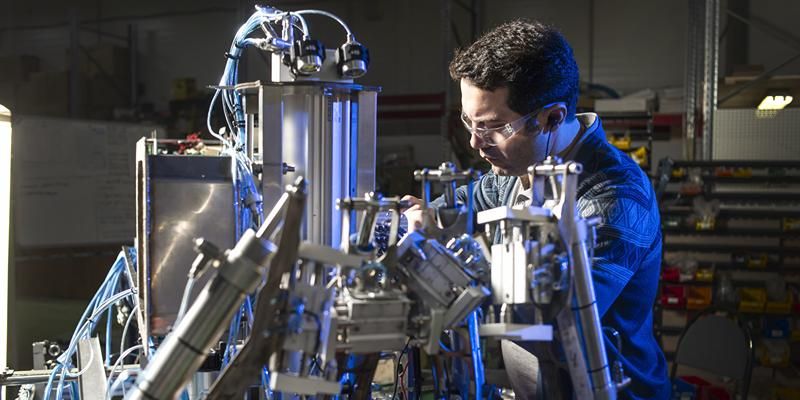
Machine tool manufacture is a key branch of the machine industry, which is critical for ensuring the technological sovereignty of the country. Sergei Sobyanin described about how the capital city is developing the machine-tool and robotics industries in a post on his blog.
“There are more than 70 Moscow-based companies which produce machine tools, instruments and high-tech robotic systems at production sites within the city. In 2024, their combined revenue exceeded 18 billion rubles — 42.6 percent more than in the previous year, and high-tech segment is increasing in volume every year,” the Mayor of Moscow wrote.
Financial support
Moscow enterprises work not only for the domestic market, but are also significant exporters. Among the city’s most important export partners are the United Arab Emirates, Uzbekistan, Turkey, Tajikistan, and China, which purchases machines for laser metal cutting and grinding from the Russian capital. Moscow-based companies export industrial robots, digital control panels, laser cutting machines and other types of latest generation equipment.
The city offers specialized preferential lending programs for priority industries, allowing them to attract debt financing at a reduced rate for the development of production operations.
In particular, the Moscow Fund for Support of Industry and Entrepreneurship reimburses interest expenses on loan agreements concluded with a bank or leasing organization. The amount of compensation paid may not exceed five billion rubles. The financial support is available for a period of up to five years, and the interest rate is 50 percent of the base rate of the Central Bank of the Russian Federation.
In addition, assistance is available from the Moscow Guarantee Fund. The Fund provides guarantee support for loan obligations, which is important for businesses who lack sufficient collateral. This support measure covers up to 70 percent of a loan of up to 100 million rubles.
In total, with the support of the Moscow City Government, Moscow companies have been able to attract more than 500 million rubles of loan financing for the implementation of their projects.
Support is also available through the i.moscow platform. Producers can receive a grant of up to 30 million rubles to purchase equipment and develop their activities. Through financing, they can also recover equipment purchase or leasing costs and interest on loans. Participants of the Moscow Innovation Cluster can apply for grants. Since 2022, 11 companies from the machine tool and robotics segments have received grants totaling over 296 million rubles.
Tax preferences are enjoyed by companies which are residents of the Moscow Technopolis special economic zone. They are exempt from property, land and transportation taxes for 10 years, and pay corporate income tax at the rate of two percent instead of 25 percent. In addition, residents are exempt from paying customs duties and VAT when importing goods and equipment under the free customs zone procedure. The enterprises use the saved funds to increase production volumes and to develop and implement new high-tech solutions.
Sergei Sobyanin gives details on Moscow’s participation in an industrial exhibition in Shanghai
Development of human resource potential
In addition to financial assistance to companies, the capital city actively promotes the development of the industry’s human resource potential and enhances the prestige of the engineering professions. Last year, Russian President Vladimir Putin opened a flagship practical training center for Moscow colleges in the Moscow Technopolis SEZ. This is the first innovative educational space for training qualified personnel to meet the needs of Moscow’s economy, and is the largest training and production center in Russia. It has the capacity to educate more than three thousand students per year.
Among the center’s workshops are turning and milling machine facilities, locksmith and welding shops, composite materials and digitally-controlled machine tool areas, a metrology, standardization and certification center, and precise digital measurement and mechanical engineering design workshops.
In addition, as part of the Technostudy project, at the Moscow Technopolis SEZ young specialists can undergo practical training and obtain relevant skills in leading industrial enterprises of the capital, including companies engaged in the development of high-tech machine tools and robots.
From robots to laser equipment
Sergei Sobyanin cited a number of Moscow companies which are successfully developing their production capabilities.
For example, at the Pechatniki site of the Moscow Technopolis SEZ, the resident company Technored opened a robotics center in May this year. The company was established in 2018 and employs about 100 highly qualified specialists.
The center specializes in industrial robots, components and software. It also operates a technology testing laboratory. The R&D team is responsible for the full cycle of work, from prototyping and modeling to the testing of robotic equipment. This approach significantly reduces the time required to market new products and improves their quality and reliability.
Technored opened another robotics laboratory at the Plekhanov Russian University of Economics. The advanced equipment housed here enables students to be prepared to deal with real tasks in the industrial sector while they are still in training.
The company is currently developing its export business. In 2024, the SEZ resident successfully implemented more than 15 projects in the Republic of Belarus, Germany and Israel. In March 2025, the Republic of Belarus purchased a new painting robot from the company. The robot can replace a team of three professional painters working at the same time. And in early September, a resident of the capital’s SEZ, together with a major Russian IT company, began production of a large robotic system that will soon be shipped to Kazakhstan.
Technored plans to expand exports of its range of cybersecurity robots and robotic systems to markets in Latin America, South Africa and India starting in 2028.
In 2024, the company’s robotic palletizing and stacking complex Redcargo won first place in the Best Industrial Design of Russia National Award.
.jpg)

Lasers and Hardware, a company with production facilities in Zelenograd, this year presented new equipment for machining of components used in aircraft engine construction. All basic modules of the device are manufactured by the company itself.
The five-axis machine is equipped with automation technology such as computer vision, which allows the operator to accurately position parts in the tooling machine. The uniqueness of the machine lies in the combination of two types of tools at once: a laser source and an electric discharge superdrill, which uses the impact of electric charges to process metal.
The system works with a variety of materials, including promising new materials such as ceramic-coated metals and polymer composites. Thanks to its innovative technology, the equipment can be used to machine complex shaped parts and can punch thousands of holes with extremely high precision.
The machines are now being mass produced. The first five systems of the new type have already been installed at the production facilities of Rybinsk-based ODK-Saturn, which is part of Rostec’s United Engine Corporation.
.jpg)
.jpg)
NPP Lassard, a Russian manufacturer of modern laser machines, has recently been granted the status of a resident of the Moscow Technopolis SEZ. Lassard is a full-service company that designs, manufactures and sells laser equipment. Among its innovations are optical tables with active vertical and horizontal vibration isolation. The company also produces an ophthalmic system in which laser technology is used to correct vision.
In the first half of 2025, the SEZ resident significantly strengthened its position in the laser equipment market. An important step was the expansion of its product line. The company has successfully developed and brought to market two new machines — an ultraviolet engraving machine and a pulsed laser welding system. In addition, it has successfully completed the development of a specialized five-axis laser cutting machine to perform individual tasks in an engine plant.
In June, at the Saint-Petersburg International Economic Forum, a cooperation agreement was signed between the Moscow City Government and SEZ residents Technored, Lassard and Nex-T. The agreement envisages the creation of a new industrial cluster, Robotics and Machine Tool Building, at the Moscow Technopolis SEZ. It also provides for the expansion of scientific and technical cooperation between specialized enterprises and the provision of support to help them develop their export potential. The creation of the cluster will increase the production of new types of high-tech machine-tool and robotics equipment in the capital.
.jpg)

.jpg)
Beavertech develops and manufactures high-precision numerically controlled machine tools in the capital. These are used in satellite manufacturing, instrumentation and automotive, construction, prosthetics and other sectors where strict demands are placed on accuracy and surface quality. Machines enable the automation of many labor-intensive operations, which reduces the manufacturing time of innovative products many times over.
Three years ago, the company assembled its first machine in a small production space of only 50 square meters. Now Beavertech has a three thousand square meter site with a full cycle production and development department.
The company has twice received equipment grants from the city. In 2024, the Beavermill machine won second place in the Best Industrial Design of Russia National Award.
One of the company’s newest developments is a milling machining center designed for round-the-clock operation in a mass production environment. The company’s machines can be used in robotic cells, a kind of automated production module. These are integrated into teaching workshops and are comfortable for faculty and students to work in.

.jpg)
Robopro, a member of the Moscow Innovation Cluster, is another manufacturer of robotic systems that has localized the production of high-tech equipment in the capital. One of the company’s newest developments is a compact collaborative robot (or “cobot”) with a payload capacity of three kilograms. It is designed to automate technological processes and can also be used for research, educational and medical purposes.
Moscow residents and guests of the capital can experience innovations by Moscow engineers at first hand — innovative robots brew coffee at Kurskaya and Nizhegorodskaya metro stations. A six-axis design with integrated motors provides the barista robot with good mobility comparable to that of a human hand.


Saga Robotics manufactures robots and automation equipment in Moscow. The company recently developed a six-axis industrial robot manipulator with a payload of seven kilograms, as well as software to control its movement. The apparatus is suitable for use in high-tech industries where the precision of the equipment is particularly important.
In addition, the company manufactures training equipment systems. It has been producing four-axis robots since 2020. During this time, about three thousand machines have been delivered to educational organizations across Russia. The Moscow company is constantly improving its developments and introducing new software to expand the functionality of its products.
.jpg)
.jpg)
.jpg)
Tubot manufactures robotic systems for branched pipelines. Its technology allows it to assess the current technical condition of pipes to prevent accidents and environmental damage. In addition, repair, treatment, and cleaning modules can be connected to its robots, which can be used in pipes under water, roads, and buildings without the need for human access.
The robot is lowered inside the pipeline through a special manhole. There it is extended and securely fastened by resting its wheels or tracks against the walls. The motors are then started and the machine begins to move at a predetermined speed. Built-in sensors transmit data to the control panel, allowing the operator to see the surroundings and, if necessary, remotely control the movement of the machine.
The company’s robots are used in the housing and utilities sector and in the oil and gas, chemical and metallurgical industries.
.jpg)
.jpg)
.jpg)
SKTB PR produces mobile robotic complexes on the territory of Moscow Technopolis SEZ. They are designed for use in emergency rescue and engineering projects in environments where there is a risk of explosions, as well as in cargo transportation.
The company has recently created a new robot capable of carrying up to 100 kilograms of cargo over any terrain. This is a development based on designs and models, software and a control system, all of which were created by the company.
The firefighting version of the robot has a barrel with the ability to deliver extinguishing agents. This development reduces the risks to the lives of firefighters and makes firefighting much easier.

Microbor, a resident of Moscow Technopolis SEZ, produces high-tech metal-cutting tools made of superhard composite materials — cubic boron nitride, ceramics and polycrystalline diamond.
The company has an in-house laboratory with an ion plasma machine that applies innovative wear-resistant coatings to tools to increase their service life.
The company also offers comprehensive solutions for various industries. For example, it produces specialized solutions for the high-precision machining of pumps, motors and bearings.

.jpg)
“The provision of support for the machine tool industry represents an investment in the future of Moscow. It enables the creation of new jobs and promotes import substitution,” summarized Sergei Sobyanin.