Vladimir Putin and Sergei Sobyanin inaugurate MCD-4
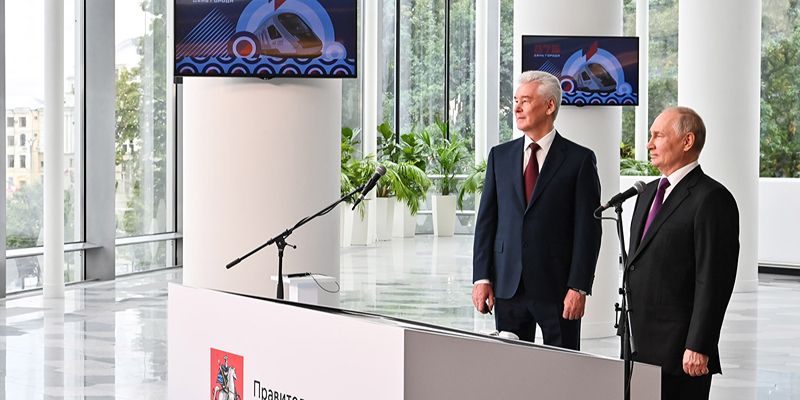
Russian President Vladimir Putin and Moscow Mayor Sergei Sobyanin have inaugurated the fourth Moscow Central Diameter (MCD-4), one of Moscow’s largest transport infrastructure facilities.
“The biggest project that we are launching today is the result of many years of work to link two railway lines, namely, Kaluga-Kiev and Kursk destinations. Traditionally, they reached the Kievsky and Kursky Terminals. These two dead-end lines were, as always, quite crowded, with slow-moving trains that were dead-ended as they reached a dead end, then turned around, and so on. There was no clock movement, and this, certainly, created huge problems. This whole colossus was only slightly efficient. That is why we decided to connect them and simultaneously lay isolated tracks for trains of the new central diameter,” said Sergei Sobyanin.
100 kilometers of extra tracks in all are laid, plus 50 kilometers of reconstructed tracks. Builders have also erected dozens of engineering structures, such as bridges, overpasses, tunnels, in addition to 24 terminals, which are integrated with other modes of transport.
Moscow’s longest diameter
Spanning 86 kilometers, the fourth diameter is the longest one in the capital to have connected seven terminals in downtown, including Kursky, Yaroslavsky, Kazansky, Leningradsky, Savyolovsky, Rizhsky and Belorussky.
Another MCD-4 feature is a large number of interchange hubs as passengers have 38 transfer options to the metro, the Moscow Central Circle (MCC), and other diameters.
Key advantages of the new diameter are as follows:
— 1.7 times more passenger seats (2 million vs. 1.2 million per day), so the carriages will become noticeably more spacious even during peak hours;
— a shorter traffic time interval, which is now only 5.5 minutes during rush hours, in addition to no 1.5-hour daytime breaks;
— 3 times lower cost (RUB 65 vs. RUB 200) on some routes, with a free transfer to the metro;
— new routes and travel options around the city, including to Three Station Square, Maryina Roshcha, Savyolovskaya, Belorusskaya, Testovskaya and other interchange stations;
— 24 well-arranged in-city commuter terminals, MCD-4 featuring the most of them among other surface metro lines. All of them, including all Kaluga-destination stations of the Moscow Railway, meet the new Moscow transport standard;
— better airport accessibility as MCD-4 is integrated with Sheremetyevo (transfers at Belorusskaya, Testovskaya and Savyolovskaya stations) and Vnukovo destinations (a transfer at Aminyevskaya).
Moreover, with two additional running tracks on the Kaluga route, Aeroexpress trains will be faster; the travel time to Vnukovo Airport from the Kievsky Terminal to be 33 minutes instead of 45 minutes.
MCD-4 opening has also improved transport services for over 20 Moscow districts, so the city has got closer for people in Aprelevka, Reutov, Zheleznodorozhny (Balashikha) and other towns near Moscow.
“Today another very big step has been taken in the development of the Moscow transport hub. Everything that has been done today is for benefit of Moscow, the Moscow Region and all the people who live in or come to this area. I am talking about millions of people, this is without any exaggeration. About millions of people who will get better logistics. Their living conditions will be improved, and this is a serious step forward for the economy, too. I congratulate everyone and wish you all the best. Many thanks to all of you!” Vladimir Putin said.
MCD-4 will carry about 190,000 pax per day immediately after the launch and 267,000 pax per day by the end of 2023. The daily passenger traffic is projected at 455,000 people by 2030. The new diameter’s infrastructure has spare capacity, so heavier traffic will not affect the comfort of passengers.
With the MCD-4 launch, which has redistributed passenger flows, certain segments of the Kalininskaya, Solntsevskaya and Arbatsko-Pokrovskaya metro lines will be relieved up to 9 per cent.
The outbound roads will have lower traffic, too, as there will be 13,600 fewer cars per day on Kievskoye, Borovskoye, Nosovikhinskoye and Entuziastov Highways.
The total length of the new MCD-4 Kaluzhsko-Nizhegorodsky above-ground metro line is 86 kilometers, including 36 stops, with two more, namely, Rizhskaya and Begovaya stations, to be added on a later stage. The diameter terminates in Aprelevka and Zheleznodorozhnaya (Balashikha).
Moscow Region Governor Andrey Vorobyov noted the new diameter’s outstanding fleet and stations and added that the reduction in cost was crucial for local residents. “This is a very important milestone for us, for our residents,” he said.
MCD-4 was a knotty and thorny diameter in terms of construction as builders had to connect disparate Moscow Railway lines running to Kaluga and Nizhny Novgorod, passing through the Belarusian, Riga and Kursk lines, and did a tremendous job on some segments in order to tackle the problem. The most complicated work included:
— construction of additional third and fourth running tracks on the Kaluga line of the Moscow Railway;
— construction of a connecting branch between the Kaluga and Belorussian lines of the Moscow railway hub;
— renovation of the Moscow-Passazhirskaya-Kurskaya-Three Stations Square (Kalanchyovskaya) segment;
— reconstruction of the Moscow-Passazhirskaya-Kurskaya — Karacharovo segment and construction of extra running tracks (the first phase);
— construction of the third and fourth main tracks at the Tree Stations (Kalanchyovskaya) Square — Maryina Roshcha section;
— construction of the third and fourth running tracks on the Begovaya — Savyolovskaya segment.
Workers have ultimately built 100 kilometers of new main railway tracks in all and reconstructed 54 kilometers of existing railway lines.
Two train depots to accommodate 17 trains, near the Zheleznodorozhnaya and Solnechnaya stations were arranged.
Specialists also built eight railway bridges across the Neznaika, Setun, Moskva and Yauza rivers, five railway overpasses, and more than 40 other artificial structures and viaducts.
Workers removed 4,570 thousand cubic meters of earth, added more than 380 kilometers of overhead contact systems and 169 switches, built/rebuilt 9 traction substations, laid over 1,360 kilometers of utility networks and rearranged more than 490 kilometers of engineering systems. The rush phases involved 3,500 builders working at one time.
Importantly, these complex works in dense urban areas were carried out without stopping traffic flows, MCC, metro, MCD-1 and MCD-2 trains.
MCD-4 in-city commuter terminals and stations
MCD-4 includes 36 stations and currently has the most advanced infrastructure among the four Moscow Central Diameters. For example, 24 out of 36, or two-thirds, of MCD-4 stations are fully functional in-city commuter terminals.
“This MCD is perhaps the most integrated with the metro and other modes of transport today as it has 38 integrations with the metro, railroad, the MCC, and so on. That’s what a project we’ve done. In addition to other projects, we have connected seven of Moscow’s largest train terminals, such as Belorussky, Savyolovsky, Rizhsky, Leningradsky, Yaroslavsky, Kazansky, and Kursky. And the line itself reaches Vnukovo from this side and here — to Balashikha’s Zheleznodorozhny microdistrict, and this is one of the most problematic areas in the Moscow Region in terms of transport. We also enable traveling through the entire city,” said Sergei Sobyanin.
15 stations on the Kaluga line of the Moscow Railway, including Aprelevka, Pobeda, Krekshino, Sanino, Kokoshkino, Tolstopaltsevo, Lesnoy Gorodok, Vnukovo, Michurinets, Peredelkino, Meshcherskaya, Ochakovo, Aminyevskaya, Matveevskaya and Minskaya, were built from scratch or totally reconstructed to meet the Moscow transport standards.
Three new in-city commuter terminals were built on the connecting line between the Begovaya and Poklonnaya stations, these including the Poklonnaya, Kutuzovskaya and Testovskaya terminals.
In addition, the launch of the new diameter coincided with wrapping up the second-phase construction of the Maryina Roshcha station, large-scale reconstruction of the Three Stations Square station, erection of a new Olgino terminal, and renovation of the Belorusskaya, Kurskaya and Zheleznodorozhnaya stations.
In 2025, MCD-4 is expected to get two more stations, namely, Rizhskaya and Begovaya, which are currently under reconstruction. The existing stations of Serp i Molot, Savyolovskaya, Chukhlinka, and Zheleznodorozhnaya are also being put in order.


New-gen trains and lower fares
From its first day, the diameter has been served by only new-gen trains — EP2D and EP2DM — which are 7 years old on average at the start of operation.
In far suburban areas, new rolling stock makes up 45 per cent of the fleet. to be completely renewed by the end of 2025.
The fourth Moscow Central Diameter is, in fact, a ground metro with the same fares and transfer options to other modes of transport. “Passenger traffic will reach up to half a million people per day, that’s a huge amount. The cost will be three times cheaper, while the traffic time interval — a historical component when we started this work — will be reduced by up to 2.7 times; after all, this is the clock movement of modern trains. Within a year or two, we will reach the point where almost the whole fleet on this section will be new,” added Sergei Sobyanin.
MCD-4 passengers can avail themselves of the common user-friendly surface metro fare system, with payment options including Troika Travel Cards and other methods convenient for passengers.
Like in the case of MCD-1, MCD-2 and MCD-3, MCD-4 is divided into three fare zones:
— Central with stations from Vnukovo to Reutov, including the Kievsky Terminal and a branch to Novoperedelkino, a one-way trip under the Wallet tariff of the Troika Travel Card is RUB 50;
— Prigorod, from the Aprelevka station to Lesnoy Gorodok and from Nikolskoye to Zheleznodorozhnaya, with one-way fare of RUB 65;
- Dalnyaya, including stations from Nara to Dachnaya and from Cherny to Krutoy, with one-way fare of RUB 65, plus RUB 30 per zone outside Prigorod.
When traveling from each zone using the Troika Travel Card, a passenger can benefit from a free transfer to the metro, the MCC or other diameters, which is available within 90 or 120 minutes, depending on the route. For example, with one transfer you can get from MCD-4 Minskaya to MCD-1 Dolgoprudnaya, from MCD-4 Vnukovo to MCD-1 Skolkovo, or from MCD-2 Dmitrovskaya to MCD-4 Peredelkino.
Traveling is now much cheaper as a result. Some routes have got almost threefold lower cost RUB 65 instead of RUB 200 for certain passengers to save up to RUB 67,000 per year. After MCD-4 is launched, travel has become cheaper for schoolchildren and students, as well, as they are offered discounted travel passes with free transfers to the metro, the MCC and MCDs, even if they ride from the Prigorod zone. The related cost has been reduced by up to three times.
In addition, with the MCD-4 launch, Dalnyaya zone passengers can benefit from a longer transfer time — 120 vs. 90 minutes, this applying to the following routes:
— on MCD-3, from Ippodrom and Ramenskoye to Khovrino, Likhobory, and Petrovsko-Razumovskaya;
— on MCD-3, from Zelenograd — Kryukovo and Firsanovskaya to Veshnyaki, Vykhino and Kosino;
— on MCD-4, from Zheleznodorozhnaya to Aminyevskaya;
— on MCD-4, from Aprelevka and Pobeda to Chukhlinka, Nizhegorodskaya, Serp i Molot, and Kurskaya;
— on MCD-4, from Kokoshkino and Tolstopaltsevo to Chukhlinka and Nizhegorodskaya; and
— on MCD-4, from Lesnoy Gorodok to Chukhlinka.
Time table
After the MCD-4’s launch, the time table for the Kaluga destination trains has changed. On the route from Aprelevka to Zheleznodorozhnaya, the average traffic interval has been shortened by 2.7 times, being 5.5 minutes during rush hours and 10 to 15 minutes at normal times. Diameter trains stop at all stops from Aprelevka to Minskaya to further go towards Poklonnaya, turn onto the connecting branch and travel towards Kutuzovskaya to Zheleznodorozhnaya. They do not go to the Kievsky Terminal. To transfer to the MCC, passengers can take an MCD train going towards Zheleznodorozhnaya and change to the Kutuzovskaya or Testovskaya stations.
Commuter trains from farther suburbs (e. g., Kaluga, Maloyaroslavets or Nara) travel to the Kievsky Terminal and on the Aprelevka — Kievsky Terminal segment they stop only at the following large stations: Aprelevka, Peredelkino, Ochakovo, Aminyevskaya, Minskaya and the Kievsky Terminal (skipping some stops). Thus, passengers can get to the terminal faster. Train intervals will remain the same, that is an average of 15 minutes during rush hours. Express trains will also arrive here, at the Kievsky Terminal as they remain fully operational on this route.
Commuter trains to Novoperedelkino will continue to run from Solnechnaya with 20-minute time intervals. A trip on this route costs the same as on the MCD; transfers to MCD and metro trains will be free of charge.
There are also changes in the train time table on the Nizhny Novgorod line. In addition to the MCD trains running along the normal Zheleznodorozhnaya — Aprelevka route, some commuters from the distant suburbs (from Krutoye, Zakharovo, Fryazevo and Balashikha) are now diametrical, their routes extended to Aprelevka, which is very convenient for passengers.
Some trains in the outer suburbs will only go as far as Three Station Square and Nizhegorodskaya, while some Balashikha commuters travel from or to Nizhegorodskaya, as before. Express trains from the far suburbs go to Three Stations Square, and from Zheleznodorozhnaya — to Three Stations Square and Nizhegorodskaya.
The average time interval on the Zheleznodorozhnaya — Aprelevka segment is just 5.5 minutes at rush hours, while during other hours trains run every 10 to 15 minutes. The same interval is also applicable to the Nizhegorodskaya radial line and the new connecting branch from Belorusskaya to Poklonnaya. There will be no more 1.5-hour breaks during the day time.
Action plans for passenger transportation in Moscow and at the Central Transport Hub
Further plans for the development of passenger traffic in Moscow and at the Central Transport Hub encompass three major projects that President of Russia Vladimir Putin ordered to elaborate.
Launch of the MCD-5 Yaroslavsko-Paveletsky Diameter. The fifth 89-kilometer diameter, including 39 stations, will connect the Moscow Region cities of Pushkino and Shchyolkovo in the north and Domodedovo in the south.
Its central portion, 12 kilometers long, will run underground with transfers to Moscow Metro stations. The fifth diameter is projected to be used by up to 603,000 pax per day.
Improved passenger transportation between Moscow and the largest nearby regional centers.
The project covers 11 regions with a population of 31 million people. Time intervals for trains running between regional centers and Moscow will be shorter — 20–30 minutes instead of today’s 45–180; the fleet will be upgraded, too.
Creation of a high-speed railway (HSR) network, including 5 3,700-kilometer HSR lines to cover areas with > 80 per cent of Russia’s population.
The HSR lines will give a powerful impetus to boost the development of the entire country — an impetus enabling economic growth, technological progress, increased mobility and improved human capital assets.
With the launch of the HSR-1 St. Petersburg — Veliky Novgorod — Tver — Moscow, travel times would be shortened 1.8 times — two hours fifteen minutes vs. four hours five minutes between the country’s two largest agglomerations, to be 39 minutes instead of one hour six minutes between Tver and Moscow and 29 minutes instead of three hours ten minutes between Veliky Novgorod and St. Petersburg.