2018, archive
Uniform Transport Navigation
Signage System in Moscow
Signage System in Moscow
Moscow has a new, consistent directional signage system that includes all types of city transport. It allows residents and tourists to identify their location and plan the best routing on consistent maps
Why is a uniform navigation signage system needed?
A modern mega city cannot do without a user-friendly navigation system. This includes not only signs and arrows, but also all the methods used by people for orientation and direction. The new navigation system puts all types of transport into a uniform network by offering clear and understandable information at the right time and in the right place along a route.
The new system makes the transport network understandable and user-friendly
The previous signage system did not present city transport as one system and it was hard to understand for tourists.
In the metro tourists found it difficult to find the exit they needed and it took pedestrians some time to learn their way around the city.
To resolve these problems we analysed how people experienced getting around in the city, their main problems and questions.
Real people's needs underlie the concept of a uniform city navigation signage system. The new system is based on a single toolset, which makes the transport network understandable and user-friendly.
To resolve these problems we analysed how people experienced getting around in the city, their main problems and questions.
Real people's needs underlie the concept of a uniform city navigation signage system. The new system is based on a single toolset, which makes the transport network understandable and user-friendly.
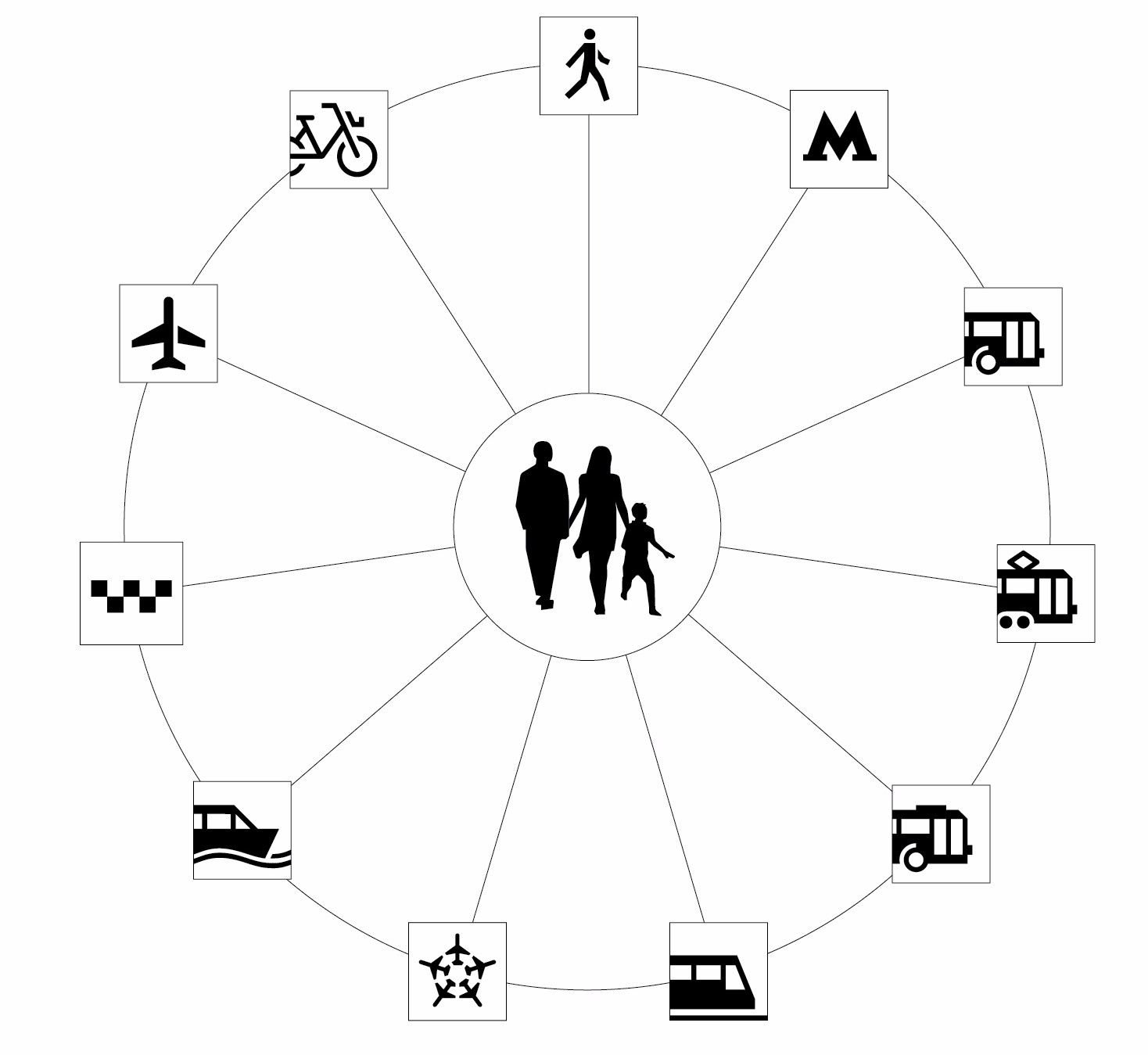
How does the navigation system work?
Route connectivity
The system is intended for the metro, surface transport, pedestrian spaces, the city's bike-share network, and transit hubs, and it facilitates orientation along the way on the ground and underground. Each component is designed for a specific place, where it helps plan a route.

Maps
City maps for pedestrians have appeared in Moscow for the first time. All of them are designed with due account of the person's location. It is marked "You are here." The maps are oriented so that everything on the right is also to the right of the person looking at the map. Those accustomed to cardinal directions for orientation will see an arrow pointing to the north. The maps have circles indicating a five-minute walk from their location.

Metro exit numbers
Metro exits are now numbered clockwise. This helps people find the right direction. Major interchange hubs comprising several stations (Okhotny Ryad — Teatralnaya — Ploshchad Revolyutsii) have consecutive numbering. In addition, exits adapted for passengers with impaired mobility are marked with ramp and lift icons.
Stop indexes
Major transit hub stops are indexed so that people can easily find the stop they need on the map and in the city.

Transliterated names
Proper names in the navigation system are duplicated in English.
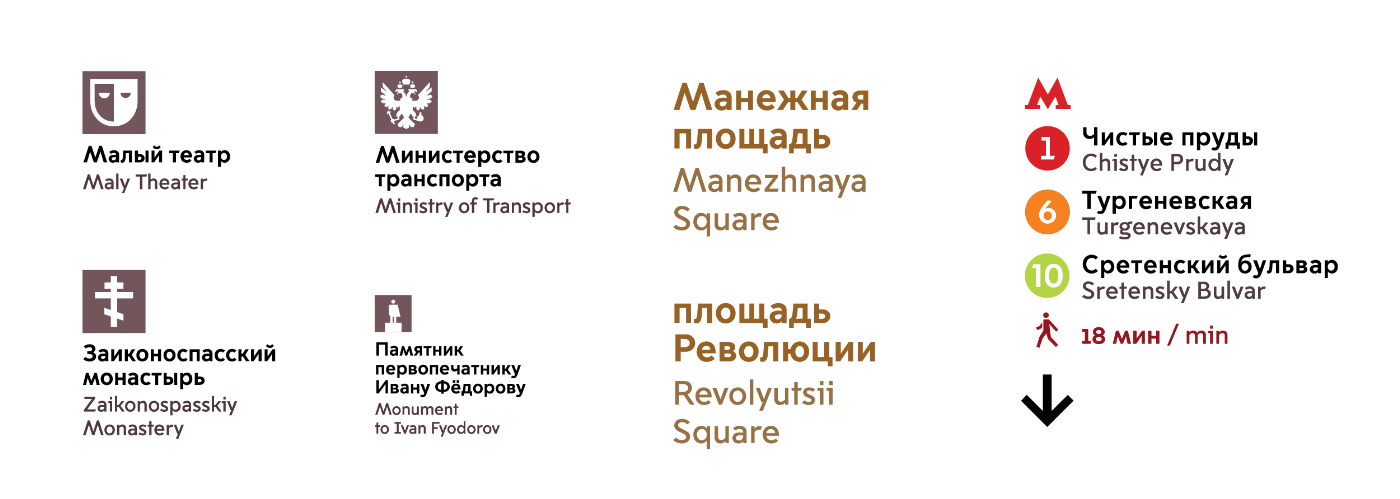
Landmarks
City landmarks that help orient visitors are marked with images and icons. This helps people identify them quicker and find the desired direction. Landmarks are indicated in the navigation system and serve as additional reference points.

Industrial design
A special style has been developed for the design of structures used in the new signage system. Materials were selected to minimise vandalism and that do not require painting to maintain their appearance. The exterior design was inspired by Moscow architecture.


How was the system developed?
The development of a single transport navigation signage system began in 2013 and was ready within a year. The pilot project was launched in the metro: information signs with pedestrian maps and exit numbers appeared at five stations.
At the same time maps for system accessibility appeared at the bike-share stations.
The first bus stop with the new signage was completed in Moscow in 2015. Signage with city maps for pedestrians also began appearing at that time.
The new navigation system began to be used on a wide scale since 2016. Information for the passengers is placed in the metro and at the stops as well as on pedestrian streets.
The first bus stop with the new signage was completed in Moscow in 2015. Signage with city maps for pedestrians also began appearing at that time.
The new navigation system began to be used on a wide scale since 2016. Information for the passengers is placed in the metro and at the stops as well as on pedestrian streets.

When the Magistral bus network was introduced in the city centre, surface transit navigation signage was revised. The maps now specify the type of route with a colour code. The new navigation signage has been introduced at transit hubs since 2017. Such maps are already available at larger hubs like Slavyanskaya Ploshchad.
A booklet for Zaryadye Park was the first printed map made in the same style as the city's graphic system.
It contains the preferable transit routes to the park and maps of the new green area and adjacent streets. The booklets were on hand at metro stations and in Zaryadye Park.
The single navigation signage system will be complete when the components have been installed at all transport and city properties. Since the new system is being introduced gradually, not all the information is available so far.
The single navigation signage system will be complete when the components have been installed at all transport and city properties. Since the new system is being introduced gradually, not all the information is available so far.
How is the new system put into service?
The new signage is placed where passengers and pedestrians need to decide their next step. The design requires analysis of pedestrian patterns, consideration for the context and specific features of each location and a list of questions for which the user can get an answer at this point in the city.
The designers used the experience of other world cities where navigation signage works most successfully. The developers permanently analyse advanced navigation methods to find the best solutions for Moscow.
Adoption of navigation always includes testing and review. Not all of the designs established in world practice are good enough for Moscow. For example, London's practice of using cardinal directions for orientation did not take root in Moscow. Passengers were confused by the "North" and "South" arrows and the use of the names of terminal stations was reintroduced, although initially the idea was to discard them.
The designers used the experience of other world cities where navigation signage works most successfully. The developers permanently analyse advanced navigation methods to find the best solutions for Moscow.
Adoption of navigation always includes testing and review. Not all of the designs established in world practice are good enough for Moscow. For example, London's practice of using cardinal directions for orientation did not take root in Moscow. Passengers were confused by the "North" and "South" arrows and the use of the names of terminal stations was reintroduced, although initially the idea was to discard them.
Who is working on the project?
The Moscow Department for Transport and Road Infrastructure Development is developing the uniform transport navigation signage system. The team comprises graphic and industrial designers, cartographers, analysts, editors and managers. Russian as well as world experts are constantly working on the project.
Any questions?
Point of contact for questions: wayfinding@transport.mos.ru
Residents can notify the city of any navigation errors by writing to: wayfinding@transport.mos.ru.
Anyone can send proposals on city signage improvement to the same address.
Anyone can send proposals on city signage improvement to the same address.