Painted eyes and solemn faces: Muscovites in 19th century photos
(11).jpg)
Invented by French artist Louis Daguerre in the first half of the 19th century, daguerreotype (a photographic technique using chemically treated metal) ushered in the era of photo studios. Read on this piece by Mos.ru and the Mosgortour agency to learn about the first and most popular photo studios in Moscow.
Interior portraits
One of the first photo studios in Moscow was a portrait studio opened in 1840 by engraver Alexei Grekov, an inventor who was the first to start using photographs in printed works. Like many other studios at the time, Grekov’s studio had a modest and simple interior. The only items in the small room with a glass ceiling and windows were a camera and a chair with a head support to help customers stay in the same position for a long time. The first portraits required very long exposure and most people ended up appearing with their eyes closed because it was impossible to not blink for several minutes. A retouch artist was in charge of drawing eyes and removing any inaccuracies as well as painting portraits in watercolour if requested by a customer.

Everything changed within a decade. Now the photo studios could offer painted backgrounds with various scenes such as home interiors, a sea shore or a rural landscape. In the second half of the 19th century, thanks to the technological progress and a growing number of professional photographers, photography became accessible to more people, with photo studios opening in many Russian cities. By that point, they were spacious studios with several rooms and versatile settings. They would be decorated with standard furniture such as desks, chests of drawers, folding screens and backgrounds imitating luxurious interiors. A customer could bring his own furniture if, for example, he wanted to be photographed in his favourite armchair.
In the 1870s, a photo studio would have more than one camera and a whole team of employees, including the owner, photographers and retouch artists. The early photographers called themselves artists and their works art but, as photography became more popular and the number of photographers grew, the services of photo studios lost their artistic status while remaining very much in demand.

Let there be light
Until the late 19th century, photography studios relied on natural lighting, which affected their structure and working hours. They could only be open from 10 am to 3 pm on sunny days.
The earliest photo studios resembled art workshops. A glass ceiling in a small room (40 to 50 sq m) was blocked with sliding screens to control the overhead lighting. Windows and even walls served as additional sources of light. The northern wall, which did not catch the sunlight, was also made of glass and let in smooth, even light while the southern wall had no windows in order to prevent glare on clients’ faces.
When electrical lighting became common in the 1880s, photo studios remained open until the evening. In the early 20th century, photographers began to make wide use of flash. Now customers’ wishes could be fulfilled at any time of the day and in any weather.

The short life of passe-partout
Portrait photography became very fashionable in the second half of the 19th century. Full-length photographs were displayed in the windows of photo studios; portraits were often given as gifts to friends and hung on the walls in people’s homes instead of paintings. A photograph taken in a studio was a positive attached to a passe-partout with the studio’s name, address, the photographer’s name and credentials, and the month when the picture was taken. The 1865 law on printing made it mandatory for all photo studios to print photographs with a passe-partout: “All owners of photographic facilities are hereby notified that they shall not, under penalty of law, release any product of daguerreotype without their photography firm’s details, <…> and any photographs of paintings and engravings shall only be made upon granted permission.”

In 1890, Russian photo studios offered several passe-partout formats: carte-de-visite (62x101 mm), minion (40x78 mm), cabinet (108x166 mm), stereoscopic (88x178 mm), boudoir (135x220 mm), imperial (175x250) and panel (180x320). Carte-de-visite and cabinet portraits were the most popular formats. Carte-de-visite photos were gifted as a keepsake or used as an ID (if an official put a mark on such an ID, it could be as valid as a passport). Cabinet portraits were framed or kept in family albums. Most typically, people posed together for a cabinet portrait because it was rather pricy: six cabinet photos cost four roubles while the same number of carte-de-visite photos cost only 1.5 roubles.
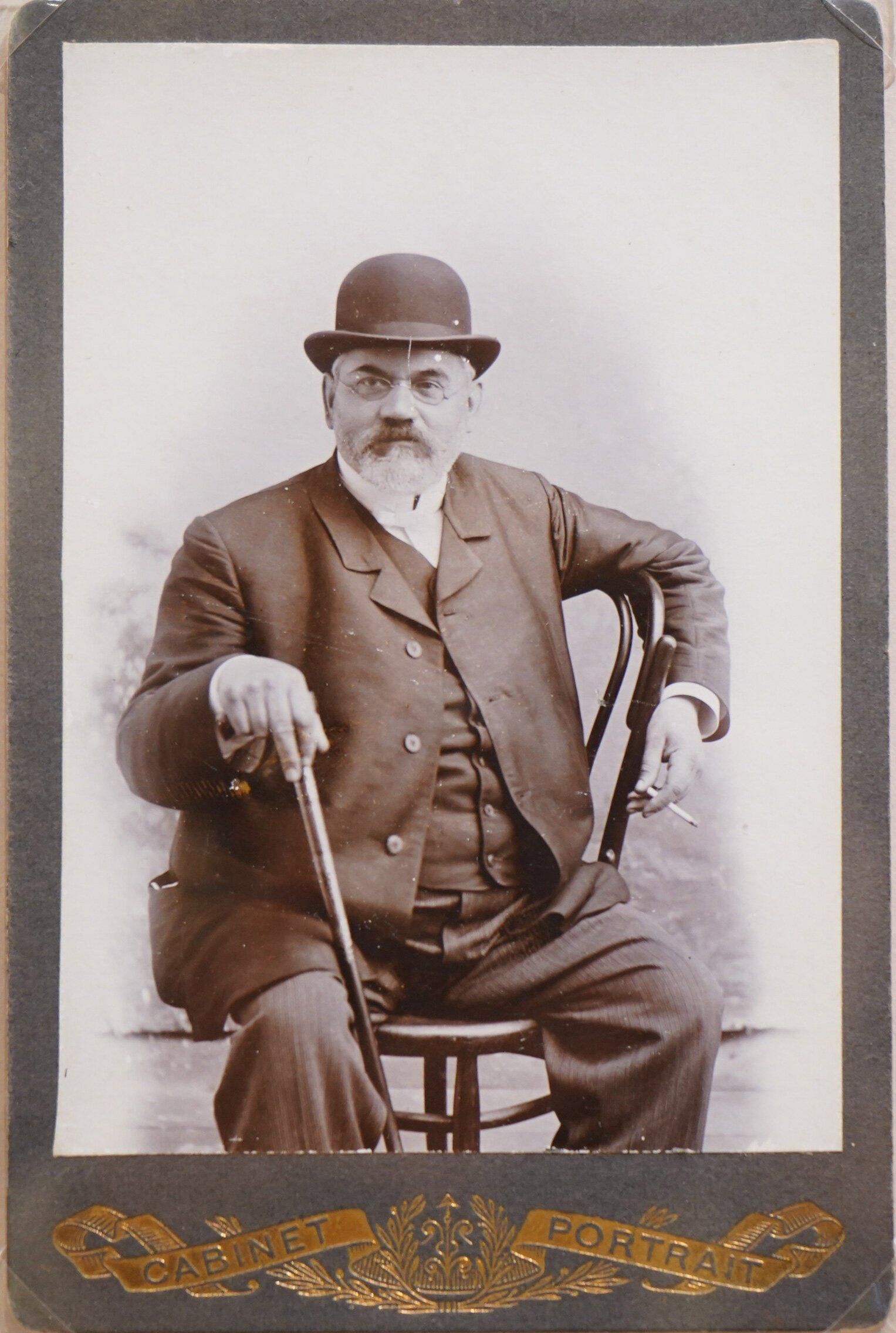
Photo studio owners ordered passe-partouts from Moscow printing firms or shops. Passe-partouts had a similar purpose as company letterheads and were printed on expensive Bristol board, with a beautiful picture on the reverse side. Not every studio could afford it, so some made do with a stamp that included the photographer’s details. If a photo studio ran out of passe-partouts with the required date, a photo would be attached to any other letterhead available so the dates on photographs were not always accurate. In the 1910s, the production of passe-partouts went into decline. Printing firms switched to cheap paper instead of Bristol board. Eventually, the letterheads went out of use.
The word “passe-partout” (also spelled “passepartout”) is French and literally means “something that can pass anywhere.” Its original meaning was “a master key” or “a key to all doors” but these days, it is also used by French speakers to refer to casual attire that suits any occasion. Although the actual era of passe-partout ended in the 20th century, the term can still be heard in picture framing shops and means a cardboard or paper sheet with an opening in the middle that is used to evenly place a picture in a frame that has a bigger size or a different shape.

Moscow photography parlours
In the 1860s, there were 45 photo studios in Moscow and their number continued to grow until the 1917 Revolution when the city already had 190 photography parlours most of which could be found in the Meshchansky District.
Friedrich Moebius’s photography parlour was one of the most popular studios in the city. In 1850, the German photographer opened a shop in Tverskoi Boulevard where he sold portraits and photos of Moscow sights. In 1860, the studio moved to a building in Bolshaya Lubyanka Street and 20 years later, it changed both location and owner. Friedrich handed over the studio, now located in Myasnitskaya Street, to his younger brother Julius who was a photographer at the studio and knew all the ropes. Julius was in charge of the business until 1892 when he sold the photo studio to Adolf Richter but asked the new owner to keep the old name. The Julius Moebius Photography Parlour existed until 1917 and was known not only as one of the first studios in Moscow but also as a studio where Vladimir Lenin had his portrait taken in 1900.

In 1867, Alexander Eichenwald opened a photo studio in Petrovka Street. He was the first Moscow photographer to use electric lighting. Also, in 1876, Eichenwald returned from a trip abroad and started taking boudoir portraits (women’s portraits in piquant settings), which was another thing that none of his colleagues was doing at the time. In 1896, the photo studio was sold but the old name was kept – Eichenwald Artistic Photography.
Otto Renar’s photo studio was another well-known place. The former official photographer to a Serbian king opened his studio in Tverskaya Street in 1881. At first, he only worked at the studio but by 1887, he started taking orders to do photo shoots at theatre plays and weddings, and to take family portraits at his customers’ homes. Otto Renar won multiple gold and silver medals for his works at exhibitions in St Petersburg, Nizhny Novgorod and Moscow. In the early 1890s, Otto Renar and Nikolai Nikolsky opened a shop selling photozincography plates. In 1990, Renar sold both the studio and the shop to his partner on one condition, that the company name would not be changed. The Otto Renar Photography Parlour remained there until 1917.