History on Moscow streets: The remnants of the Time of Troubles
(8).jpg)
National Unity Day in Russia is associated with the distant events from a period called the Time of Troubles. The drama unfolded in and around Moscow, with the throne of the tsars being the target. It was in this area that the main historical battles took place: rulers were ousted, fortresses besieged, and armies defeated one another. Alexander Balakirev, a publishing department specialist at Moscow’s Main Archive Directorate, revealed what the city was like at that period of time and which landmarks have survived in modern Moscow.
Background
It all began in 1598 with the death of the last representative of the Rurik dynasty, tsar Fyodor I who did not have any children. The line of succession was broken, and Boris Godunov, elected by the Zemsky Sobor, an advisory assembly usually convened by the tsar, ascended the throne. His reign saw several lean years, an unprecedented famine, peasants’ flight from their landowners and popular unrest. At the same time, False Dmitry I, Tsarevich Dmitry who allegedly miraculously escaped an assassination, resurfaced in Poland (Rzecz Pospolita) and in 1604, his troops invaded the Moscow state. The Troubles were actually driven by infighting between the boyar and nobility groups with each trying to put its protégé on the throne and seeking support from outside forces.
The situation further deteriorated after Godunov’s death in April 1605. His heir, Fyodor, took over the throne, but was soon overthrown by False Dmitry I, the protégé of Rzecz Pospolita. He did not rule for long either. Less than a year later, Muscovites, outraged by the gross violation of Russian Orthodox customs by the new tsar and his Polish court, rose up and disposed of the impostor.
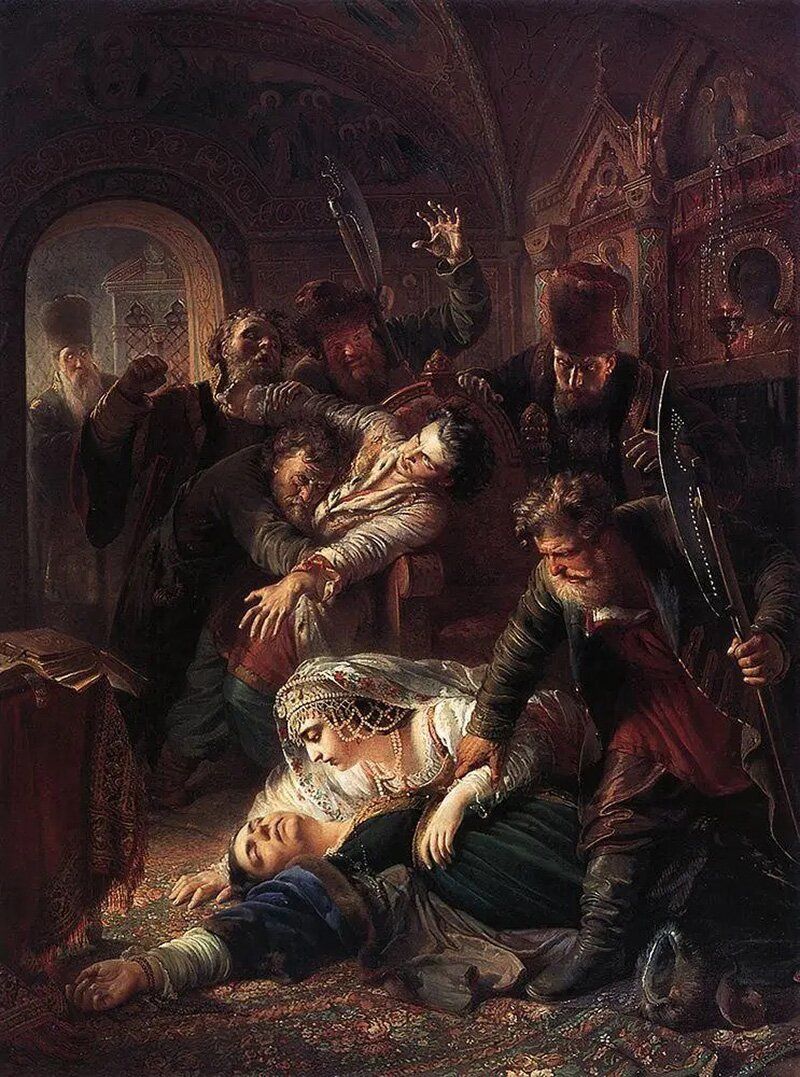
He was replaced on the throne by Vasily IV Shuisky, the ‘boyar tsar.’ Shuisky had to continuously fight Ivan Bolotnikov’s armed units, recapture besieged Moscow several times and reside close to False Dmitry II’s camp in Tushino. Simultaneously with the flight of the ‘Tushino thief,’ Shuisky was overthrown, too, and the Poles entered Moscow in August 1610. Now Patriarch Hermogenes of Moscow called for defending the Orthodox faith and fighting the Polish-Lithuanian invaders. The First Zemstvo Militia was established and marched towards Moscow. The city residents, too, rebelled against the invaders. Moscow was besieged and set on fire, but it was not liberated.
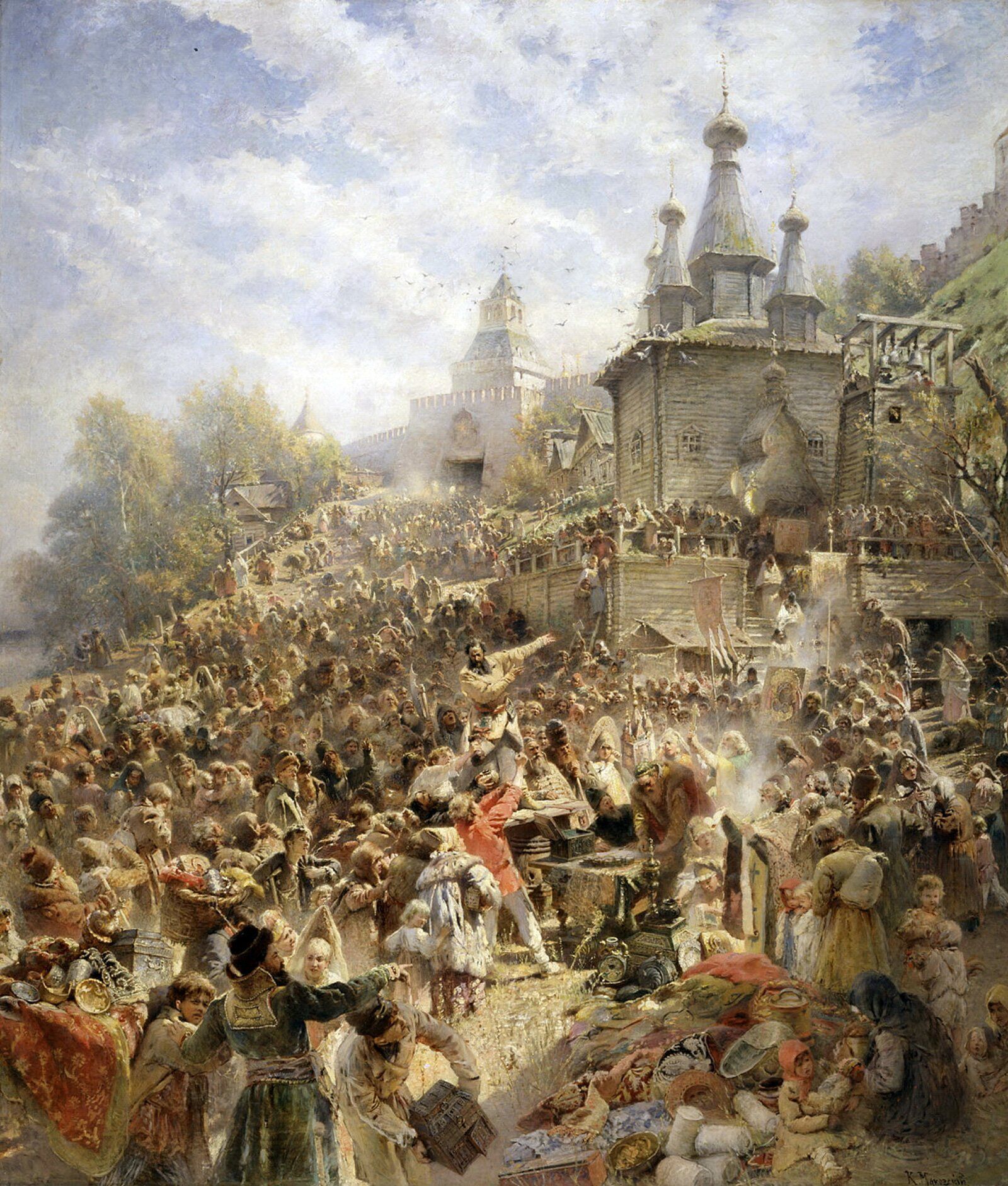
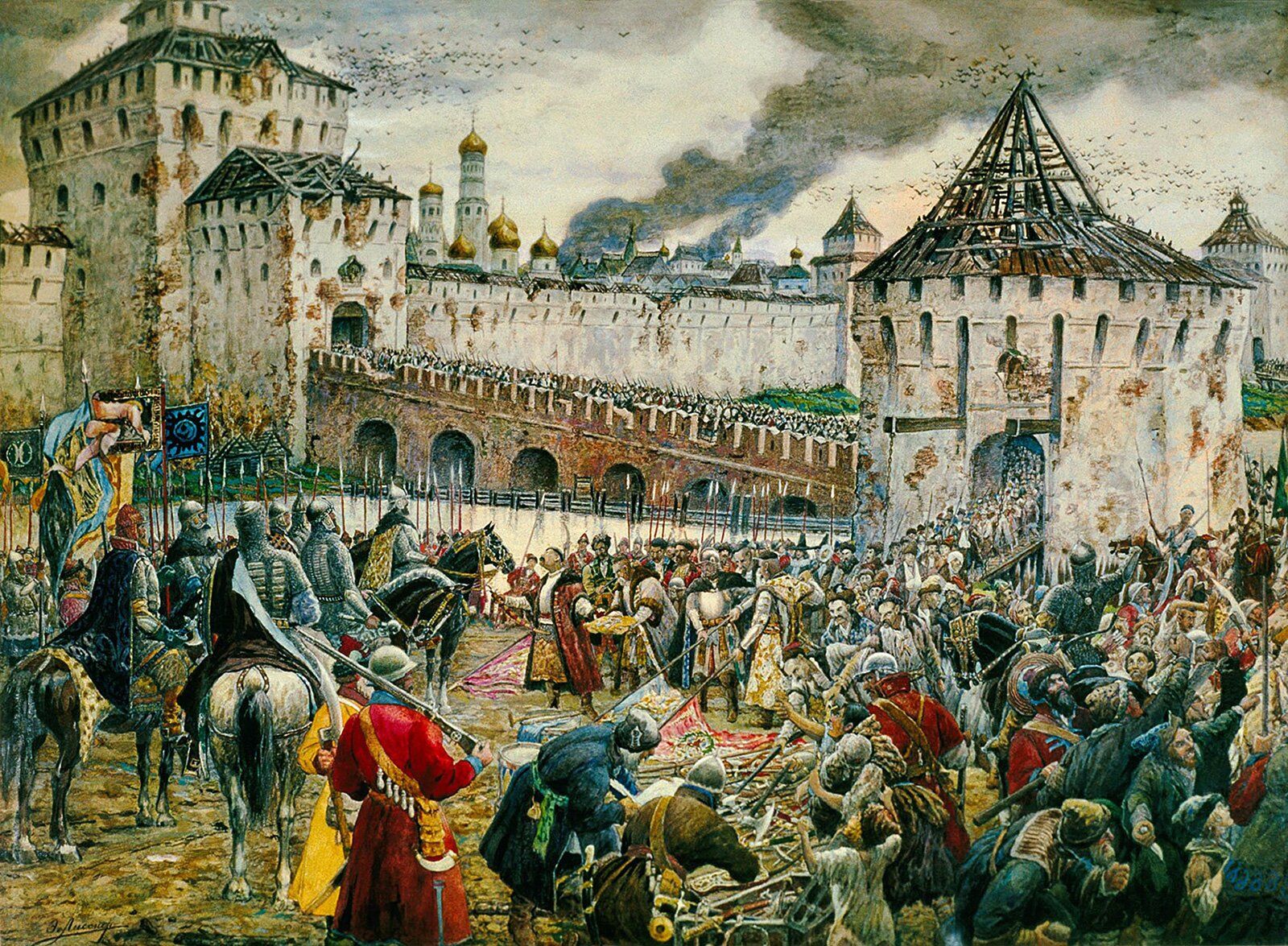
The Second Zemstvo Militia was led by Kuzma Minin and Dmitry Pozharsky. In 1612, they succeeded in uniting all forces, stormed the Kitai-Gorod fortified part of Moscow and forced the Polish troops to surrender. The Zemsky Sobor drew the line under the Time of Troubles in 1613 by electing Mikhail Romanov the new tsar.
Residents of Moscow
During the Time of Troubles, Moscow was the largest city in Europe by both area and population. In the middle of the 16th century, it had about 100,000 people. The later years of devastation reduced the number of residents, but immediately after them, the city population began to grow rapidly and by the year 1600, there were about 80,000 people.
“The condition of the entire Moscow state has improved, and the population is increasing. Completely devastated and ruined by the terrible tyranny of the late Grand Duke Ivan and his officials (and the protracted Livonian War – Alexander Balakirev), now, thanks mainly to the kindness and meekness of Prince Fyodor, and also thanks to the extraordinary abilities of Godunov, Muscovy has begun to recover and grow rich again,” wrote Dutchman Isaac Massa who lived in Moscow at the beginning of the 17th century.
The city population included noble boyars who held high positions, numerous sovereign service members, soldiers, as well as merchants. A significant part of the working population was in bondage to princes, boyars and monasteries and this was not only serfs, but also artisans who worked to order. They lived on their masters’ estates or in separate ‘white’ neighbourhoods (meaning exempt from taxes). Others were formally free traders, craftsmen and farmers who paid taxes.
Ordinary people and most of the nobles lived in wooden houses and estates. Moscow and even its Kremlin have been devastated by fires more than once. Yet, a number of stone structures have survived to this very day, buildings that witnessed the dramatic events of those years. Most of these buildings are inside the Kremlin.

In the Moscow Kremlin
The Kremlin walls we can see now were not built until the end of the 15th century. They were surrounded by ditches at the time, and the towers were not decoratively covered on top.
During the Time of Troubles, the sovereign's palace stood at the peak of the Kremlin Hill. It was built at the end of the 15th century and taken down at the end of the 18th century. Of the entire ensemble, the Faceted Chamber is the only part that has survived to this day.
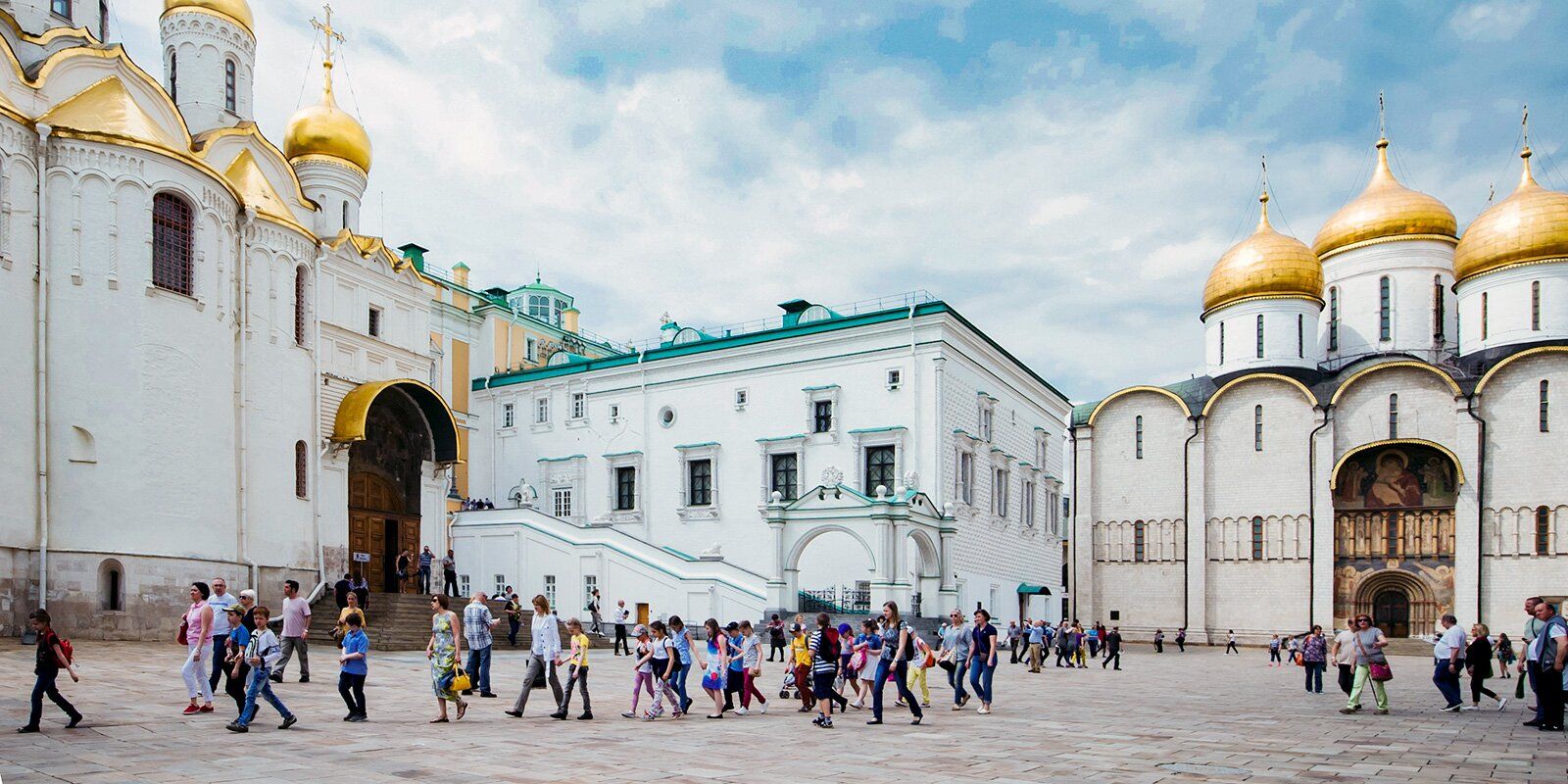
In the early 16th century, they began building a tall bell tower over the Church of St John of the Ladder. This, named after the saint, now known as Ivan the Great, was completed in 1600.
“The Time of Troubles is well remembered by the Annunciation and the Archangel Cathedrals at the Moscow Kremlin, the Church of the Deposition of the Robe and, finally, the Cathedral of the Assumption, the main place of worship at the time. It was the venue of coronations as of the 16th century; the Zemsky Sobor that elected Mikhail Romanov tsar met there in 1613,” Alexander Balakirev says.
The Kremlin also housed the Chudov Monastery with its single-domed Cathedral of the Miracle of the Archangel Michael. The tsars’ children were baptised there. Patriarch Hermogenes, imprisoned by the Poles, perished in the monastery’s dungeons in February 1612. The Chudov Monastery was destroyed in 1929 along with the Ascension (Starodevichy) Convent.

Story of the Chudov Monastery where royal children were baptised
During the reign of Boris Godunov, a two-story stone palace (later a reserve one) was built on the southern side of the Kremlin hill, overlooking the river, the largest building in the country at the time. It was taken down in the 1770s.
The area inside the Kremlin was quite densely developed at that time and housed the estates of the most noble princes and boyars. Later on, they gradually moved outside the Kremlin walls making room for state institutions that were called Prikazy.

One of the most iconic landmarks of the Time of Troubles has hardly changed. This is the Lobnoye Mesto, a platform on Red Square built of white stone in 1599 and with a latticework fence. Initially, it served to announce decrees released by the tsar. During battles and uprisings, the opposing sides’ leaders used it as a rostrum. From there they would address the Muscovites, oftentimes aiming to direct the crowd to storm the tsar’s chambers. During the days of the Zemsky Sobor (in February 1613), Archbishop Theodorite and Boyar Vasily Morozov asked Muscovites from the Lobnoye Mesto who should be elected to the throne. The crowd supported Mikhail Romanov. It was there that the boyars and Cossacks kissed the cross swearing allegiance to the new sovereign who was still in Kostroma.
On the other side
Not long before the Time of Troubles began, under Tsar Fyodor I, important changes occurred in the urban space outside the Kremlin walls. It was then that Moscow began looking much like it is now.
A third line of fortifications was built, another circular belt outside the Kremlin and the Kitai-gorod, the White City walls. Now it has been replaced by the Boulevard Ring. Still further out, a fourth ring of defences was added, an earthen rampart and a ditch almost 15 kilometres long. Subsequently, the Garden Ring replaced those. The area surrounded by those fortifications was called the Earthen city, or Wooden city. It was also nicknamed Skorodom, or ‘Quick Building,’ as it was very quickly built.
There were 50 towers along the White City walls; some of them were gate towers that protected the entrances to Moscow. The names of the local squares still hold memory of those towers such as Nikitskiye, Petrovskiye, Sretenskiye, and Pokrovskiye Vorota (gates). Those are also the sites where many events of the Time of Troubles took place.

In June 1611, Prince Dmitry Trubetskoi and Ataman Ivan Zarutsky, who led the First Militia, deployed their forces with Cossacks from Vorontsovo Polye to Pokrovskiye Gate; the nobleman Prokopy Lyapunov with his Ryazanians covered the Yauzskiye Gate; Prince Fyodor Volkonsky held the Pokrovskiye Gate; and Governor and Prince Alexander Izmailov, the Petrovskiye Gate. This way they blocked the invaders inside Kitai-Gorod, but disagreements among the militia prevented them from liberating the city then. Hetman of Lithuania Jan Karol Chodkiewicz came to the aid of the besieged; he stormed the Novodevichy Convent, entered the White City, but retreated without getting the siege lifted.
In 1612, the Second Militia advance units were stationed at the Petrovskiye Gate, and eventually, they managed to enter Moscow. Later on, the approaching troops stopped at the Nikitskiye and Chertolskiye gates. Dmitry Pozharsky set up his headquarters at the Arbatskiye Gate, and Prince Trubetskoi, in Zamoskvorechye.
Another memorable place where battles were fought in 1612 is the Conception Monastery, founded by Fyodor I in the White City between Ostozhenka Street and the bank of the Moskva River. Here, the militia led by Kuzma Minin repelled Chodkiewicz’s attacks when the Hetman again tried to break into the Kremlin with fresh forces.
.jpg)
On the outskirts
The Tushino village has been known for centuries since the Time of Troubles. In 1608, False Dmitry II built a fortified camp not far from the place, at the confluence of the Moskva and Skhodnya rivers. The remains of its ditches and ramparts were clearly visible even after 250 years and were designated on the Moscow province maps until the second half of the 19th century as the Tushino Camp. The former camp quickly turned into a densely populated area where tens of thousands of people resided.
Some Moscow boyars and nobles went over to the side of the impostor. So they established their own Boyar Duma in Tushino and elected their own patriarch. For almost two years, the country had two capitals, two monarchs and two patriarchs. Messages were sent from Tushino to all cities with calls to join False Dmitry II.
The two opposing armies, one loyal to the Tushino government and the other, to the Moscow one, clashed fiercely during 1608 and up until the summer of 1609. Those battles took place to the northwest of the Khoroshevo village, on the banks of the Skhodnya, Khimki and Khodynka rivers. Shuisky was particularly successful in a battle on the Khodynka River, not far from what is now known as the Khodynskoye field. The Moscow army effectively used something called Gulyai-gorod (‘wandering town’) – a mobile fortification made of wall-sized shields mounted on carts. That defeat hastened the collapse of the Tushino Camp. Some of the boyars and nobles, former supporters of False Dmitry, hurried to return under the leadership of the Moscow Tsar.
.jpg)
Tribute to the victory
A historic battle with the Poles took place on Nikolskaya Street on 1 November (22 October) 1612. After that battle, the Second Militia succeeded in capturing Kitai-Gorod, and just a few days later, they liberated the Kremlin from the invaders. The militiamen brought to Moscow a miracle-working icon; later, Dmitry Pozharsky built the church of the Kazan Icon of the Mother of God. However, in 1632, the wooden church burned down, and was replaced with a stone structure. It was altered and rebuilt over time, but during the Soviet years, the church was taken down. In the early 1990s, it was reconstructed according to surviving documents.

“Along with the famous cathedral in honour of the icon of the Kazan Mother of God on Nikolskaya Street, Prince Dmitry Pozharsky also built the Church of the Intercession of the Virgin on his estate in Medvedkovo to honour the memory of his militia’s last camp they used before entering Moscow on 20 August, 1612. This landmark, fascinating from an architectural point of view, has survived to this very day,” historian Alexander Balakirev explained.

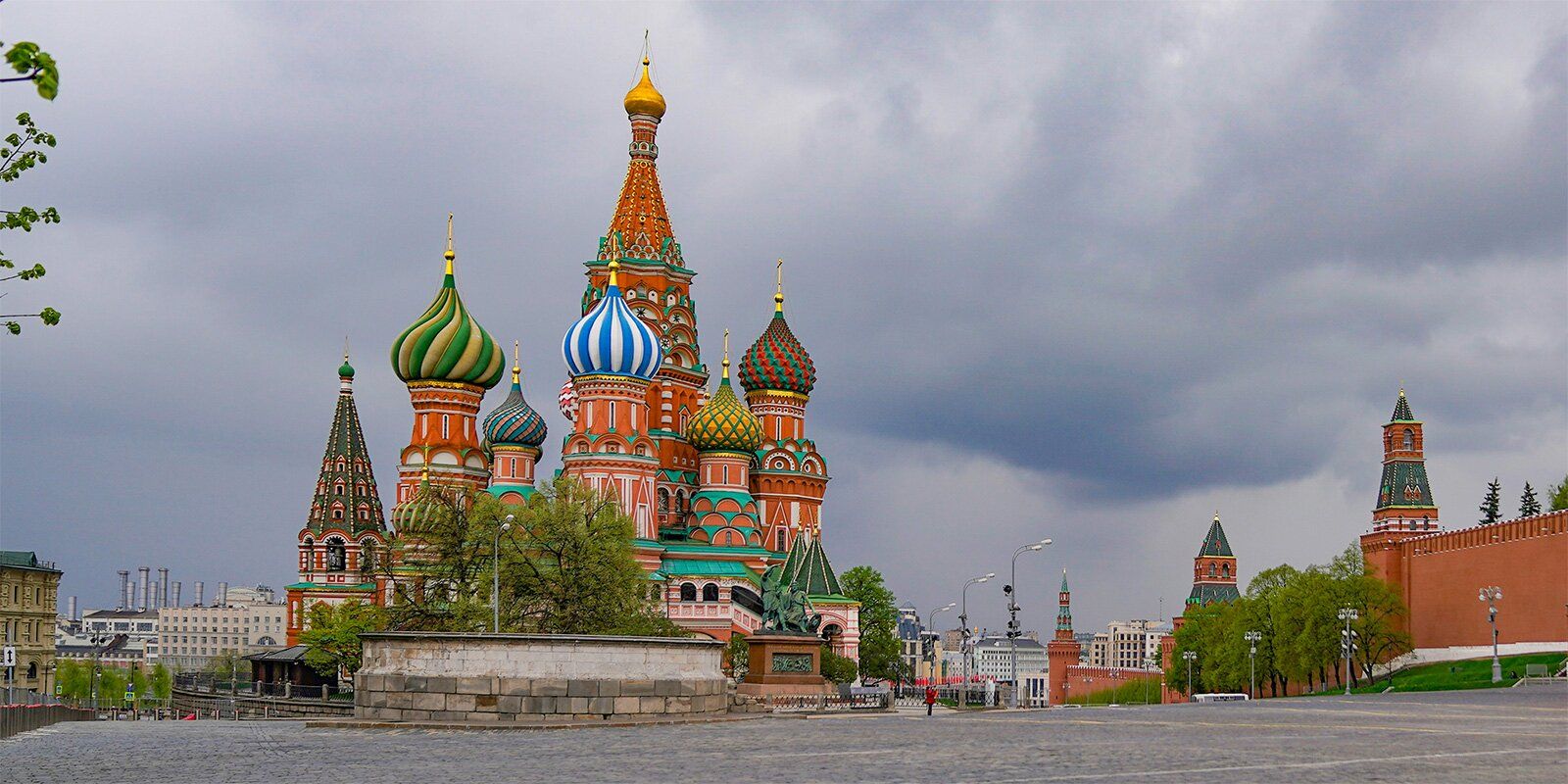
But of course, the best-known landmark is the Minin and Pozharsky monument designed by Ivan Martos. It was unveiled on Red Square in 1818 during a ceremony attended by Emperor Alexander I. A little over a hundred years later, the monument was moved, but it nevertheless remained one of the main symbols of the Russian capital.

An obelisk for the 300th anniversary of the Romanov dynasty, erected in June 1914 in the Alexander Garden, also commemorates the end of the Time of Troubles. In 2013 after being restored it could once again be seen in its original form. Another monument was built not far from it to pay tribute to the hero of those events, Patriarch Hermogenes.

One can explore the history of the Time of Troubles by walking along Moscow streets. But many artefacts are also kept in the capital's museums. For example, the State Historical Museum on Red Square has authentic items from the early 17th century on display such as weapons of that time, coins that were minted by monarchs quickly succeeding one another, portraits of prominent people, books and household items.