Mayakovsky’s tender notes. Favorite items of the Museum curator
.jpg)
A curator is one of the most fascinating professions for a museum employee. It involves knowing how the museum got this item or that, the stories that come with it and the value it brings. Alexandra Menshova, manuscript and document curator at V. Mayakovsky State Museum, chose a few items she considers the crown jewels of their collection, and told us about them.
Rough draft of two verses from A Cloud in Trousers
Mayakovsky started his A Cloud in Trousers poem in the early 1914. The work took six month, with the last corrections made in July. The same month, the poet first met Lilya and Osip Brik, and, after reading the poem to them, asked right away if it was all right if he dedicated it to Lilya.
“Osip was the first to come to his senses. He couldn’t imagine! That was beyond his wildest dreams! The best poetry he’s ever known! He declared Mayakovsky the greatest poet ever, even if he stopped writing right then,” Lilya Brik reminisced. Her husband published the first edition of the poem in 1915.
A photograph of Mayakovsky, with the rough draft of final A Cloud in Trousers poem scribbled on the reverse side in Mayakovsky’s own hand was sent to the Museum anonymously by mail in 1939-1940. The sender didn’t attach any other information or notes. The picture took a unique place in the Museum collection not only thanks to the unusual way it was acquired. The version of the poem finale written on its reverse side has never been published anywhere:
Cocoa sky
Summer smells
Like burnt [strikethrough] singed camel
Steps excited
Like macao players
And the railway station [strikethrough] boulevard’s hat
Has people like plumes
Over [strikethrough] Heaven! Take off your well-worn hat!
I’m coming!
Hollow! The universe rests its shaggy ear
On its paw with ticks of stars.
.jpg)
.jpg)
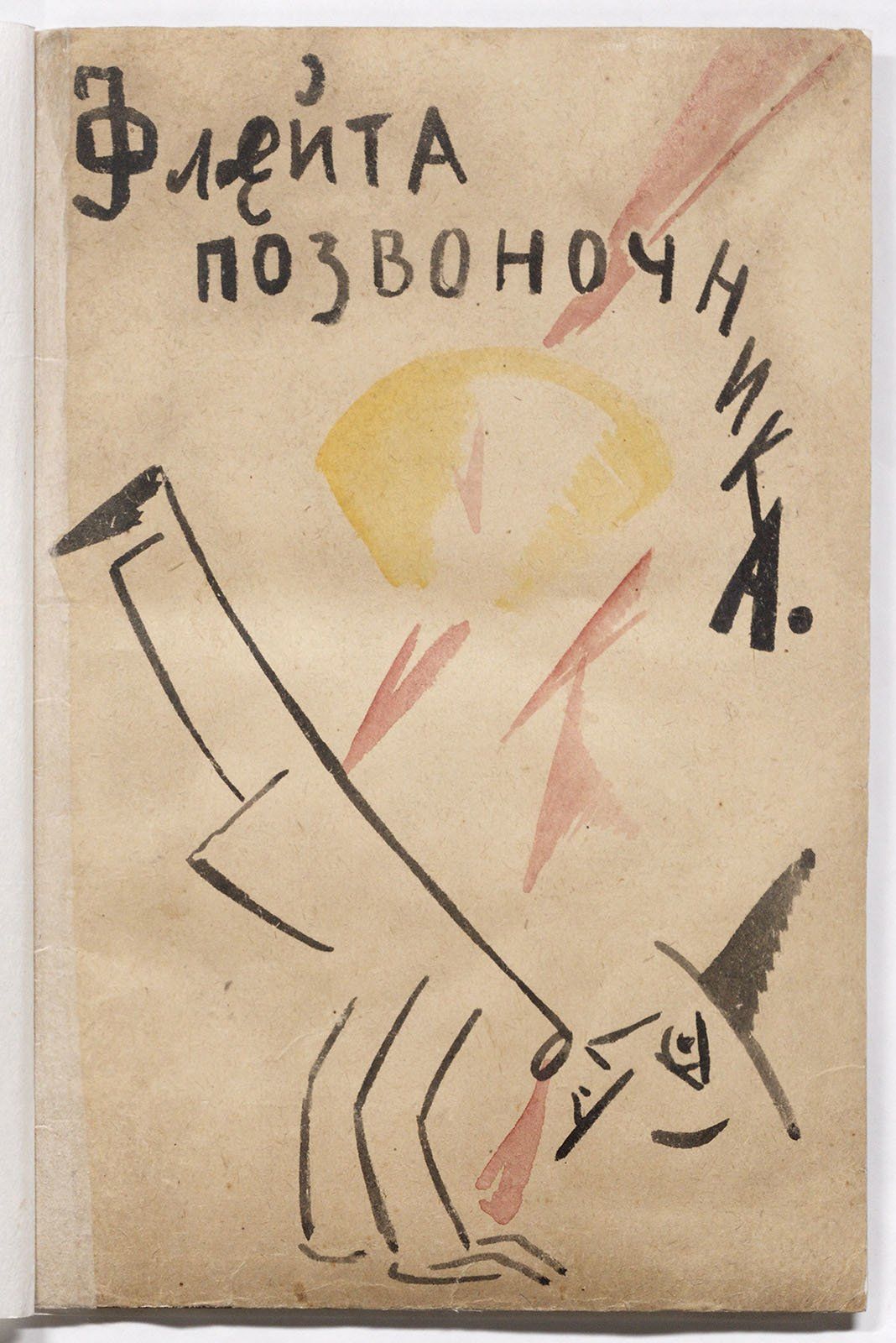
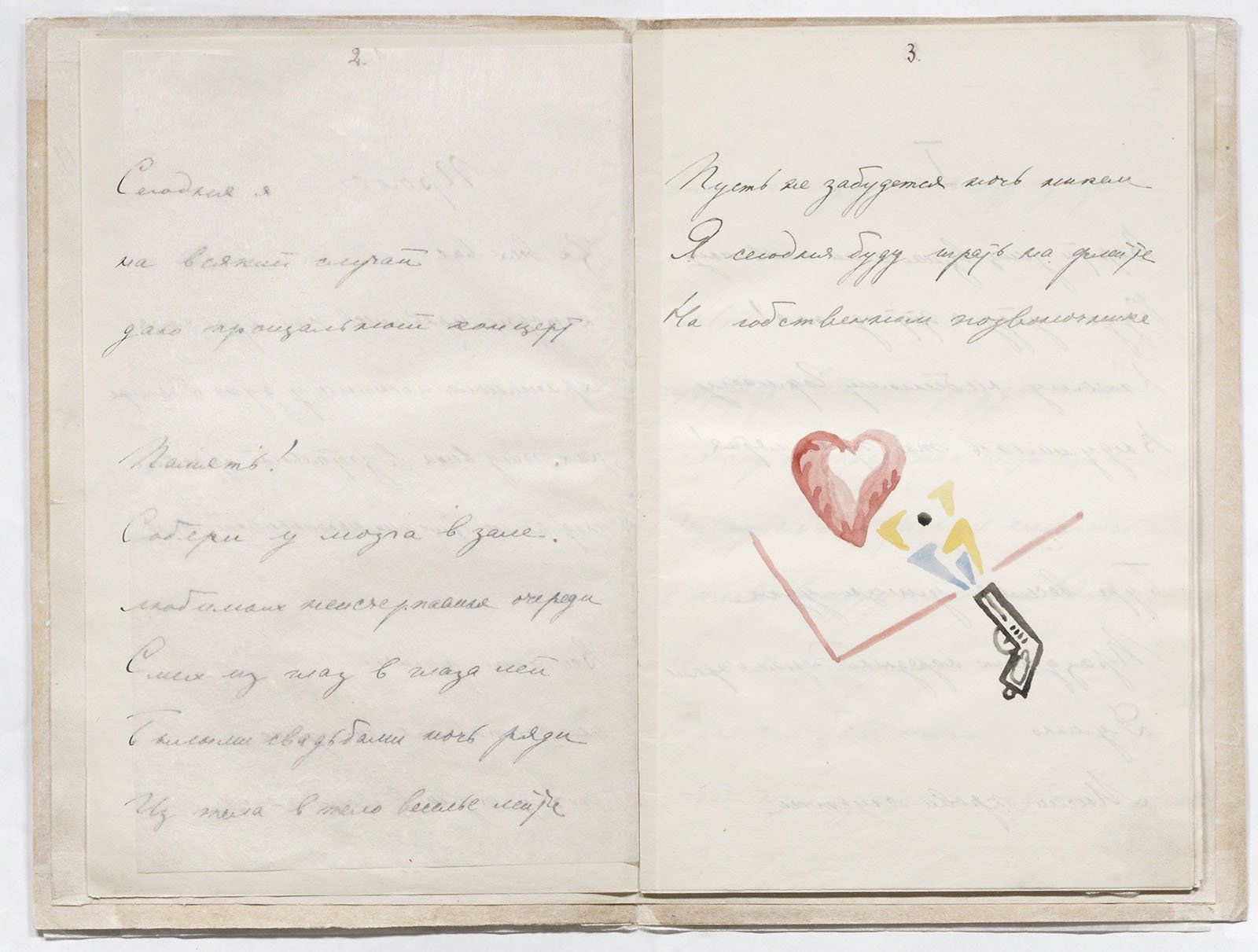
Handwritten manuscript of Backbone Flute
A real crown jewel of the Museum collection is a manuscript of Backbone Flute stored in the manuscript and document department.
In 1919, Mayakovsky followed the Briks from St. Petersburg to Moscow where they rented some space in a communal apartment at Poluektov (now Sechenovsky) Pereulok. They all had to live cramped in one small room, eating poorly due to lack of money and saving themselves from cold by covering the floor and the walls with rugs. That was when Lilya Brik got an idea: she made a handwritten copy of Backbone Flute, the poem Mayakovsky had dedicated to her back in 1915, and gave it to Mayakovsky to add the cover and illustrations. Lilya sold it at the writers’ shop and made some money.
In theb 1980s, a book collector named Zholtkevich found the manuscript in one of the used book stores of Moscow, and bought it. The Museum purchased it from him in 1986.

Mayakovsky’s notes to Lilya Brik
The museum has two of Mayakovsky’s notes addressed to Lilya Brik. Those short messages are tender and very touching. “Kiss my Kitty’s sweet face... Kiss my Kitty with no rhymes,” and “Kiss your mouth, my dear Cachalot,” that’s how the poet talked to his Muse.
The Museum acquired the notes in 1953. They were donated by artist Varvara Stepanova. In 1923, together with her husband Alexander Rodchenko, Mayakovsky was making advertisement banners and other print products.
According to Lilya’s own memoirs, Mayakovsky was writing letters to his Muse and lover even when they had to be separated for a short while. The poet often signed his messages and telegrams as “Puppy” or “Pup”, or “entirely yours”, “your faithful”, “always loving”, “waiting for you until death”. Brik and Mayakovsky had intimate, affectionate nicknames for each other: “Kitty” and “Pup”. The poet often added sketches of puppies or cats to his letters.
.jpg)
.jpg)
To Sergei Yesenin
In the 1920s, everyone in the Soviet Russia knew the names of Yesenin and Mayakovsky. They belonged to different literary schools (imaginism and futurism, respectively), and often critiqued each other, but Mayakovsky repeatedly admitted Yesenin’s contribution to the Russian poetry. After Yesenin’s voyage to America in 1922, the two poets grew closer.
“Recently, Yesenin even started showing some pretty obvious liking for us (the LEF followers): he started approaching Aseev, calling me, sometimes just tried to cross paths. He was becoming slightly pudgy and flabby, but still had that unmistakable Yesenin elegance,” wrote Mayakovsky in his article “How to Make Poetry” in 1926, after Yesenin’s death.
After Yesenin’s passing, Mayakovsky wrote one of his most poignant poems. It was not dedicated to an opponent, or a friend, or a competitors, but to his comrade in literature, a true Poet.
The manuscript was donated to the Museum in 1945 by Vasily Katanyan, Mayakovsky’s biographer, who was married to Lilya Brik at the time. The poet’s Muse was his biographer’s wife starting from 1937 and until the end of her life. From 1958 on, the couple lived at Kutuzovsky Prospekt, next to Maya Plisetskaya and Rodion Shchedrin. Later, in her memoirs, the great dancer mentioned her neighbors, calling them both by the wife’s name, “The Briks have always been amazingly entertaining... By the late 1950s, I think, theirs was the only society parlor remaining in Moscow.”
.jpg)
