Walking underwater: The purpose of under-river tunnels
(11).jpg)
Underground utility mains form intricate mazes beneath Moscow; in a way, they form an underground city. Almost 800 kilometres of tunnels hold communications and power supply cables, heating mains and water supply systems.
Placing utility lines underground has some obvious advantages. Unlike overhead utility lines, they remain unaffected by fluctuating temperatures; also, wind and precipitation cannot damage them. Utility mains in tunnels can usually be repaired in case of problems. Stopping traffic, digging up pavements or roads and resurfacing them again isn’t necessary. Workers can walk the tunnels, or collectors, to maintain utility lines out of the weather. Moscow has unique experience in building underground utility lines. No other country or other Russian regions have such a ramified system of interconnected collectors.
The use of underground conduits for cable communications keeps the city’s architectural appearance cleaner. The city has comprehensive regulations that require placing power lines and communications cables underground, while keeping historical façades free of clutter.
Some tunnels make allow for utility mains beneath the Moskva River. A cable collector, about 20 metres underground at the Presnya substation, is one of them.
A tunnel in a reinforced concrete jacket
The Presnya substation cable collector was built just last year and is a unique part of Moskollektor Co. The company created this facility beneath the riverbed for the first time using a tunnel-boring machine with a diameter of 3.2 metres. Similar though larger tunnel-boring machines are boring metro line tunnels.
“Everything has to be double checked. While operating the tunnel-boring machine, we found this operational power supply cable on this side of the river. The drawings show the main cable line, but some part didn’t match. The contractor’s experience was the only that kept us from damaging the cable. We had to lower tunnel-boring machine’s trajectory and bypassed the utility main,” Moskollektor Director-General Yakov Rotmistrov noted, in describing the project.
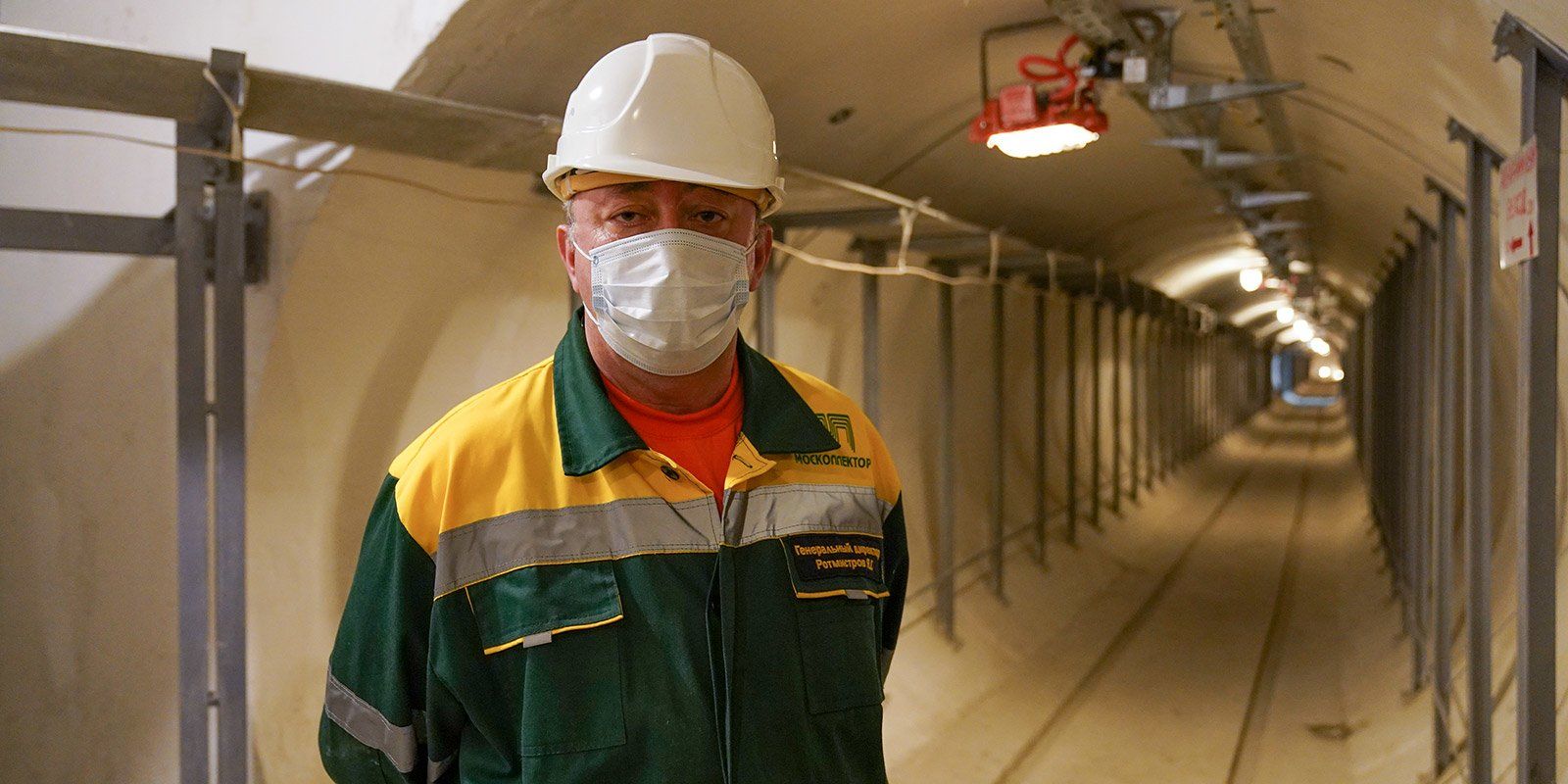
The collector itself was with 30-centimetre blocks. The underwater section was enclosed in a monolithic reinforced concrete jacket 25-30 centimetres thick. A 200-meetre section of the 700-metre collector is located underwater.
“Forms are built inside and are filled with a concrete layer for thicker walls, to keep the water from seeping inside and eroding the walls,” Mr Rotmistrov explained.
The collector, that has a service life of over 50 years, will eventually be upgraded and rebuilt and will serve another 25 years. This upgrade process can be repeated.
An underground gallery
It is cool inside an open collector. The uniformed specialists wearing helmets and gloves go below; safety comes first. They hold the railings and descend four floors down.
The collector actually looks clean and bright inside. It has white sterile looking walls, metal pipes and long tunnels that apparently stretch forever. Trenches and troughs divert unexpected water seepage. It is hard to imagine that only about eight metres separate the riverbed from the top of the collector. Ventilation systems, standard and emergency lamps, fire and security alarms support operations. A pump station can remove drainage waters, if any.
.jpg)
.jpg)
.jpg)
.jpg)
.jpg)
.jpg)
.jpg)
.jpg)
Workers will lay a high-frequency trunk cable line through the tunnel to communicate with the dispatch office; cell phones do not function at these depths underwater and underground. Gas-level meters are also installed in tunnels. Staff members also carry portable gas analysers resembling small boxes with tubes that measure the percent of oxygen and methane.
“This is an essential precaution for your own security while visiting when underground facilities like this occasion. A portable gas analyser shows the concentration of methane and oxygen. Oxygen should be about 19.5 percent and methane not more than 0.5 percent,” Mikhail Savkin, a facility maintenance technician, noted.

A shelf mounted along the length of the tunnel is reserved for one cable line. So far, the shelf remains empty, but up to 33 cable lines (20 kilovolt each) can be installed on it over the next five years. The line will power residential buildings in the Dorogomilovo, Arbat and Presnensky districts, as well as major facilities like the Luzhniki Sports Complex and the Moscow International Business Centre (MIBC). According to Rotmistrov, one cable can power two multi-story blocks of flats. “I have no doubt that this collector will make it possible to distribute and channel these capacities,” he said.
These Moskollektor facilities look like submarines, but the technicians don’t like to compare them. Still, conditions are similar because workers have to spend a lot of time underground and underwater.
“We ask job applicants if they have claustrophobia because not everyone feels comfortable here. Some people can’t take the stress and quit after two days. They say the collectors are not for them,” Sergei Yanin, Head of the REK-2 Management Company, noted.

Underground facility
It is impossible to get inside unnoticed, although there are no cable networks there. Dispatchers, technicians, repairmen and controllers will find an intruder without much trouble.
“We install sensors on every hatch. Sometimes, workers accidentally tear off the sensors, and security guards and the police respond quickly. The shafts are fitted with motion and opening sensors and a two-level security system,” said Andrei Smirnov, a Senior Foreman with the REK-2 Management Company.

The collectors are checked twice a week; it takes about 60 minutes to inspect the entire facility. They also check the collectors daily on the surface.
“We maintain and inspect them, look for defects and tell the foreman. After that, we call techs from a specialised company who either correct malfunctions or make repairs. We also fix some things ourselves,” Mr Savkin added.
The Moskollektor staff services over 792 kilometres of communications collectors with over 7,500 kilometres of power cables, over 21,000 kilometres of communications and special communications lines, plus the hot and cold water distribution pipes. In this context, Moscow’s experience differs from international practice.
“The world isn’t very well developed in terms of collector infrastructure; we have studied this. We have only found one small collector facility in Prague about 90 kilometres long. The collector with its cables and other systems runs under the Vltava River,” Mr Rotmistrov noted.
.jpg)
.jpg)
.jpg)
.jpg)
.jpg)
.jpg)
.jpg)
.jpg)
The city is also upgrading the older facilities. There are plans to modernise 108 kilometres of collectors with heating and water supply pipelines, high-voltage power cables, communications and special communications cables until 2025. New and upgraded underwater and underground collectors keep the capital going. The underground cables make it possible to modernise the entire power grid.
The collector tunnels provide uninterrupted power supply to all city residents and make the power grid highly reliable. Moscow’s collector facilities are the largest in the world.