Honouring cities and naval commanders: Crimea on Moscow's map
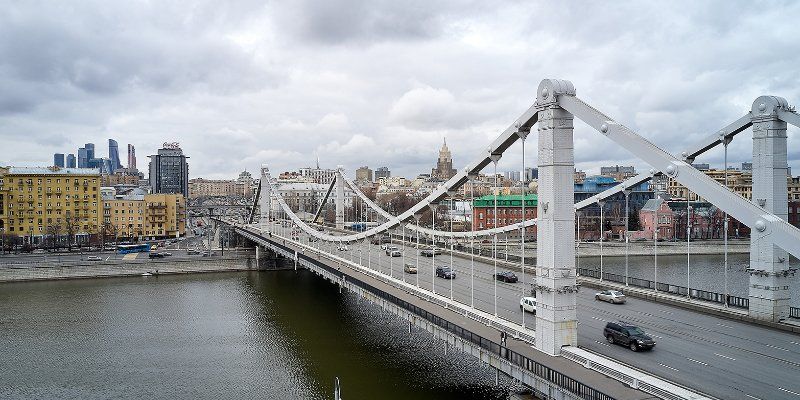
On 18 March, we celebrate the day of reunification of Crimea with Russia. The peninsula became part of Russia in 2014. The history of relations between Moscow and Crimea began much earlier, centuries ago. Moscow's toponymy has its marks, too.
There are some four dozen streets named after Crimean cities, artists, writers, sailors and other renowned Crimean natives. We will tell where in Moscow you can find boulevards and avenues reminding of the Black Sea waves and sunny shores.
Mousetrap, steel and lace — Krymsky Bridge
One of the most popular Moscow locations associated with Crimea is Krymsky Bridge. The first, wooden bridge called Nikolsky, appeared in 1789. In the 1870s, it was replaced with a metal one. For its lace lattice structure, Muscovites called the bridge a mousetrap. At the turn of the 19th–20th centuries, Krymsky Bridge had a horse-drawn tram line later replaced by a regular tram line. In 1936, the bridge was moved 50 m downstream to be finally dismantled later.
Construction of a new, the first suspension bridge in Moscow was completed in 1938. The unique structure was designed by architect Alexander Vlasov. Newspapers of the time called the bridge 'the metal lace of the Moskva River'.
Krymsky bridge connecting Zubovsky Boulevard and Krymsky Val Street is 688 m long and 38.5 m wide. Its suspension structure makes the bridge look light, although the weight of its metal parts reaches 10,000 tons. As a comparison, Eiffel Tower's steel elements weigh a little less.
The roadbed is suspended on 300 m long metal cables made of a special grade of heavy-duty steel, which the Soviet metallurgists smelted for the never-built Palace of Soviets. This grand 415 m high structure was supposed to be the tallest in the world.


Krymsky Bridge owes its name to Krymsky Court, which was located nearby in the 16th–17th centuries. Historians believe that ambassadors and merchants from Crimean Khanate once settled on the territory now occupied by the Central House of Artists.
Moscow guests could reach the other bank through the ford, which was also known as Krymsky ford. The water level here was very low, so one could easily cross Moscow’s main river on a horse.
In the 17th century, Krymsky Court declined to finally disappear later. Only some names have survived until present: on the one bank of the Moskva River, you can find Krymskaya Square, Krymskaya Overpass, Krymsky and Novokrymsky passages. The other bank has Krymsky Val Street, Krymsky Tupik and Krymskaya Embankment.

Jackdaws, crows and artists
Krymskaya Embankment on the right bank of the Moskva River is part of Yakimanka district. Moscow layouts of the mid-19th century have this place as 'Krymskaya dam', 'Krymsky Bridge dam' or 'passage from Krymsky Bridge'. At the time, there were meadows with horses grazing in the area.
The banks were not built up, as the Moskva River occasionally overflew here. According to the memoirs of the writer Mikhail Zagoskin, in the Moskva River of the early 19th century, five-year-old children played in the water reaching their knees, with 'jackdaws and crows walking on the wide shallows'.
Local historian Pyotr Sytin wrote in his book 'History of Moscow Streets' that in the late 19th century, the land known as Krymskaya Embankment today was occupied by the vegetable gardens of the First City Hospital and a merchant Sveshnikova's homestead. In the early 20th century, there was a low-lying coast with small buildings, warehouses and garbage dumps there
In the 1930s, the embankment was cobbled, with the roadway reconstructed in the 1940s. In the 1970s, the building of the State Art Gallery of the USSR (now the Central House of Artists) was built on the embankment.
In 2013, Krymskaya Embankment was reconstructed and pedestrianised, with a wave taken as a central architectural concept. So, you can see waves everywhere, including Vernissage's roofs going like a wave, wave-shaped pedestrian and bike lanes and benches placed around artificial hills. The embankment offers to buy paintings by contemporary artists and relax next to the largest dry fountain in Moscow.

Streets, boulevards and avenues
Following a long tradition, many Moscow streets and districts are named according to their geographical direction. In particular, that is why Volokolamskoye, Kaluzhskoye and Yaroslavskoye highways run from Moscow to different cities and regions of Russia. If you take a closer look at the Moscow map, you will see Simferopolskoye Highway in the south of the city. This highway located in Severnoye Butovo and Yuzhnoye Chertanovo districts is where you can start your journey from Moscow to Crimea.
There are other locations nearby to find reminders of Crimea, such as Zyuzino and Nagorny districts. Almost two dozen names out of the 35 streets located there are associated with this Black Sea peninsula. Here you can stroll through Simferopolsky and Chernomorsky boulevards, take a ride on Sevastopolsky, Balaklavsky and Nakhimovsky avenues.
Most of these names originate from the names of Crimean cities. The only exception is Nakhimovsky Prospekt, as it was named after Admiral Pavel Nakhimov, a hero of Sevastopol's defence. A mosaic panel at Nakhimovsky Prospekt metro station, whose lobbies open to Azovskaya Street, is also dedicated to the memory of the naval commander.
Nakhimovsky Prospekt Station opened on 8 November 1983. The same day, Sevastopolskaya Station of Serpukhovsko-Timiryazevskaya Line saw its first passengers. Its tunnel walls are decorated with dozens of small mosaics featuring Crimea, the Black Sea and the Black Sea fleet. Also, Krymskaya Station, which was launched on 10 September 2016 as part of the Moscow Central Circle, is also named after the peninsula.

Assault of the Isthmus of Perekop during the Civil War and the liberation of Crimea during the Great Patriotic War in 1944 is commemorated in Perekopskaya Street, Bolshaya and Malaya Yushunkaya streets. Sivashskaya Street, located between Simferopolsky Boulevard and Odesskaya Street, was named after the lake located between the Crimean Peninsula and the north coast of the Black and Azov seas. There is a reminder of the famous Artek in Gurzuf, too, a Soviet pioneer camp, which is now an international children's centre, in Artekovskaya Street, Nagorny district.

Most of these names appeared in Moscow in 1965. The list of Crimean toponyms in Moscow was extended in the mid-1990s. The then-new districts of Moscow — Yuzhnoye and Severnoye Butovo — had 1st and 2nd Belogorskaya streets, and Grina Street. The writer (Alexander Grin) created many of his works, including his famous novel 'She Who Runs on the Waves', in Crimea. You will find Koktebelskaya, Feodosiyskaya and Dzhankoiskaya streets here. Starokrymskaya Street, boulevard and the metro station named after the Russian naval commander Fyodor Ushakov are located nearby.
Admirala Lazareva Street reminds of the discoverer of Antarctica and the commander of the Black Sea fleet. Aivazovskogo Street commemorates the marine artist who was born in Feodosia. You will find it between Sevastopolsky Prospekt and Litovsky Boulevard.