Konka horse-drawn trams, Lunar Rovers and electric buses: three centuries' history of Moscow transport
(4).jpg)
Moscow public transport dates from the launch of horse-drawn trams (konka), predecessors of the modern tram, on 7 July 1872. That's why we traditionally celebrate the Moscow Transport Day on the second Saturday of July. But in fact, the history of transport started much earlier.
Lineikas and konkas
Cab drivers appeared in Moscow in the 16th–17th centuries. They were mostly peasants who came to Moscow in late autumn, when there was dead season in villages. They were also called zimniks and kashnicks. By the 18th century, they were already professionals, and the number of cab drivers approached 5,000.
From 1847, cabs were running along fixed routes, so people called them Lineikas. In winter, roofed coaches on sleds travelled from the Kremlin to Kamer-Kollezhsky Val outposts, and in summer, these routes were extended to Ostankino, Sokolniki, Petrovsky Park and Serebryany Bor. Passengers sat on two benches, with their backs to each other, facing pavements. Each Lineika coach had a driver and a conductor.
But not all city residents liked these dusty Lineika coaches, whose horses looked haggard. More affluent Muscovites preferred their own coaches or hired cab drivers, already accounting for 19,000 people in the 2nd half of the 19th century.
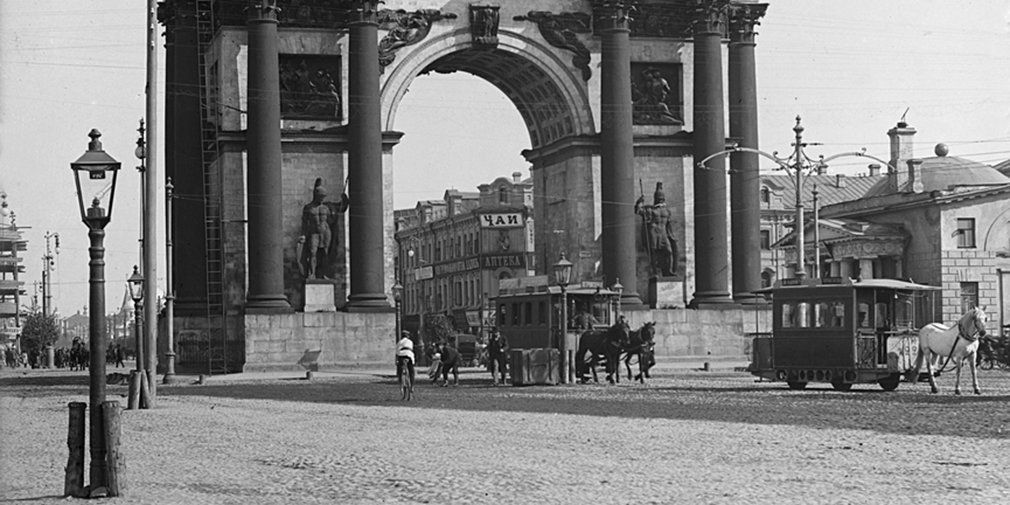
Konka horse-drawn trams, open and closed cars pulled by horses along the tracks, appeared to be more reliable public transport. In 1864, experts submitted the first plan to lay Konka horse-drawn tram lines all over Moscow. However, it was not implemented until 1872, when the Polytechnical Exhibition opened. The first horse-drawn Konka trams started running on 25 June 1872 (7 July Gregorian calendar) along a temporary route between Iverskiye Gates and Tverskaya Zastava, now Belorussky Railway Station.
The city opened the Petrovskaya Line, the first permanent Konka tram line, in 1874. It linked Iverskaya Chapel to Petrovsky Park via Strastnaya Square and Tverskaya Zastava. By November 1891, there were 25 routes in Moscow for a total route length of 88 versts (94 kilometres). This system used about 2,000 horses and about 400 carriages. People were able to ride in all directions using one ticket; this step reduced prices and increased the number of passengers.
There were also bi-level open-top carriages in Moscow. A seat on the top cost only five kopecks, but women were not allowed. It was believed that it would be difficult for ladies to climb the narrow spiral staircase in their puffy skirts without violating the rules of etiquette.
The city used Konka trams until 1912.
.jpg)
Lamp carriages, Annushka and Vityaz trams: Moscow tram evolution
Moscow trams were originally steam-powered and used only to deliver passengers to the outskirts. In 1886, a steam tram ('parovichok') started running from Butyrskaya Zastava to Petrovskaya Agricultural Academy (now Moscow Timiryazev Agricultural Academy). A year later, the second line was opened — from Kaluzhskaya Zastava to Vorobyovy Gory.
"It was the easiest, and, as conductor used to say, the most 'summer house' line in Moscow. A small steam locomotive that looked like a samovar was hidden in an iron box along with its pipe. Only a childish whistle and a couple of steam clubs gave it away. The locomotive was pulling four 'summer house' carriages. In the evenings, they were lit by candles, as there were no electric light in steam trams," wrote Konstantin Paustovsky who worked as a tram conductor for some time.
There were wooden pavilions with benches and occasional trading points arranged for passengers. One of these stops has survived (now it is called Krasnostudenchesky Proyezd).
The first electric tram route was officially opened on 26 March 1899 (7 April Gregorian calendar). Trams started running between Butyrskaya Zastava and Petrovsky Park, and then to Tverskaya Zastava.
Belgian Falkenried and Czech Ringhoffer trams were the first to run Moscow streets. The first carriages were wooden and narrow – only 2.2 m wide. Benches were placed along the carriage. Trams developed speeds up to 25 kph, overtaking horse-drawn cars and private coaches.
In September 1904, first trams started running along the Maryinskaya Line (between Sukharevskaya Square and Maryina Roshcha). Sadovnicheskaya, Bogorodskaya and Vorobyovskaya lines were also later converted to electric traction.
Russian tram carriages were introduced in 1909. The most famous was the lamp car, deriving its name from the lamps on top of the carriage. Before 1912, over 600 F carriages were delivered to Moscow.
.jpg)
After the October Revolution, Moscow residents favoured trams most of all. In 1918, the total length of tram tracks was 323 km, with 475 cars running. In 1922, there were already 13 fixed routes, including the famous A (Annushka) and B (Bublik or Bukashka) routes. A route passed along the Boulevard Ring, and B route passed along Sadovoye Koltso.
In the early 1930s, trams carried a record number of passengers, over two million (with Moscow population being four million people). With the metro launch, flow of passengers decreased, but the competition made the trips more comfortable.
In 1936, first metal carriages, M-38, started to run. They were known as Blue Carriages due to the colour of their body. Canted corners, three doors, soft forward-facing seats and one headlight made the car design state-of-the-art.
In 1940, a traditional tram traffic schedule, 05:30 am till 02:00 am, settled in. It was adhered to even during the Great Patriotic War.
In the late 1940s, the tram system in Moscow reached its maximum length of 560 km. From 1959, the so called 'Czechoslovak Age' started in the history of trams. Tatra-T2 hit Moscow streets first, followed by Tatra-T3, with enhanced comfort carriages, a separate driver's cabin, smooth running and a convenient control system among the advantages.
Today, you may see Tatras in Moscow streets, but they are different now, although they look like their predecessors. The trams have been overhauled and upgraded, and have had their old components replaced.
By 1972, tram lines reached many residential areas, including Tushino, Khoroshevo-Mnyovniki, Chertanovo, Volkhonka town and the 52nd Novogireyevo residential block. The tracks were laid separately from the rest of transport routes, which allowed to increase the speed. Further, tram traffic development slowed down, with some of the tracks removed and paved over.
The revival of tram system in Moscow started in 2011. The total tram line length is now 418 km, with over 800 trams of Mosgortrans State Unitary Enterprise, the chief Moscow land transport operator, running. More than 650,000 people use 45 city routes every day.
With separate tram tracks, and no turnstiles, trams became more reliable and regular transport. 97 percent of all trips are scheduled.
Moscow has been gradually restoring the old and building new lines. In particular, traffic on Tverskaya Zastava Square has resumed. Route No. 7 linked four main railway stations of Moscow, namely Belorussky, Kazansky, Leningradsky and Yaroslavsky railway stationsNew lines are expected to appear in Biryulyovo Zapadnoye and Biryulyovo Vostochoye, with lines extended to the Moscow Ring Road passing along Entuziastov Highway.
Old carriages have been replaced by Vityaz-Moskva trams, specially designed for Moscow. Since 2017, Moscow has acquired about 270 trams of this type, and by the end of 2019, their number is to reach 300 units. Further, it is expected to buy about 100 trams annually. This will allow to completely upgrade the tram fleet by 2024.
Buses and shuttles: a convenient tandem
Private buses appeared in Moscow long before the October Revolution, but the authorities deliberately suspended the development of this type of transport, as they were reluctant to create extra competition for trams.
It was not before 1924 that the first city bus route launched. Eight British Leyland buses linked Kalanchyovskaya Square with Aleksandrovsky (now Belarussky) Railway Station. The following year, buses shuttled between Kursky and Bryansky (now Kievsky) railway stations, Vindavsky and Saratovsky railway stations, they used to carry passengers to Serebryany Bor, Novodevichy Convent, Karacharovo, Lefortovo and Maryina Roshcha.
In 1927, the USSR established its own bus production with imported parts used. 'Yashki' hit the streets (Ya-3 and Ya-6), with ZIS models running in the early 1930's. The body of Soviet models was made of metal-coated wood.

Bus traffic surged in the 1950s and 1960s to keep up with the city’s fast expansion and the construction of new residential areas. By 1950, there were 50 routes (24 urban and 26 suburban); this increased to 154 (88 and 66, respectively) by 1960 and to 256 (226 and 30) in 1970.
In 1961, the numbering of routes changed: urban routes were numbered 1 to 299, and suburban routes got numbers 500 to 599. At the same time, production moved to the Likino Bus Plant in the Moscow region, where further the first LiAZ buses were produced. That is where legendary 'Lunar Rovers' (LiAZ-677) were produced in 1967, which were running in Moscow streets for about 40 years.
In the 1980s, buses accounted for one-third of passenger traffic, with about 3.3 million people using them daily (with the population being 8.5 million at that time). Bus routes were more than 6,000 km long. LiAZ buses were running along less loaded routes, with Ikarus buses transporting most of the passenger flow.

In the next two decades, buses have been mostly displaced by shuttles.
First shuttles appeared in Moscow in the 1930s. At that time, the city operated ZIS-101 and ZIS-110 passenger cars that linked railway stations, large shops and parks. Shuttles delivered visitors from the All-Union Agricultural Exhibition. In 1964, the city had 18 daytime and ten late-night shuttle lines. The fleet consisted of RAF shuttle buses.
The number of local shuttles grew year after year, with its peak in the early 2000s. But the quality was wanting. So the city moved to overhaul the passenger transport sector in 2015-2016. Since then, a catch phrase 'Pass the fare' is a thing of the past, as modern transport operates without conductors and turnstiles, and drivers of private carriers no longer have to count the change during stops. Troika travel card, low-floor transport, air conditioning and ramps for passengers with limited mobility, free Wi-Fi have become part of the life of Muscovites, making trips fast and comfortable.
There are over 7,000 Mosgortrans buses and private carriers in Moscow today. The transport fleet is constantly updating. Since the beginning of the year, Mosgortrans has received 500 new buses running along over 900 city routes. Semi-express buses moving on bus lanes are especially popular.
In addition, since October 2016, Moscow has a Magistral, a new surface transport network. Now buses link remote areas with the city centre, thus reducing the number of transfers for passengers.
Trolleybuses
Trolleybus service was initiated in Moscow on 15 November 1933. The first route linked Tverskaya Zastava with the Belt Railway Bridge in the village of Pokrovskoye-Streshnevo. A year later, the second route was opened through Arbat Street to Dorogomilovskaya Zastava. Two years later, B route linked Kudrinskaya Square and Kursky Railway Station.
The first navy-blue trolleybuses had a metal-coated wooden frame, 37 soft seats, nickel-coated railings and luggage nets. Front doors were opened manually by the driver, with the conductor opening the rear doors. The trolleybuses’ heaters were turned on in cold weather, a new advantage.
By the summer of 1941, the city had 17 trolleybus routes, but this system reached its heyday between 1960 and 1972.
In 2010-2018, about 600 trolleybuses were purchased to upgrade the fleet.

Electric buses: new urban transport
Last year, electric buses hit Moscow streets. Since September 2018, they have carried more than 7 million passengers.
Electric buses are environmentally friendly, they do not make noise and charge at the terminals, which makes them more mobile than trolleybuses. There are climate control systems, satellite navigation, USB ports to charge mobile devices, information media screens and free Wi-Fi. An electric bus can carry 85 passengers.
Today, over 140 electric buses are running along nine routes. The route network of this innovative transport will keep expanding, with 300 electric buses to arrive in Moscow by the end of the year.
Metro: where its history started
In the last century, the metro boosted the development of public transport. The first metro line opened on 15 May 1935, linking Sokolniki and Park Kultury stations, with a branch to Smolenskaya station. Before the Great Patriotic War, 9 more stations were commissioned. Metro construction did not suspend during the hard war times, which translated into the decoration of metro stations.
Metro construction had no delays. But now, the progress rate of metro building is unprecedented. Builders use the most advanced technology, set records for the pace of new stations' commissioning. Since 2010, 83 new stations have been opened. Radial branches extend beyond the Moscow Ring Road, Big Circle Line is under construction, an above-ground metro is developing.
By 2023, dozens more stations are to open. You will get to Vnukovo Airport using Kalininsko-Solntsevskaya line, and to get to Severny, you will take Lyublinsko-Dmitrovskaya line. Besides, work on Big Circle Line's construction is to be completed. The main goal is to make sure that at least 90 percent of Muscovites live within walking distance of metro stations.

Moscow Central Circle and Moscow Central Diameters: above-ground metro under development
Work is underway to include railway transport in the urban transport network. Launch of the Moscow Central Circle (MCC) has initiated this process.
Opened on 10 September 2016, the above-ground metro circle immediately gained popularity. Daily, Lastochka trains carry more than half a million passengers on the MCC. Convenient transfers save 9 to 16 minutes of travel time. Transfer from MCC to 23 stations of radial metro lines, 9 railway platforms and surface transport.
The next step is to develop Moscow Central Diameters. They will connect different railway lines and allow crossing Moscow in just 40 minutes.
The first two diameters, MCD-1 Odintsovo to Lobnya and MCD-2 Nakhabino to Podolsk, are to be opened in late 2019 or early 2020. Three more diameters are expected to launch: MCD-3 Zelenograd — Ramenskoye, MCD-4 Aprelevka — Zheleznodorozhny, MCD-5 Pushkino — Domodedovo. During the design phase, routes and their parameters may be changed.
Ivolga trains are to run according to the metro schedule from 05:30 am till 01:00 am. During rush hours, Ivolga trains will arrive to the platform every 5 or 6 minutes. Carriages will have air conditioning and air disinfection systems, mounts for bicycles, Wi-Fi hot spots and USB charging sockets.
.jpg)
.jpg)
.jpg)
.jpg)
.jpg)
.jpg)
.jpg)
.jpg)
Taxicabs and car sharing: reasonable competition
In September 1907, Golos Moskvy (Voice of Moscow) journalists spotted the first local taxicab, a US-made Oldsmobile, with a sign saying: “Cabman, prices negotiable.”
By 1930, the city had two taxicab pools, with the number of taxicabs reaching 18,000-19,000 in the 1980's. But legal taxicabs almost vanished throughout the 1990s, and private drivers took over. The situation changed due to strict control of transportation and Moscow government support of taxi operators.
Today, Moscow boasts some of the newest taxicabs in Europe, with average age of less than three years. Daily, Muscovites make about 760,000 taxi rides. One 10.6-kilometre trip costs an average of RUB 449 and lasts 20 minutes. Average waiting times are down to five minutes, one of the best results in Europe.
(1).jpg)
Alternatively, the Moscow Car Sharing project was launched in 2015, offering short-time car rent. The fleet of car sharing services in Moscow has mushroomed to 17,000 vehicles and will further grow to some 30,000 by the end of the year.
Almost a million people rent cars on a regular basis, with 54 percent of them using the service several times a week and 21 percent renting cars at least once a month. 84 percent of users rent a car to get to work or use it for short trips.
You pay nothing for gasoline. Besides, you may park in the city for free.
