Meteo-devil and letters on cloth. Curator of the GULAG History Museum speaks of major exhibits
.jpg)
Each piece of the State GULAG History Museum collection is a reminder of the fate of people who lived in a country that no longer exists. People who lived in the most difficult and terrible times of the country. Olga Brovkina, a research scientist of the museum archival storage sector, chose five things with a human’s story and the history of the whole country behind.
Mos.ru and Mosgostur's collaborative article.
A piece of laundry soap
Adam Grosblat and his fiancée, Eugenia Aizenshtat, moved to the USSR from Poland in 1924, inspired by the idea of revolution. In Moscow, they got married, and in 1926 became parents of little Irina. Adam worked at the Moscow Power Plant as a design engineer. In 1937, he was arrested after a delation 'about sabotage and disruption of the Stakhanovism at the plant.' Eugenia Grosblat was kept under observation. Having broken down under the pressure and fearing for her relatives’ fate, the woman came to Lubyanka to get arrested.
Coincidentally, the spouses found themselves in the same transportation of prisoners. During the change of wagons on the platform, Eugenia heard a loud cry: 'Zhenya!' She turned around and saw her husband. They were placed in different wagons, but the woman still managed to get the guards to hand over to Adam a knitted sweater, a pillow and a piece of laundry soap, which she divided in half. But he did not take the last things from his wife; he returned everything to her, having left only a piece of soap. Irina Somova, daughter of Adam and Eugenia Grosblat, brought it to the museum.
Spouses Grosblat were fully exonerated in 1955 due to a lack of evidence.

Letters on cloth
The Dragunskys family lived in Rostov-on-Don. Bella was a housewife and brought up four children - two sons and two daughters. In 1937, her husband Isaac was arrested, and a year later she was put under arrest too.
After parents’ arrest, their children lived with the family friends. One evening, a woman came to them with a bundle of cloth. She reported that their mother was sent to Kazakhstan, and the train in which she travelled was in Bataysk. It turned out later that Bella Dragunskaya wrote messages for her children on scraps of cloth and threw them out of the train window. A woman passing through picked up the letters and brought them to the indicated address.
The Dragunskys sisters went to Bataysk to meet with their mother. On the second day, they reached the designated place. One of the sisters, Maya Dragunskaya, later remembered this moment as one of the strongest in her life: it was a real happiness to see their mother on the departing train.
Bella Dragunskaya was exonerated in 1956.
.jpg)
A little book
This book is a story with caricature sketches and ironic couplets about meteo-devil, which overcomes daily difficulties. Olga Ranitskaya, who was serving a sentence in Karlag, kept this diary from 1941 to 1943. The woman worked in the camp at the meteorological station. Out of prison, she had a son, Sasha, for whom she created a cheerful meteo-devil and composed stories about his adventures.
In 1943, Ranitskaya received news that her son had died. Olga had nobody to pass her diary to, so she left it to her campmate. The stories by Ranitskaya have been published: in 2017, the State GULAG History Museum published the book 'Meteo-Devil. Work and Days'. Unfortunately, all author’s photos have been lost.
Olga Ranitskaya was exonerated in 1956.


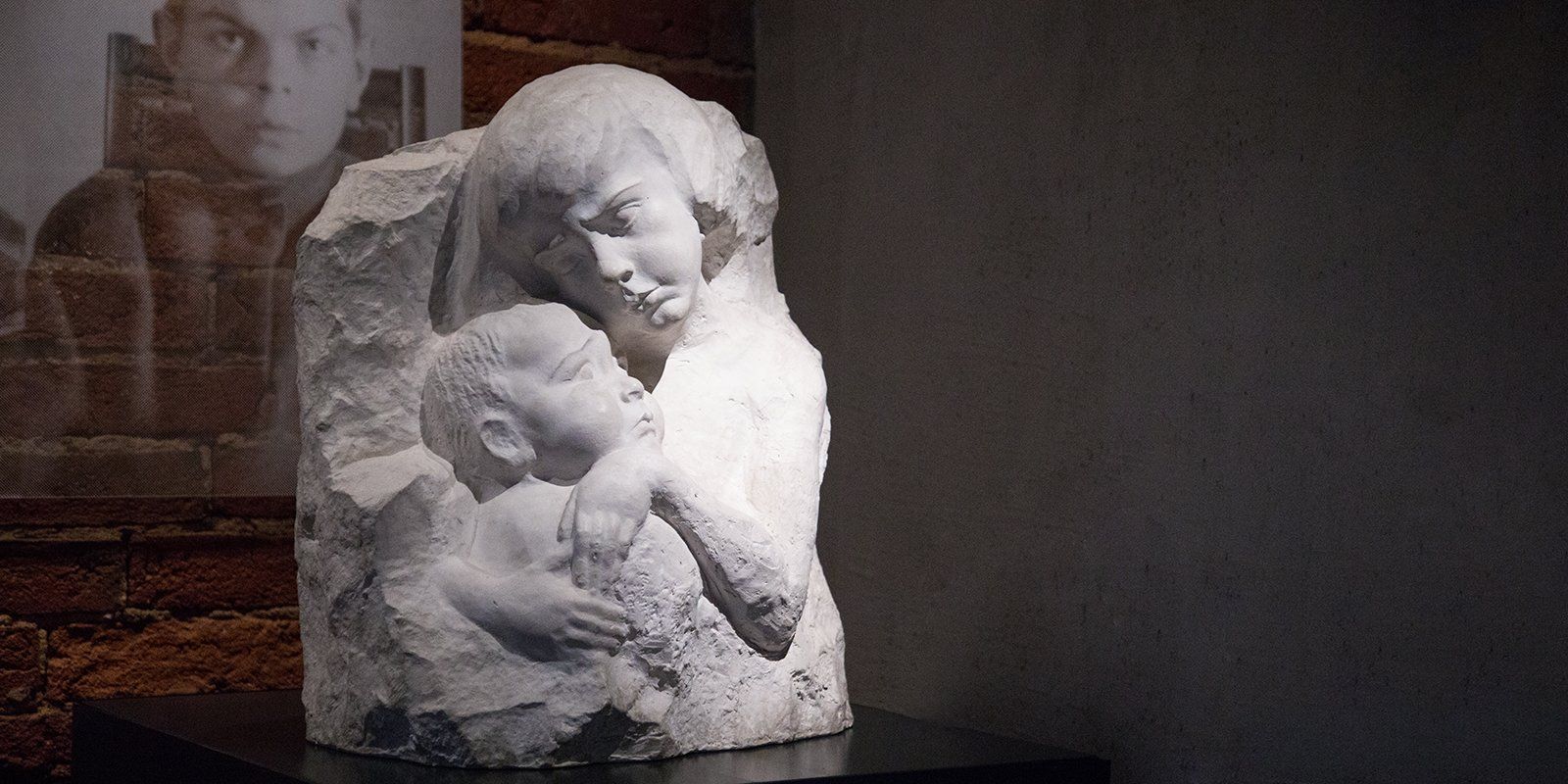
Sculpture of George Lavrov
Georgy Lavrov was a Soviet sculptor, author of the composition 'Thank You, Comrade Stalin, for Our Happy Childhood'. The artist made this work according to photograph of 1937 with the girl Gelya Markizova giving flowers to Joseph Stalin. A year later, her father was arrested as an enemy of the people, so in all the images with the leader, Gelya was replaced with another child - a cotton picker. And Lavrov was arrested in 1938 and sent to Kolyma.
Having returned from the camp, the artist continued to create new works. And rethink the old ones. In 1962, he renamed the sculptural composition 'Echo of War', created in 1934. The new name was pretty much bitter than the old one – 'The children of illegally repressed parents. Orphans of the regime'. The sculptor’s widow has passed the sculpture with two names to the State GULAG History Museum.
George Lavrov was fully exonerated in 1954.
The postcards
Aleksandr Minovich Chernoutsan was born in the family of a priest and followed in his father's footsteps. For the first time, archpriest Chernoutsan was arrested in 1925 and sent first to exile, and later to Solovki, where he served his sentence from 1928 to 1931.
He sent postcards to his son Petya from the camp; they were filled with warm words and details about camp life. The family never reunited: first Peter died, then his second son Nikolay and his wife. Only the daughter Tatyana survived.
After Solovki, Aleksandr Minovich was exiled to the Udmurt ASSR, then to Arzamas. There he was arrested for participation in 'church and fascist sabotage terrorist organization' and was sentenced to be shot.
Aleksandr Chernoutsan was exonerated posthumously in 1989. His granddaughter donated his postcards from the Solovki camp to the museum.
