Five centuries of Russian history: Legendary church where Alexander Pushkin got married
The origin of the name: Why is it Great Ascension?
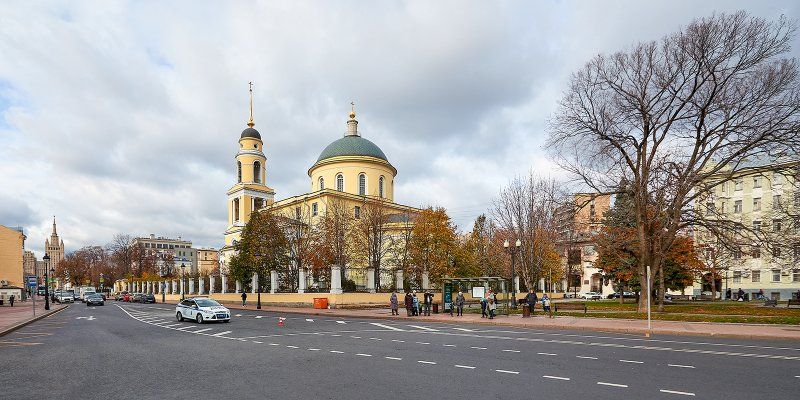
The Church of the Ascension in Storozhi, or the Church of the Great Ascension, is one of the best-known churches in Moscow. It was the place where Alexander Pushkin and Natalya Goncharova got married. The word “great” relates to the nearby 17th-century church located opposite the Conservatoire at 18 Bolshaya Nikitskaya Street. The church is called the Smaller Ascension. This building has also been recently renovated.
The Church of the Great Ascension at 36/1 Bolshaya Nikitskaya Street is named after the resurrection of Christ followed by his ascension into heaven.
The first church to be built where the Church of the Great Ascension stands today was built in the mid-16th century behind the wall of the White City, which was then outside the boundary of Moscow. During the 17th century it was close by to the palace of Natalya Naryshkina, the wife of Tsar Alexei Mikhailovich and the mother of Peter the Great. It was her who ordered the wooden church be replaced with a stone building, the Church of the Ascension, which was built in 1685.
Five stupendous architects: Who built the church?
A century ago, Prince Grigory Potemkin, the commander of the Preobrazhensky Guards, decided to build a new church, close to the old one.
The construction began in 1798, a year before Alexander Pushkin was born, and came to an end in 1836, a year before Pushkin’s death. It took 12 more years to finish the interior murals.
The project’s first architect was Vasily Bazhenov. Later on, the job was given over to Matvei Kazakov famous for his architectural legacy in Moscow. Among his works are the Moscow Kremlin Senate, the Tsaritsyno Palace, the Petrov Palace and the Governor-General’s House on Tverskaya Street which currently houses City Hall.

The church was severely damaged in the fire of 1812, and it had to be rebuilt almost from scratch. The reconstruction work was led by Fyodor Shestakov famous for his Empire and Classicism style creations. For instance, he designed and built the wall of the Moscow Kremlin’s Alexander Garden, as well as the refectory of the Church of the Nativity of St John the Baptist on Presnya, the bell tower and refectory of the Church of St Nicolas in Tolmachi. After Shestakov’s death in 1836, the restoration of the church was continued by Yevgraf Tyurin. He built the Cathedral of the Epiphany at Yelokhovo, the Church of St Tatiana at Lomonosov Moscow State University and also rebuilt the Moscow Kremlin Arsenal. Another architect engaged in the reconstruction of the Church of the Great Ascension was Osip (Joseph) Bové, the architect of the Manezh, the Bolshoi Theatre, Alexander Garden and the Triumphal Arch.
St Nicolas side altar where Pushkin was married
By 1831 the old church was disassembled and the services were held at the new church. The Goncharov family, who lived nearby, often went to this church. On 18 February 1831, Natalya Goncharova and Alexander Pushkin, a valet de chamber, walked down the St Nicolas side altar of the still uncompleted church. Once a year memorial services in honour of Pushkin are held at the Church of the Great Ascension.
After the construction came to an end in 1836, a decision was made not to add a new belfry as was originally planned as there was a tent-shaped one that remained from the previous church. This was functional up until 1937. On 19 September 1848, Metropolitan Filaret of Moscow consecrated the new church.


The Soviet era: Chaliapin’s voice and high-voltage lab
During the 20th century the church witnessed the Revolution. In October 1917 there were street clashes in Moscow on Tverskoi Boulevard, Arbat Street and also on Nikitskiye Vorota Square. In the morning of 28 October the Kremlin was taken by military school cadets, but on 2 November, following an artillery attack, they surrendered to the revolutionary troops and left the Kremlin. The funeral of students and cadets took place in the Church of the Great Ascension.
In 1920, this church was where the wedding of Feodor Chaliapin’s daughter took place and her father read a lesson during the service.
On 7 April 1925, two days after Patriarch Tikhon had conducted his last service he passed away. Chosen in 1917, he had been the first patriarch in Russia since 1721.
In 1931 the church was closed down and in 1937 the belfry was demolished. However, the church itself was spared. It housed a garage and in the 1960s it was used by the Krzhizhanovsky Institute of Energy who turned it into a laboratory for high-voltage gas discharge tubes and lightning rods. An artificial lightning machine, as well as glass balls and spirals occupied the vaulted part of the church.
The laboratory moved in 1987 and the church was handed over to the Russian Orthodox Church. On 23 September 1990 Patriarch Alexy II conducted the first service there. A new chapter in the history of the church began with the renovation.


Church renovation and Muscovites’ donations
For over 10 years, Alexei Artemyev was in charge of renovating murals in the church. In 1990s, the renowned restorer did up several churches and he was awarded a medal from the Academy of Arts for the recreation of the frescoes at the Cathedral of Christ the Saviour.
On 20 May 1999, the church was consecrated. It was the same year that the 200th birth anniversary of Alexander Pushkin was being marked. The church was used as the venue for several events during the celebrations.
From 2002 to 2004 a belfry was built that fit in with the architectural landscape perfectly. The designer, Oleg Zhurin, built it using Fyodor Shestakov’s sketches. Zhurin also took part in the renovation process of the Cathedral of Our Lady of Kazan on Red Square and many other landmarks. People in Moscow funded the bells, furniture and the restoration work.
Bells can frequently be heard being rung in the Church of the Great Ascension but that is not all. Due to its magnificent acoustics, it is also used by choirs, especially during the Moscow Easter Festival.


Reborn: Returning the church to the people
During the 2010s work continued to try and recreate the unique appearance of the church. This process was possible thanks to a Moscow government programme which provides grants for places of worship and landmarks to be done up. The programme’s biggest advantage is that the funds are allocated both for federal and regional landmarks. It ensures that the required job be carried out promptly and efficiently. The programme was approved by the Patriarch of Moscow and All Russia Kirill and is recommended for use in other regions of the country.
As part of this programme, at the Church of the Great Ascension, the ramp and steps from Malaya Nikitskaya Street were installed and the brick arches as well as the refectory walls plus seven fence poles were reinforced. From 2017 to 2018 the murals were touched up on the walls and arches in two aisles, on the central altar and on the dome. Experts also recreated the artificial marble and the moulding decorations.
A church with a glorious history: Main cathedral of Vysokopetrovsky Monastery restoration all but overTourist information centre opens at Cathedral of Christ the Saviour
In all, there are 432 cultural landmarks of religious importance in Moscow that belong to the Russian Orthodox Church. Many of them have been done up as part of a subsidies programme or the Moscow Culture programme.
Since 2011, restoration work has been carried out on 85 facilities; 54 of them are either renovated or will be ready by the end of the year.
Among the renovated churches or those being done up are such famous places as the architectural ensemble of Vysokopetrovsky Monastery (also known as the High Monastery of St Peter) at 28/3 Petrovka Street, the Church of St Simeon the Stylites at 5/1 Povarskaya Street, the architectural ensemble of the Church of the Consolation of All the Afflicted at 20 Bolshaya Ordynka Street, the Church of St Nicholas in Khamovniki at 1/2 Timura Frunze Street, the Church of John the Baptist at 4/2 Pyatnitskaya Street, the Church of St Florus and St Laurus at 9/3 Dubininskaya Street, the architectural ensemble of the Nativity Convent at 20/8 Rozhdestvenka Street, the Church of the Small Ascension at 18 Bolshaya Nikitskaya Street, and the buildings of the St John Convent at 2a Maly Ivanovsky Pereulok.


