Why is the Garden Cheerful, the Theatre Green and the Girl with an Oar— five Gorky Park stories
(29).jpg)
Moscow’s central park of culture and leisure, which recently celebrated its 90th anniversary, opened on August 12, 1928. It was named after Maxim Gorky in 1932 when the main proletarian writer returned to the USSR from Italian emigration and the 40th anniversary of his writing career was marked throughout the country.
Over its 90 years the concept for the park, as well as the list of major sights, has changed several times. Mosgortur (Russia’s largest tour operator) has compiled an account of five places that became park symbols at different times.
.jpg)
Gorky Park’s flower gardens
One of the main puzzles of modern Gorky Park is the name of Neskuchny Sad (Cheerful Garden). According to one story everything comes down to a special security system that was used in the garden by its founder Prokofy Demidov — a nobleman and a whip cracker from the Catherine the Great era, who was fond of botany. You may have seen his portrait by Dmitry Levitsky in the Tretykov Gallery. Demidov is depicted with a bailer, flower pots and an opened herbarium.
1773.jpg)
Demidov dreamt of Europe’s largest garden. He started implementing his dream in the middle of the 18th century, having bought land on the current park’s site. Over 700 employees would work on the five terraces that descended to the river in a cascade. The flora collection embraced all continents except the Antarctic. It took German natural scientist Peter Pallas one month in 1781 to compile a detailed catalogue of the plants in Demidov’s garden. However, the wealthy botanist had a different estimate of his collection. Pallas counted 4,363 varieties according to the catalogue, while Demidov counted 3,634 plants in addition to that for about 8,000 total. The herbarium he collected in his garden consisted of 4,000 plant names by the time it was moved to Moscow University.
The garden’s name was supposedly related to one of its owner’s whims. He installed whitened naked serfs in hothouses under the guise of antique statues to scare off furtive visitors. As soon as someone stretched a hand to a peculiar plant or fruit, the “statues” began to move, scaring the potential thief. But there is also a version that the mansion of the previous owner Nikita Trubetskoi already had this name – Neskuchnoye - and it was simply inherited by the garden.
In 1931 the garden’s greenhouse was handed over to Gorky Park. This was the beginning of floral carpet art — artist Vaso Bezhani created enormous floral portraits of Lenin, Stalin and Gorky in the park. Incidentally, through September 30 modern copies are on display at the exhibition “Gorky Park: Factory of Happy People” in the Moscow Museum of Modern Art.
.jpg)
A rosary appeared in the park in 1938 — a big open parterre with flower beds that had 12 types of tea roses. Today these old floristic traditions are continued by the greenhouse in Neskuchny Sad, which occupies over a thousand square metres. Flowers for Gorky Park’s floral gardens are grown there.
“Hexagon”
In the early 20th century the bigger part of today’s parterre and Muzeon were occupied by a city dump site. It was cleared up by 1923. A temporary national agricultural and handicraft-industrial exhibition (VSKhV), the predecessor of VDNKh, was installed. The borders of the exhibition determined the site of the future Gorky Park.
.jpg)
The country’s best architects from different generations were invited to design 225 pavilions. Ivan Zholtovsky, Alexei Shchusev, Vyacheslav Oltarzhevsky and Alexander Kuznetsov were among them. Turkestan’s Oriental Pavilion was the last building designed by the master of modern architecture Fyodor Shekhtel, while the Rustic Tobacco (Makhorka) Pavilion was one of the first buildings by vanguard architect Konstantin Melnikov.

Most buildings were wooden. The central pavilion of machines and weapons was an exception. It was designed by Ivan Zholtkovsky, Mikhail Parusnikov and Viktor Kokorin. This pavilion had a reinforced-concrete structure. An adherent of the classic style, Zholtovsky built six hangars crowned with frontons, which faced an inner courtyard with a fountain. The exhibition was opened for three months. The pavilion was called a hexagon because of its shape. Some pavilions were used later in Gorky Park but only the Hexagon, albeit ruined, has survived to the park’s 90th anniversary.


The country’s first international auto show was held there in 1925. The exposition of painting and sculpture of the Moscow Artists Society was held in the summer of 1929. In the same year the Hexagon was used as a giant factory kitchen that could produce 30,000 meals per day. A lemonade factory was started in one of the blocs, while carts with ice cream were stored in another. By 1936 the factory kitchen was converted into a popular beer restaurant. A Russian billiards centre was opened there and dance parties were held in the evenings.
In 1942 the Hexagon was partially destroyed by bombing. After the war it was partially restored and used for household needs. One of the country’s most fashionable dance floors was in one of the halls from the late 1950s to 1966. It was used in many movies: “Hipsters” (aka Stilyagi) starts with it and it is also shown in the film “Moscow Does Not Believe in Tears.” This architectural relic was left unused by the 1980s. Now it is being restored and will become an exhibition site for the Garage Museum of Modern Art.

Two “Girls with an Oar”
In the mid-1930s Gorky Park received sculptures under a new master plan drafted by Alexander Vlasov, who later became the Chief Architect of Kiev (1944) and Chief Architect of Moscow (1954). He received a Grand Prix prize for the plan at the World Exposition in Paris in 1937.
The park was filled with replicas of classics and original works by leading Soviet sculptors. “The Girl with an Oar” was the major piece. It was created by Ivan Shadr whose monuments were displayed in VSKhV in 1923. He won national fame for his monuments to Lenin and Gorky, and his images of working people that were used on the first Soviet money and the sculpture “Cobble — the Weapon of the Proletariat” made for the tenth anniversary of the October revolution.
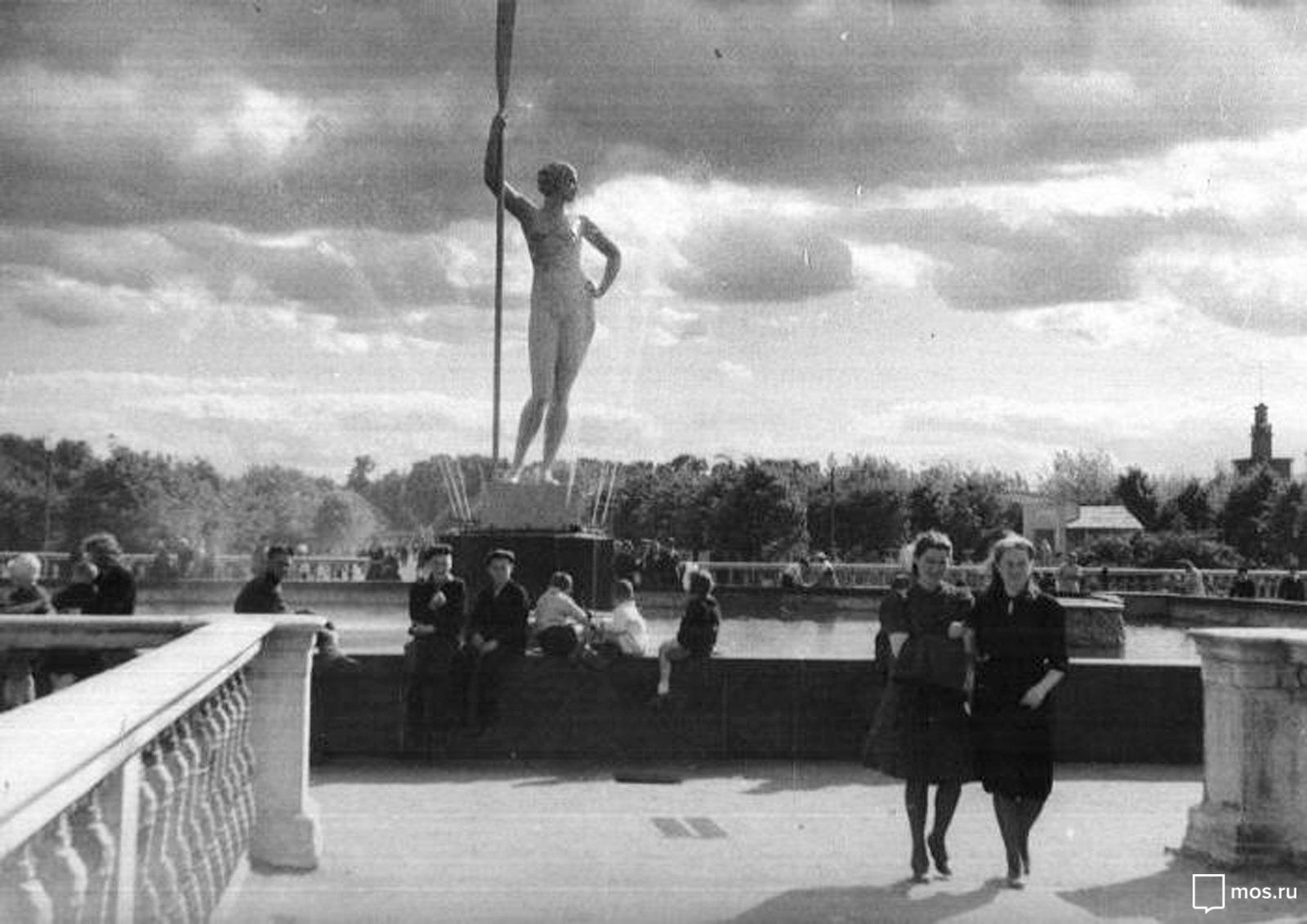
In 1935, Shadr put a nine-metre tall dominant piece in the centre of the parterre’s Fountain Square – a statue of a naked athlete that combined the features of an antique spear-bearing goddesses and the sculptor’s ideal image of a woman from the world’s first state of workers and peasants. Young athlete Vera Voloshina was the model for this statue. During the war she joined guerrilla fighters. She was in the same unit with Zoya Kosmodemyanskaya and lost her life on the same day. In 1994 she was posthumously awarded the title of the Hero of Russia.
Another “Girl with an Oar” appeared in Gorky Part before the war, because the first one was considered provocatively erotic. According to one story, Stalin personally saw the Soviet Venus during his visit to the park. He said: “Remove it or they’ll see it and won’t go any further.”
Shadr was allowed to find a new place for his masterpiece. At his expense the first “Girl with an Oar” was taken to an open railway platform in the country’s south. In Odessa someone suggested putting nickers on it. It stood by the local yacht club in Nikolayev for some time but after the afore-mentioned verdict nobody wanted to give her a permanent home.
The new “Girl with an Oar” occupied the original location in the park in 1936. She was bound to be different. This time gymnast Vera Bedrinskaya was the model. But Shadr remained true to his vision — the statue was a nude again. Regrettably, not a single version survived.
.jpg)
The bronze mockup and a copy of the statue’s head are stored in the Tretyakov Gallery, as are several photos — this is all that remains from a monument that is still one of the main symbols of Gorky Park.
Parachute Tower
A 35 metre spiral tower was built in the park near Krymsky Val in the summer of 1929. Visitors dropped down on small carpets. Ilya Ilf and Evgeny Petrov ridiculed it in their satirical article in the Pravda newspaper, calling it a sensation of the 19th century. However, the new attraction received a new designation before long.
.jpg)
Aviation Day, a new annual holiday, was established in the USSR on August 18, 1933 “with a view to further promoting civil and military aviation among the masses.” It was crowned with the simultaneous jump of 62 parachutists from three planes in Tushino — a record.

Since the start of the 1930s, Soviet parachutists have broken a host of world records. Their names were famous throughout the country. Parachute towers were built in every city and in every district in Moscow, Leningrad and Kharkov. Thus the spiral tower in Gorky Park was converted into a parachute tower (visitors could descend from it as well).
.jpg)
Everyone could jump with a parachute suspended by a cable. A rider had to listen to the instructions and pay one rouble. This was one of the most expensive and popular attractions in the prewar park.
.jpg)
During the Great Patriotic War the tower was once again changed. It was converted into an air defence observation point. It was disassembled in the early 1950s. Now the bronze sculpture “Ballerina” by Yelena Yanson-Manizer stands in its place. The sculptor was inspired by Soviet ballet prima Galina Ulanova. A model of the parachute tower is on display in the Gorky Park Museum.
Green Theatre
The first summer “aerial” theatre appeared in Neskuchny Sad in 1830 on Nicholas 1’s instruction. On one occasion Alexander Pushkin invited Natalie Goncharova there and kissed her on the way back, about which he made an entry in his diary.
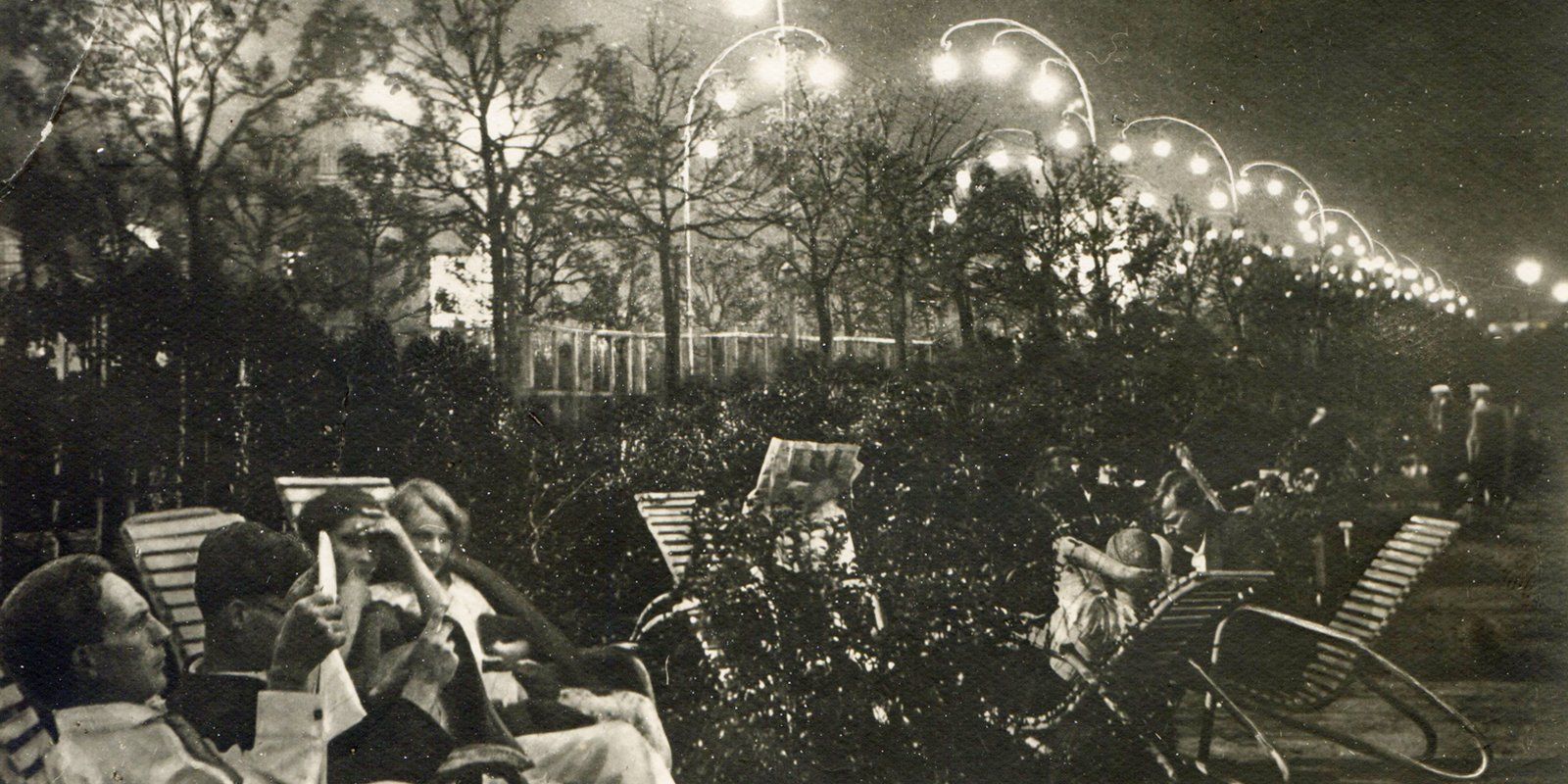
By the beginning of the 20th century the theatre ceased to exist. A temporary stage for public performances was installed near the parterre and Neskuchny Sad. In the summer of 1933 it was replaced by the Green Theatre that held 20,000 people. In 1935 the Bolshoi Theatre’s opera Carmen by Georges Bizet was staged there; in 1936 it hosted the opera “And Quiet Flows the Don” by the Leningrad Maly Opera Theatre, in 1937 the ballet “The Fountain of Bakhchisaray” by the Leningrad Kirov Opera and Ballet Theatre and in 1938 the Bolshoi Theatre’s ballet “The Prisoner of the Caucasus.” Several plays by the Moscow Operetta Theatre were also staged there.


“You are sitting in a huge hall, the walls of which are rustling with green foliage of centuries-old trees. You see in front of you a transparent bluish cupola of the evening skies; stars are sparkling over and around you — you see the lights of the skies and the lights of Moscow that spread out beyond the river. It is difficult to describe in words the impression produced by this wonderful theatre. Come and see for yourselves,” wrote the newspaper Komsomolskaya Pravda in 1936.
Cinema shows were a huge hit. The screen “Giant” — as big as a three storey building — was bought in Britain for this film theatre. The Research Institute of Cinematography developed sound equipment. 29 May 1926 became a landmark in the history of domestic cinema. The sell-out premiere of Grigory Alexandrov’s film “Circus” with Lyubov Orlova took place on that day.

During the war the site was used for lectures and concerts that were part of the fund-raising campaign for the construction of T-34 tanks. It was called “For Advanced Science!” After the war the theatre was rebuilt for the 1957 World Festival of Youth and Students. It was moved 25 metres further into the park, which made it more convenient to walk on the embankment.
The shooting of the final scenes of Vladimir Solovyev’s iconic movie “Assa” became the theatre’s swan song. Over 12,000 people came to see the performance of Viktor Tsoi’s Kino band in the film. Since 1989, Stas Namin’s Music and Drama Theatre has occupied this territory.