Tilework, a 16th century cross and other finds near Maroseika Street
.jpg)
Redevelopment works in central Moscow have exposed ancient church items, old tilework and a medieval-Russia weapon. These finds are at least 400 years old.
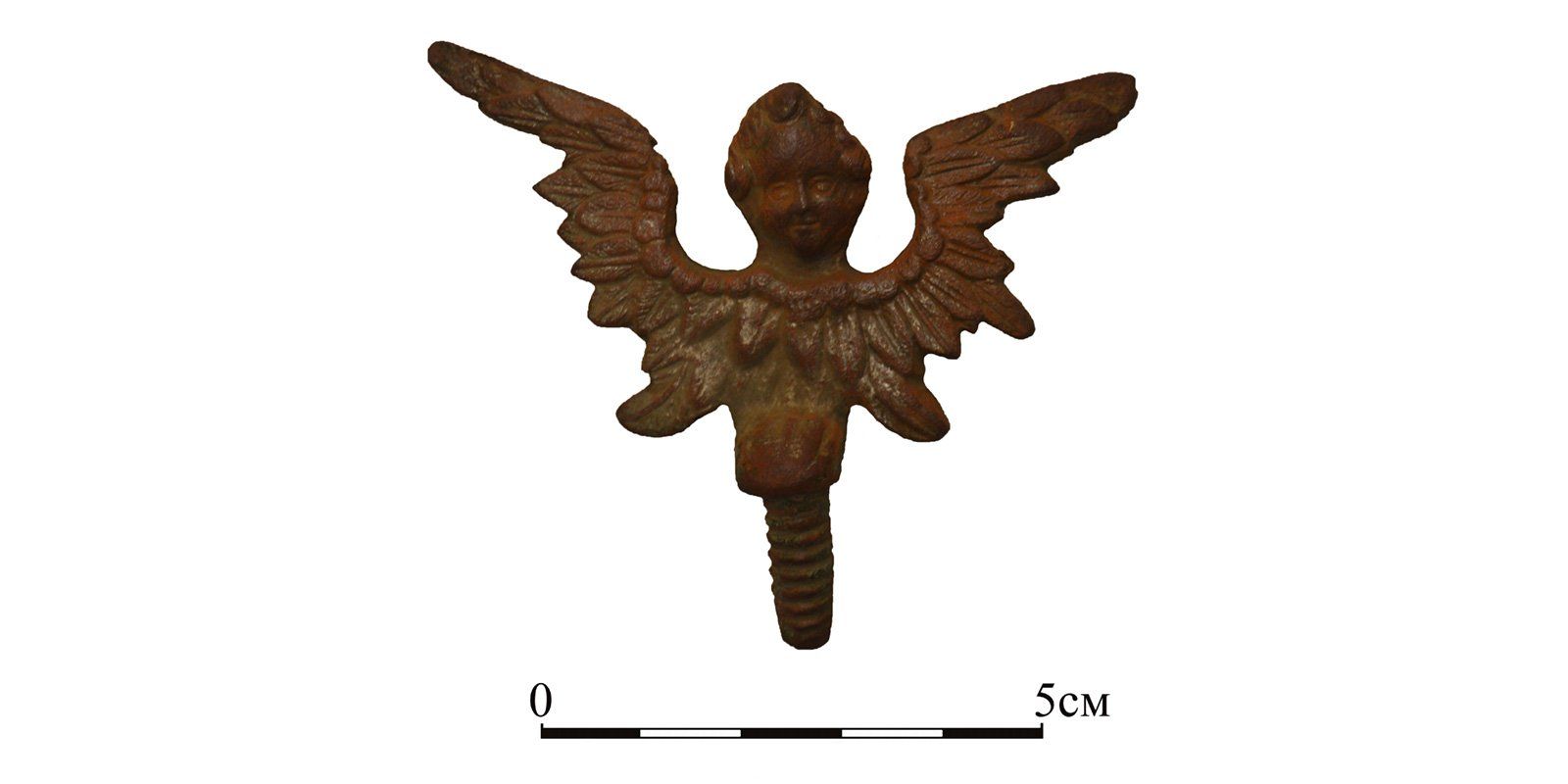
“Archaeological excavations in central Moscow have revealed unique items near Maroseika Street,” said Alexei Yemelyanov, head of Moscow’s Department of Cultural Heritage. “Archaeologists discovered a piece of a stove tile with a 17th century battle scene, a 16th century copper reliquary cross, a part of a lamp in the shape of a cherub, and a sharp-edged forked stick mentioned in the 13th--century chronicles of Novgorod. The artefacts will be added to the expositions of the city museums.”
The piece of stove tilework featuring a battle scene was found near 6 Petroverigsky Pereulok. This is where the Church of Reverencing the Fetters of the Holy Apostle Peter used to be. It was built in 1669 by Boyar Ilya Miloslavsky to commemorate his daughter Maria’s marriage to Tsar Alexei Mikhailovich Romanov. The church was unassembled in 1844. Experts say the tilework was made of red clay in the early 17th century. The face of the tile still shows a fragment of the relief drawing in a frame devoted to the military exploits of Alexander of Macedon described in Alexandria book that was a popular reading in medieval Moscow. These stove tiles were widely used in Moscow for interior decoration in the 17th century.

Archaeologists also found a 16th century copper reliquary cross near 3 Maly Zlatoustinsky Pereulok. Interestingly, the Church of St Nicholas the Wonderworker in Stolpy used to be not far from here until 1938. This church had been built in 1669 by stonework apprentice Ivan Kosmin (Ivan Kuzmin Kuznechik). The discovered cross has two sections joined together with pins. On the face of it, in the centre, there is a cross. On the back, there is an image of Archangel Michael holding a scale and a mirror, and half-body images of saints on the ends of the cross. St Nicholas can be clearly seen among them.
.jpg)
Another discovery was part of a copper alloy lamp in the shape of a cherub, an angel’s figure with a fixture. Experts assume the lamp belonged to the interior of the Church of St Nicholas the Wonderworker in Stolpy. Archaeologists believe the figure could have been trapped between layers during the church demolition.
Among other finds, the excavations revealed a sovnya, a sharp-edged weapon resembling a forked stick. Militia widely used sovnyas, including in the Time of Troubles. A sovnya is first mentioned in the Novgorod chronicles of the 13th century. In 1234, the Novgorod army led by Prince Yaroslav defeated the Lithuanians, forcing them to flee the battlefield and abandon their arms, which included sovnyas.

Archaeological excavations in central Moscow during redevelopment works are quite common. In late April, an artefact was found in Soimonovsky Proyezd, which, experts believe, used to be a thieves’ coin of the 18th century. Pickpockets would use these coins to discreetly cut a bag or a piece of clothing.
Recently, archaeologists found a unique artefact of the 15th-16th century – a fragment of a reliquary discovered in Luchnikov Pereulok, which might have been lost on the way from the Kremlin or Kitai-Gorod to the Chrysostom Monastery.