Novospassky Monastery restoration 50 percent complete
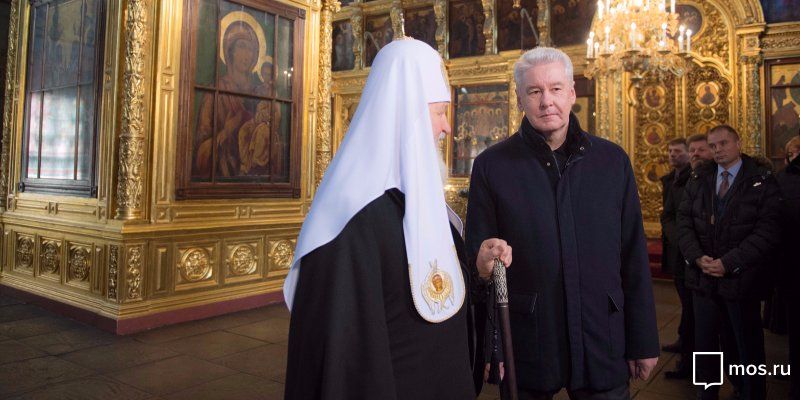
Thirty-three churches, monasteries and convents have been restored in Moscow, Mayor Sergei Sobyanin said, as he and Patriarch of Moscow and All Russia Kirill checked on the restoration work at the Novospassky Monastery.
“We have renovated 33 of the oldest churches in Moscow and that many more are currently being rebuilt,” Mr Sobyanin said. “This work is really about recovering a huge historical layer of both Moscow and the whole country. The Novospassky Monastery is a good example of this, along with the magnificent churches that are the embodiment of the capital city’s historical milestones.”
The Mayor said the fundamental work is to be completed in 2017.
“We plan to continue additional work, in particular, at this church,” Mr Sobyanin said. “The restoration of this monastery is designed to last for centuries and bring joy to the parishioners and Muscovites in general.”
The Mayor also congratulated Patriarch Kirill on his enthronisation anniversary marked on 1 February.
“I’d like to congratulate you on the anniversary of your service in this great calling,” Mr Sobyanin said. “The eight years that you’ve been doing this job have been years of progress. We can see the obvious results in Moscow.”
Seven centuries of history
Moscow Prince Daniil Aleksandrovich founded the Orthodox Novospassky Monastery in 1282, south of Moscow at the site where today’s St Daniel Monastery is. The monastery remained there for 50 years until Prince Ivan Kalita decided to move it into the Kremlin in 1330. The monastery was devoted to the Holy Transfiguration and was designated a chamber monastery.
Following the devastating Kremlin fire in 1488, Great Prince Ivan III decided in 1490 to move the Holy Transfiguration Monastery outside the city to Krutitsy in the southeast (named after the steep left bank of the Moskva River). The monastery was renamed Saviour at the New Site, or Novospassky (today’s address is 10 Krestyanskaya Square).
Surrounded by a solid wall, the monastery would have been a good fortress, if necessary, to protect Moscow against Crimean tartar assaults. The monastery’s history acquired new significance after it became a family vault for the Romanov boyars in the first years in Krutitsy. The Romanov family produced the new tsar dynasty 100 years later.
“This is one of the most cherished Moscow relics and, of course, a historical site,” said Patriarch Kirill. “The monastery is linked to the Romanov dynasty. Mikhail Fyodorovich, the first Russian Romanov tsar, was the one who built this particular church. This is also where the Romanov family vault is.”
The monastery was gradually expanded:
— the first church devoted to the Holy Transfiguration was built in 1491-1497;
- the stone wall with towers was built around the monastery under Tsar Mikhail Fyodorovich in 1640–1642;
- a new building was erected on the foundation of an unbuilt church in 1645–1649, and has survived to this day;
— the St Nicholas church was built near monk cells and a hospital in 1652;
- the Church of the Intercession of Our Lady was built in 1673–1675 to include the dining and the bread-baking chamber;
- the Church of Our Lady of the Sign was built in the 18th century;
- a new bell tower was set up with the St Sergius of Radonezh Church on the second level in 1759–1785;
— a building with the Prince Cherkassky and Count Sheremetev family vaults was erected in 1791–1795.
The monastery suffered serious damage from fire and looting during the French occupation of Moscow in 1812 but was fully rebuilt over the next eight years.
In 1810, nun Dosifeya was buried at the monastery’s cemetery. She was the legendary daughter of Empress Elizabeth of Russia and Count Alexei Razumovsky. In the early 20th century, a small white bell tower was built over her tomb, which has survived.
In 1919, the Novospassky Monastery was closed and transferred to the All Russian Emergency Commission (VChK) to be used as a concentration camp. Prisoners were shot inside the monastery’s walls. Another three Moscow monasteries suffered the same fate.
In the 1920s, the former monastery accommodated a women’s penitentiary and a children’s colony. The graveyard was desecrated and removed in 1927-1930. A sobering room was opened in the Church of Our Lady of the Sign. Since 1935, the monastery complex was under the authority of the NKVD (Stalin’s secret police) economic department. Most of the buildings were then used as accommodation and hostels.
In the early 1940s, the authorities decided to pull down the monastery completely but were prevented by the Great Patriotic War (WWII). After the war, the plans to destroy the monastery were abandoned but the buildings were in desperate need of repair. Only the Holy Transfiguration Church-turned-archive remained in a reasonable condition.
It wasn’t until 1960 that residents began to be moved out of the monastery. In 1968, the Government decided to open a museum of history and modern restoration practice of the USSR but the idea was never fully implemented. In 1985-1990, though, a large restoration centre did indeed operate at the site.
In the 1980s, the first efforts were made to revive the historical image of the monastery and many buildings were partially restored.
The monastery was returned to the Russian Orthodox Church and its religious identity resumed in 1991. Four years later, the remains of Prince Sergei Aleksandrovich that were found in the Kremlin were reburied in the monastery and the Romanov family vault reopened to the public.
The ruined graveyard became home to one of the best gardens in Moscow. Visitors can also see a picturesque Italian courtyard, which was used as an execution site in the early 20th century.
Massive monastery restoration project
A large reconstruction and restoration project has been under way at Novospassky Monastery with support from the Moscow Government and private companies. The project was 50 percent complete at the end of 2016.
“Let me thank you, Mr Sobyanin, for understanding the importance of the work and for the ambitious projects being pursued in the capital today: magnificent architectural landmarks, our national historical buildings are being restored,” said Patriarch of Moscow and All Russia Kirill.
In 2017, the work will focus on the monastery’s bell tower and its future 16-metric-ton bell.
The bell tower under restoration was built in 1759–1785 and designed by architect Ivan Zherebtsov. It has a total floor area of 766.7 sq m. Since December, builders have been reinforcing the load bearing elements, restoring the facades and white brick elements (columns, flowerpots, ledges, frames), recreating wood joints, restoring and gold-leafing the domes, the cross and its foundation, restoring the St Sergius of Radonezh church-over-the-gates, including the mural paintings, cleaning and restoring paintings in the arch, installing the 16-ton bell, repairing internal rooms and converting them for modern use, and updating the plumbing and utility systems.
The second priority restoration project is the St Nicholas Church near the hospital with 445.9 sq m. From June to October 2016, the church had its roof tiles restored along with the cross and its drum, facades, including the top surface of the bricks, brick architectural elements including ledges, cornices, architraves, resurfacing the peeling bricks, recreating the front of the ground floors, work on frescos above the front entrance, including dirt clearing and treating the lacquered layer, recreating windowsill boards, cleaning and painting the metal elements of the window cages, replacing windows on the eastern façade, changing water pipes, figure elements of the water pipes, holderbats (pipe brackets), and rebuilding the white stone porch.
The next restoration project is the Church of Our Lady of the Sign built in 1793–1795, 1802 by architects Yelizvoi Nazarov and Vasily Bazhenov. The building has a total area of 59.6 sq.m. From June to October, builders restored the facades and the white stone ground floor, rebuilt window trim, cast iron cages and white stone porches.
From October 2015 to October 2016, the refectory and the Intercession Church built in the 16th-17th centuries were under restoration. The building with an area of 1,930.9 sq m had its facade cracks filled, a doorframe in the baking chamber was discovered, the mural paintings in the interior were also detected and conserved, white-stone vault surfaces restored, a doorframe found and the white-stone stairs from the refectory into the vault recreated, doorframes of the basement filled, the white-stone floors restored in the basement, and more white stone provided for the stairs leading to the basement. All the work is funded by the city.
From May 2015 to May 2016, the wall and the small tower in the courtyard built in the 18th century were restored by reinforcing the foundation. The destroyed building in the Sunday church school was also recreated.
The repair and restoration projects from 2012 through 2016 have helped recreate the destroyed roof tiles on the southwest corner tower.
Orthodox Moscow: Construction and Restoration
Moscow churches and monasteries representing architectural landmarks are being restored with funds from religious communities, charities, and Moscow coffers. The city funds the restoration of churches directly within the Moscow Culture programme or via subsidies (300 million roubles a year) for religious organisations to arrange restoration.
From 2011 through 2016, 69 churches and monasteries have been rebuilt. By now, 33 architectural church landmarks have been completed, including significant projects such as the St Kliment Church on Pyatnitskaya Street, churches of the Chernigovskoye Podvorye, the Moscow Diocesan House on Likhov Pereulok, Zaryadye churches, and the Our Lady the Joy to All the Afflicted Church on Bolshaya Ordynka.
New churches are built in Moscow with funds from religious communities, sponsors and charities. The 200 Churches programme is the most ambitious construction project to build churches in residential areas near people’s homes. Since the programme was launched in 2010, 36 churches have been completed, including 27 already opened with nine in the final construction stages with regular church services. The basic construction and assembly work has been finished at another five churches while 43 churches are still under construction.
A total of 106 temporary wooden churches have been put up at the construction sites for church services.
Additionally, 11 churches have been built outside the 200 Churches programme, with the Transfiguration Church rebuilt from scratch on Preobrazhenskaya Square being the largest project.
Thus, Moscow has acquired at least 50 new Orthodox churches in the past five years.
Cultural expositions, Christmas readings and cadet parades
The city, along with the Russian Orthodox Church, have been organising an annual exhibition “Orthodox Russia – to National Unity Day” in Manezh, which has been very popular and attracted tens of thousands of people. The expositions inspired the idea to open a new museum “Russia: My History” at the VDNKh.
The city has also been involved in the religious and educational events of the Russian Orthodox Church, including:
- publishing the multi-volume Orthodox Encyclopedia; international Christmas educational readings (January, over 10,000 participants);
-religious educational events marking Orthodox Book Day (March, over 40,000 participants);
-organising public access to Orthodox relics brought to Moscow for worship;
-cadet parade at Park Pobedy (6 May);
-organising a concert in Red Square to celebrate Day of the Slavic Writing and Culture, Saints Cyril and Methodius (24 May, over 10,000 participants);
-church processions, exhibitions, concerts, jubilee events.