The Triumphal Arch: How the city’s symbol of military glory came into being
.jpg)
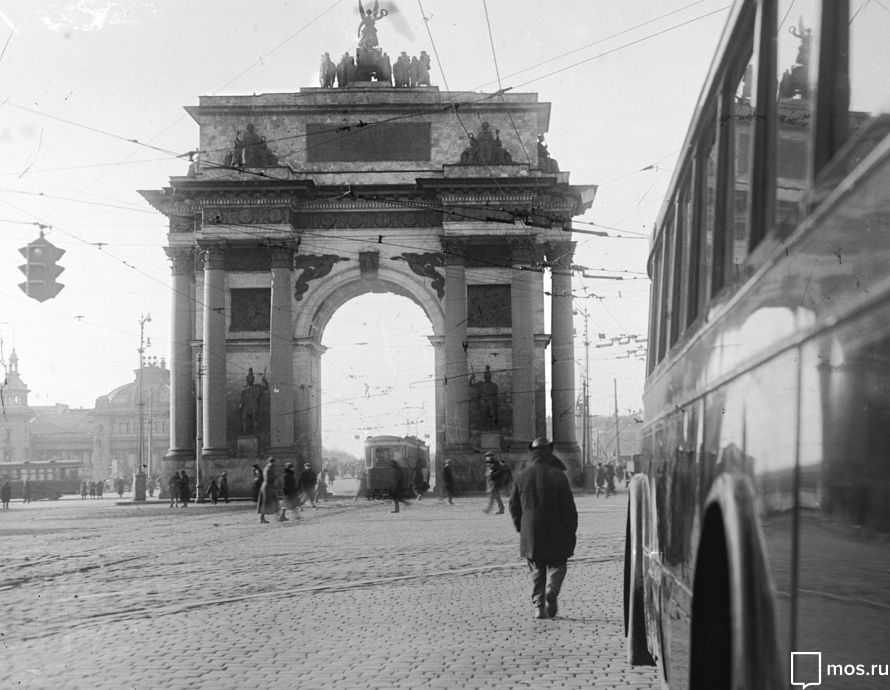
The Triumphal Arch at Tverskaya Zastava
In the summer of 1814, a triumphal arch was erected on Tverskoy Zastavy Square as a tribute to the Russian army returning from Europe after its victory over Napoleon. The choice of location was meaningful: it was the point where Moscow officials, nobility and honorary citizens usually greeted the Emperor on his arrival from St Petersburg. Later, the road from the northern capital was inaugurated in 1822 under the name of Petersburgskoye Motorway (currently Leningradskoye Motorway).
The arch was designed according to the best traditional standards, just like the many others erected along the path of Russian troops before and since[1].
In 1826 Emperor Nicolas I, considering the victory worthy of a more durable monument, ordered the wooden arch to be replaced with one in stone. The design was commissioned from the renowned architect Osip Bove (Joseph Bové). Construction began three years later and took another five; according to some sources, the delay was caused by lack of budget funding due to the large-scale rebuilding of the city that had been devastated by the 1812 fire; others claim that the project was being held up by Moscow officials who for some reason had taken a dislike to the project.
At long last, in September 1834, the opening ceremony took place. Sadly, Joseph Bové had died a mere few months before, and the construction was completed under the supervision of his younger brother Michaele. In terms of both architecture and sculpture, the monument was truly majestic. Six pairs of pillars supported high plinths on which stood mighty figures of armour-clad ancient warriors wearing peaked helmets. The elaborately carved frieze bore the coats of arms of 36 Russian governorates whose population had taken part in the 1812 Patriotic War, as well as medallions with the monogram of Nicolas I. On top of the arch, the statue of Nike, the winged goddess of victory, stood in a chariot drawn by six horses. The two frontispiece inscriptions – one in Russian facing the city centre, and one in Latin on the opposite side – glorified Emperor Alexander I as the country’s saviour [2].

The monument’s troubled history
In 1872, a road was laid through the archway, first used by horse-drawn carriages running from Tverskaya Zastava to Voskresenskaya Square (now Revolution Square), which was replaced in 1899 by the city’s first electric tram line from Strastnaya Square (currently Pushkinskaya Square) to Petrovsky Park. The heavy traffic inevitably took its toll on the monument’s condition. In the run-up to the centenary of the Battle of Borodino, the arch had to undergo its first – albeit purely cosmetic – restoration, followed by another refurbishment in the mid-1920s, under Soviet rule [2, 3].
In 1936, as Tverskaya Zastava was being rebuilt in accordance with the general plan for the reconstruction of Moscow enacted a year earlier, the Triumphal Arch was dismantled for thorough restoration and re-assembly. In the process, experts from the Shchyusev Museum of Architecture scrupulously measured, sketched and photographed the structure. Most of its components were cleaned, renovated, and then moved to the Museum’s branch on the grounds of the Donskoy Monastery where they blended in quite well with the environment: the warrior statues lined the central lane, the haut-relief pieces were fitted into wall niches, while the Chariot of Glory was placed on a specially built plinth.
The outbreak of the Great Patriotic War indefinitely postponed the reinstallation of the arch. Its parts remained stored at the Donskoy Monastery throughout the post-war period during which the city, along with the entire country, was essentially being rebuilt from scratch. The pig iron pillars were less fortunate. Stashed away on Miusskaya Square, they remained there for several years; eventually, eleven of them were melted down for war purposes, leaving just one behind. It seemed that the arch, like so many “remnants of the past”, was doomed to oblivion.
Arches and gates in retrospect
Triumphal gates come to us from ancient history. The classical prototypes created in ancient Rome under Emperors Titus, Septimius Severus and Constantine the Great were followed by the Arc de Triomphe built in Paris by Napoleon, to which the arch at Tverskaya Zastava in Moscow and the Narva Triumphal Arch in St Petersburg (1834) served as a kind of “symmetrical response” by Russia.
The ancient tradition is deemed to have been brought to Russia by Peter the Great who in 1696 commemorated the conquest of Azov with a triumphal arch, and in 1709 commissioned as many as seven of them to celebrate the victory at Poltava. All those arches, elaborately decorated though they were with paintings, statues and allegorical figures, were temporary structures, mainly wooden, pulled down either immediately after the festivities or later on, as they fell into decay; many of them perished in fires.
The first long-standing structure of this kind was the Krasnye (Red) Gate built in 1753 under Empress Elizabeth Petrovna on the site of a former wooden arch. Attempts were made to raze the gate as early as in the 19th century; it was finally demolished in 1927 in order to enlarge the Garden Ring. Its memory is preserved in the name of the square on which it had stood, as well as in the name of the metro station built nearby in 1935.

Triumphal arches are close relatives of Golden gates. Though not always related to a particular victory, such gates were usually erected at a city’s main entrance, often to denote its capital status. The first of them to appear on Russian soil was set up in the 11th century in Kiev, under Yaroslav the Wise, replicating the Byzantine arch of Constantine the Great. Later on, Golden gates emerged in other major cities, such as Vladimir (12th century).
Also similar to triumphal arches are Royal gates in Orthodox churches. An age-old tradition can be observed here as well. In ancient Rome, all gates and doors were presided over by Janus, the god with two faces who looked both forward into the future and backwards into the past, thus linking two opposing worlds. It is after Janus that the Romans named the first month of the year. The Royal gates of a church iconostasis symbolise the transition from the earthly realm to the Celestial City, i.e. the gateway to paradise. Moreover, some researchers find that the overall outlines of classical iconostases typical of the late 18th and early 19th centuries bear resemblance to triumphal arches [4].
On the whole, the Soviet regime had good reason for scepticism about such a distinct symbol of imperial glory, with its religious connotations to boot.
Triumphal Arch reinstalled: New times, new significance
The victorious ending of the Great Patriotic War ushered in an ideological shift. In May 1947, a vast arch, carved with traditional folk motifs and illuminated at dusk with coloured lamps, rose on Pushkinskaya Square. More that just a gateway to the first post-war fair called the Spring Bazaar, it was a symbol of the incipient transition from famine and devastation to abundance and prosperity.
.jpg)
In the early 1950s, massive and truly triumphal gates appeared at the main entrances to Gorky Park and VDNKh, Moscow’s main exhibition area, both of which were at the time popular for open-air festivities.
It was not until 1965, though, that the Supreme Soviet of the USSR recognised the artistic and historical value of the Triumphal Arch and ordered it to be reinstalled. However, as it no longer fit the new layout of the Belorussky Station Square, a new location for it was found in Kutuzovsky Prospekt, across from the Battle of Borodino Panorama [1].
Strictly speaking, the monument was reproduced rather than reassembled. During the 30 years since its dismantling, many components got lost or became unusable. For this reason, apparently, the restorers decided to let all haut-reliefs and statues remain at the Donskoy Monastery and to produce exact copies, following the drawings and photographs made in 1936, as well as the model of the arch done in the author’s own hand kept at the Shchyusev Museum. Thus, new pig iron pillars were cast at the Stankolit plant, while the ornamental foundry in Mytishchi produced statues, coats of arms and haut-reliefs.
Predictably, some alterations had to be introduced. Instead of the original brickwork, the new basic structure was in reinforced concrete; granite and grey Crimean limestone took the place of the former white stone facing. Also, the commemorative inscriptions did not mention Alexander I any more but quoted Field Marshal Kutuzov's address to the army [2]. The latter change was clearly a matter of principle, giving credit for the country's salvation to the people, rather than to the Emperor. Moreover, the gateway was no longer a thoroughfare; the arch was put on a raised islet on top of a flattened hill between two opposite traffic flows, and was linked to the pavements by underground pedestrian crossings.
The inaugural ceremony, per tradition, was timed to precede the main Soviet public holiday and took place on 6 November 1968 [3]. Eight years later, in the run-up to the 30th anniversary of the end of the Great Patriotic War, the area surrounding the Triumphal Arch was named Pobedy (Victory) Square, so that the re-created arch acquired a dual memorial significance. Subsequently, the double burden of visitation and celebration was partly taken over by the war memorial and Victory Park set up on the Poklonnaya Gora.

The Arch in the new century: Restoration and reconstruction
Time never slows down and spares nothing, not even stone and iron. At the turn of the century, experts observed that the Triumphal Arch was in need of restoration. The work was carried out in 2012, in the run-up to the bicentenary of the Patriotic War. The surrounding plot was also given a facelift with fresh flowerbeds and new lighting. The restored monument was among the presents that the people of Moscow received for City Day.
At the Moscow Restoration contest, the renovation of the Triumphal Arch won a total of seven awards, including best design and best execution.
Moreover, the stand of the Moscow Government, with the restoration of the Triumphal Arch as its central piece, was honoured with an award at the 18th International Exhibition of Restoration, Memorial Preservation and Urban Renewal held in Germany under the auspices of UNESCO.
Sources
- Krayevsky, B.P. “The Triumphal Arch” — M.: Moskovsky Rabochy, 1984.
- Kharitonova, E. V. “The Capital's Triumphal Arch” // Moskovsky Zhurnal. — 2012. — № 5 (257). — p.91–96.
- Mikhailov, K. P. “The Moscow We Lost” — M.: Exmo, 2010.
- Posternyak, K. V. “Heterodox Borrowing in Russian Church Interiors in the Time of Peter” // Vestnik PSTGU. Series V. The History and Theories of Christian Art. — 2015. — Issue 3 (19). — p.102–119.