Moscow’s record-breaking parks: places to see centuries-old trees and historic structures
Moscow parks subordinate to the Moscow Department of Culture are home to many sites that stand out for their age, scale, or history. The Vorontsovo Estate, for example, has preserved one of Moscow’s oldest estate bridges, the Tsaritsyno Museum-Reserve boasts the oldest and longest cascade of ponds in the capital, and Serebryany Bor Nature Park features Moscow’s longest ecological trail. The city’s green spaces are also home to centuries-old trees, including a 300-year-old oak in N.N. Pryamikov Children’s Park and a 255-year-old oak in Hermitage Garden.
The bridge at the Vorontsovo Estate was built in 1790. It remained buried under a layer of earth for a long time and was accidentally discovered during archaeological excavations in 2005. Today, the bridge offers a reminder of what the estate grounds looked like several centuries ago.

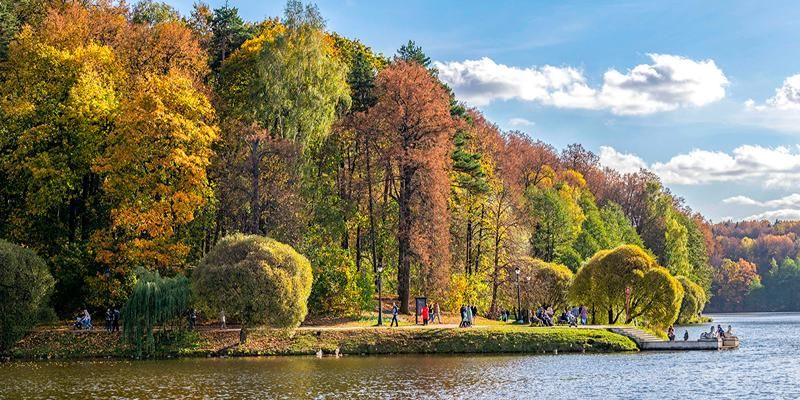
The ponds at that Tsaritsyno Museum-Reserve also have a centuries-long history. One of Moscow’s oldest and largest pond cascades comprises the Upper, Middle, and Lower Tsaritsyno Ponds and the Borisovskiye Ponds. The Borisovskiye Ponds became part of Tsaritsyno in 2025, reuniting the historic cascade. Its water system took shape over several centuries in the valleys of the Gorodnya River and its tributaries, the Yazvenka, Cherepishka, and Chertanovka.

Borisovsky Pond is the oldest in the cascade. It was created in the late 16th century during the reign of Boris Godunov. The Upper and Lower Tsaritsyno Ponds were created in the second half of the 17th century, when the estate belonged to the Boyars Streshnev. The reservoirs later underwent various transformations: under Catherine the Great, Lower Tsaritsyno Pond was deepened and cleared, while a decorative horseshoe-shaped island was created there in the 1790s.

Today, the total area of the cascade together with the Borisovskiye Ponds is about 170 hectares. The reservoirs remain part of the park’s natural ecosystem: the Borisovskiye Ponds have beaches and recreation areas, while Lower Tsaritsyno Pond provides a habitat for many species of waterfowl, including rare species listed in the Red List.
Centuries-old trees
The trees in Moscow parks also preserve memories of the past. The 300-year-old English oak in the center of N.N. Pryamikov Children’s Park is a legally protected monument of landscape art and a cultural heritage site.

The 255-year-old oak in Hermitage Garden was already growing here in the 18th century, long before Yakov Shchukin established an entertainment garden on the site in 1894. When the garden was laid out in the late 19th century, the tree was deliberately preserved. Today, specialists monitor its condition, inspect the wood, reinforce its branches, and care for its root system.

Fili Park, located on the grounds of the former landscaped park of the Kuntsevo Estate, is also home to an ancient oak estimated by dendrologists to be more than 250 years old. Its trunk circumference exceeds 410 centimeters. The tree is included in the nationwide Trees — Monuments of Living Nature program and in historical walking routes through the park.
A mature larch has survived in the formal park at the Kuskovo Estate. It has been growing opposite the Great Stone Greenhouse for more than 200 years, dating back to the period when the estate flourished under the Counts Sheremetev.
Record-breaking scale
Opened in 2018, the In Harmony with Nature ecological trail in the Serebryany Bor natural monument is 5.5 kilometers long. The route passes through a variety of natural landscapes, from the quiet bays of Lake Bezdonnoye and pine forests to views of the Moskva River and the Lemeshev Oak. Along the way, visitors can see lindens, birches, larches, sea buckthorn, reed beds, and water lilies, as well as forest inhabitants including squirrels, woodpeckers, and songbirds. Rare plants from the Moscow Red List can also be found among the grasses.

The capital also has a record-breaking park in terms of size. Losiny Ostrov National Park is recognized as Moscow’s largest park by area. It is home to more than 2,700 animal species, including moose, wild boars, and rare owls, as well as insects. The park is listed in the Russian Book of Records.

Izmailovsky Forest Park holds several records, both natural and historical. Covering more than 1,300 hectares, it remains the largest area of natural forest within the Moscow Ring Road. Its forest and recreation area allow visitors to relax, exercise, and enjoy nature without leaving the megacity.
The Ploshchad Muzhestva memorial complex preserves the memory of wartime history and is the largest open-air museum of military equipment in the Eastern Administrative District. It features an exhibition of armored vehicles and anti-aircraft systems from the Great Patriotic War. The complex was created in 1968 according to a design by architect M.N. Moshinsky. Its creation is directly linked to the events of the Great Patriotic War: in July 1942, the 85th Guards Katyusha Mortar Regiment was formed from volunteers on the grounds of Izmailovsky Park.
Cultural life
Moscow parks also hold records in the cultural sphere. The Rakushka main stage at N.E. Bauman Garden is one of Moscow’s oldest operating open-air concert venues. It was built in the 1920s−1930s and is still used for its original purpose. Leonid Utyosov, Klavdiya Shulzhenko, and other famous performers appeared on this stage, while today it hosts music evenings and the garden’s main events.

Modern walking routes, concert venues, and recreation areas in Moscow parks stand alongside sites whose histories span decades, centuries, and even several centuries. Each such record offers another way to see the capital’s familiar green spaces from a new perspective.
Parks of Moscow is an ambitious city-wide initiative focused on setting up comfortable, modern, multi-purpose recreation areas for Muscovites and tourists. It embraces more than 50 parks that have been transformed into popular hotspots for engaging in sports, culture, family leisure, and communion with nature. On top of preserving unique landscapes and ecosystems, the project also enhances its parks with modern infrastructure.