American Flamingo Chicks Hatch at Moscow Zoo
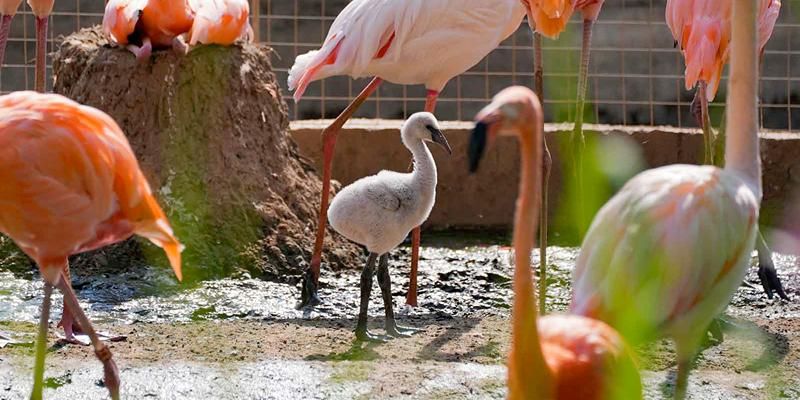
Two pairs of American flamingos at the Moscow Zoo, which is overseen by the Moscow Department of Culture, got their chicks hatched in mid-July. The chicks can already be seen at the Big Pond alongside the adult birds. They are the first offspring since the flamingos fully adapted to changes in the group and the redesigned exhibit.
To ensure that the American flamingos could nest undisturbed, Moscow Zoo specialists prepared the Big Pond in May, once consistently warm weather had arrived. The birds were moved from their winter pavilion to the outdoor pond, the shoreline was reinforced with a mixture of sand and clay, and special turf was planted. The conditions have been designed to resemble the flamingos’ natural habitat as closely as possible, helping them stay comfortable throughout the breeding season.
In early summer, the flamingos began building nests and laying eggs, and a month later the chicks hatched.
“The chicks are still covered in grayish-white down; their characteristic bright pink-red adult plumage will develop later. Flamingo chicks are also born with short, straight bills. For now, their parents are feeding them; they will begin feeding on their own later, once their bills develop the distinctive shape characteristic of the species. At the zoo, the birds are fed grated carrots, minced fish, crustaceans, gammarus, and specially formulated feed enriched with vitamins. The more carotenoids the birds obtain from algae and crustaceans, the brighter their plumage becomes,” says Svetlana Akulova, Director General of the Moscow Zoo.
How Ornithologists Breed Flamingos
American flamingos are monogamous birds, forming lifelong pair bonds. In the wild, they live for around 30 years, while in zoos they can live for up to 50 years.
Breeding flamingos is considered one of the most challenging tasks for ornithologists. These birds live in large colonies and are highly sensitive and excitable. Conflicts between adults are not uncommon during the nesting season, and intense disputes can result in damage to egg clutches. That is why Moscow Zoo staff keep the situation under close supervision.

Over the years, Moscow Zoo ornithologists have used special techniques to protect flamingo clutches. For example, during the breeding season, eggs were temporarily replaced with dummies and returned to the parents shortly before hatching. This significantly improved offspring survival rates. In 2018, the technique produced a record result, with 12 greater and American flamingo chicks hatching at the zoo at around the same time.
This season, Moscow Zoo specialists decided not to intervene in the incubation process. As the American flamingo group has become smaller, the birds were allowed to care for their eggs on their own. The parents took turns incubating the eggs and successfully managed without assistance from zoo staff.
The arrival of the chicks marked the natural conclusion of the American flamingos’ adaptation period following the reorganization of the exhibit. In 2023, the collection was divided: the greater flamingos moved to the new Aviary exhibit, while the American flamingos remained near the red wolf enclosure. Once the group had adapted to the new arrangement and improvements to the shoreline had been completed, the flamingos resumed nest-building and breeding.

Flamingo Species at the Moscow Zoo
American, or Caribbean, flamingos are among the most vividly colored members of the flamingo family. In the wild, they can be found in the Caribbean, along the Gulf of Mexico, and in the Galápagos Islands, where they favor shallow saltwater lagoons and coastal bays. American flamingos are smaller than greater flamingos, reaching no more than 110 centimeters in height and weighing up to 2.5 kilograms. However, this species has the most intensely red plumage, making it one of the most striking birds in the world.
The Moscow Zoo is one of the few zoos in Russia where American flamingos breed regularly. This has been made possible by carefully managed conditions and years of work by ornithologists to conserve and breed the species.
The greater flamingo is found in Africa, Southern Europe, and Southwest Asia. In Europe, the bird occurs in southern France, Spain, and Sardinia. In Africa, it is found mainly in the south of the continent, as well as in Tunisia, Morocco, Mauritania, Kenya, and Cabo Verde. The species inhabits lakes in southern Afghanistan, northwestern India, and Sri Lanka, and also nests annually in central Kazakhstan. The greater flamingo is the largest flamingo species, with adult males reaching up to 145 centimeters in height and weighing up to four kilograms.

The Moscow Zoo is a rapidly growing space; it is engaged in scientific research, hosts international conferences and delivers educational programs, while creating a unique atmosphere for introducing visitors to the amazing world of wild animals.
In early 2025, Moscow Zoo set a world record for the number of animal species represented in its collection, with 1,253 species. By 2026, that figure rose to nearly 1,280.