Pixel, Electronic House, and supplier-oriented web-portal: a glimpse of machine vision technology used in Moscow

Machine vision is the technology that helps a computer understand what can be seen in a photo, video, or footage transmitted by a camera in real time. Its applications are expanding every year, as today it is used in video surveillance, unmanned transport, medicine, document management, robotics, and so on. The Moscow Department of Information Technologies (DIT) explains how municipal service providers employ machine vision.
How a machine learns to see
Machine vision allows machines not just to understand and interpret visual images, but also to extract and classify information from images (e. g., photographs, pictures, videos, barcodes) identifying patterns and offering forecasts. In order to teach a computer to automate those processes, they apply machine learning methods. Artificial intelligence (AI) helps create algorithms that can learn from models and improve the accuracy of image recognition.
Today, almost everyone encounters machine vision technology in everyday life, indeed, as it definitely enhances photos, converts texts in images, receives CCTV camera notifications of human presence, to mention just a few examples. A DIT survey proved that last year 75 per cent of Muscovites used photo-based search, 52 per cent processed photos with masks or filters and more than 30 per cent paid for purchases using biometrics. Furthermore, the technology has been employed in the capital’s solutions, applications, and municipal services for over fifteen years.

“Moscow is the world’s most technologically advanced city and a leader in implementation of AI technologies in urban solutions. Every year, dozens of new AI-powered services appear in the capital, while existing solutions gain new features and capabilities. Moreover, the introduction of technologies is largely welcomed by residents themselves. According to DIT analysts, 93 per cent of Muscovites support the introduction of AI in at least one municipal project. In fact, CV-based tools received the highest approval,” reports the Press Service of the Moscow Department of Information Technologies.
Medicine, unmanned transport and street robots
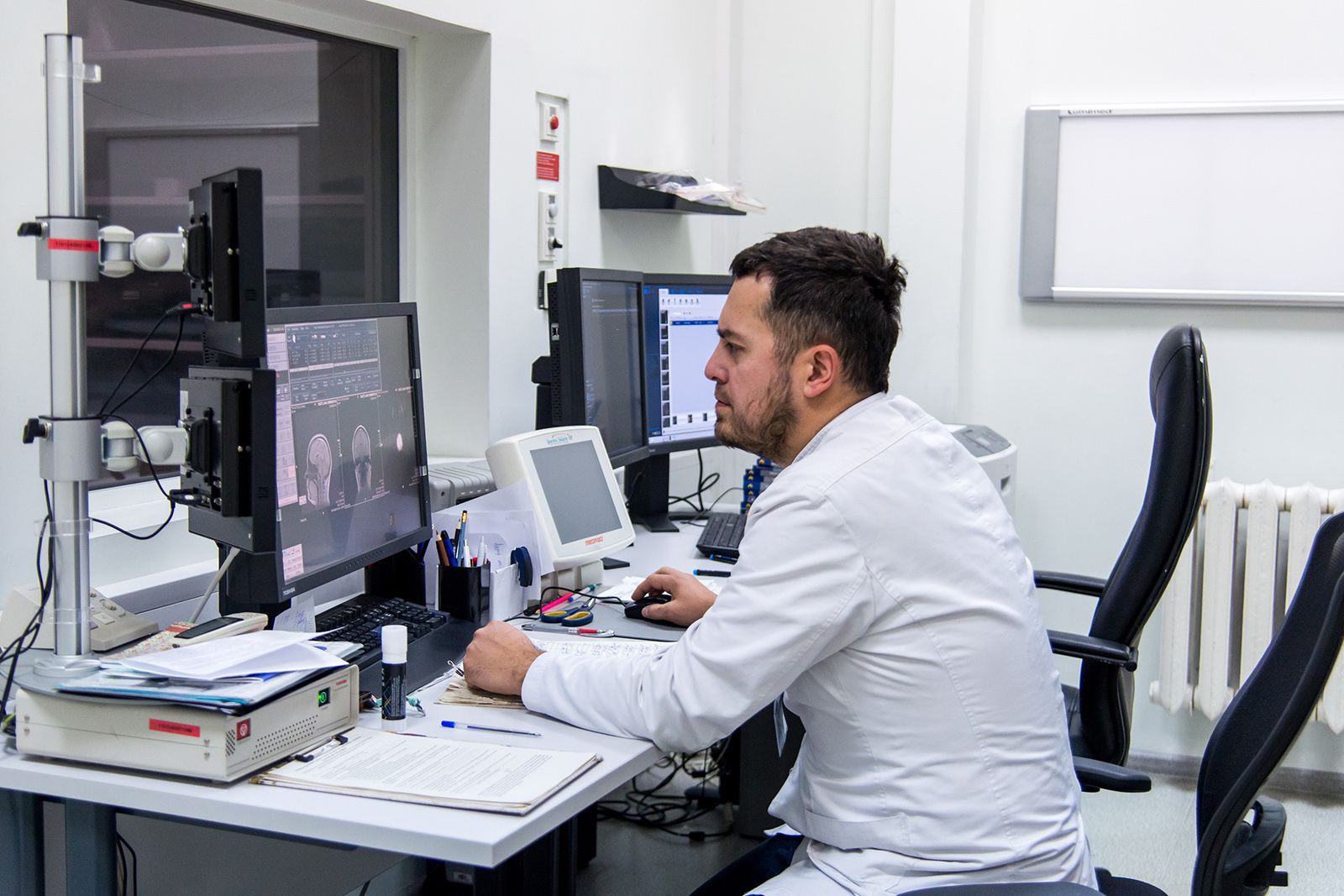
Indeed, computer vision (CV) is widely used in areas dealing with vast arrays of visual information, for example, by Moscow’s doctors. The technology analyzes and describes radiation images, e. g., fluorography, mammography, radiography, CT and MRI scans, algorithms identifying signs of potential abnormalities on medical images, thus enabling accurate diagnostics and prompt treatment. Moscow radiologists have access to over 60 AI-based tools, which they use in more than 40 clinical areas. Moreover, 17 of the best Moscow-developed AI-based solutions are also available to doctors in Russia’s regions on the MosMedAI platform.
Last September, the local authorities pioneered the world’s first one hundred per cent driverless tram to provide scheduled passenger services in the city. In January 2026, the Moscow Metro began testing Russia’s first-ever driverless metro train, its machine vision software scanning the space in front of the train, identifying anomalies on the track, reading traffic lights, and so on. According to the public transport strategy endorsed by Sergei Sobyanin, approximately two-thirds of Moscow’s trams will be driverless by 2030, the first driverless metro line to be launched by that time, too. Local IT engineers are engaged in developing software for unmanned public transport.

Russia’s pioneer autonomous environmentally friendly electric-powered cleaning robot, Pixel, can be seen In the parks and streets around Moscow. It was developed by Moscow-based Avtonomika, a Lomonosov Cluster resident and a participant of Moscow Innovation Cluster. Featuring a multi-sensor security system and computer vision, Pixel has good spatial awareness and can avoid collisions. The robot is also capable of operating year-round at any time of day as it is noiseless and does not require human presence after training.

Supplies, procurement and fiscal documents
With the CV technology, businesses using the Moscow supplier web-portal can benefit from saving time when choosing the right product category. When a new item is uploaded to the catalogue, the neural network uses photographs to identify the related category within a few seconds and suggest suitable characteristics; today the catalogue contains over 3.4 million unique items.
Meanwhile, the Moscow City Treasury employs machine vision technology to automatically verify financial documents. The software evaluates the accuracy and completeness of paperwork, analyzes contents of scanned contracts, acceptance certificates or invoices and identifies any discrepancies between them. Once the analysis is complete, it generates a report to be further used for making decisions about transferring funds to contractors or suppliers. The software is monitored by treasury engineers, the AI accuracy exceeding 90 per cent to date.

AI for condominium residents
The Electronic Home platform allows for submitting image-based water meter readings as a user is just to take a photo of the meter using the mobile app, the software to automatically recognize and fill in the data. Users no longer need to enter numbers manually, the technology therefore reduces the risk of potential errors, saves time for the users and simplifies interactions between residents and housing and utility providers. The new feature is available to authorized users.
Today, AI-based solutions have been integrated into more than 130 citywide projects in medicine, education, transport, public services, security, and city management. More information about how the capital employs artificial intelligence is available on the project’s web-page.
Support for the development and implementation of AI-based technologies is consistent with the national project for Data Economy and Digital Transformation.