In Moscow: AI early detects weak bones
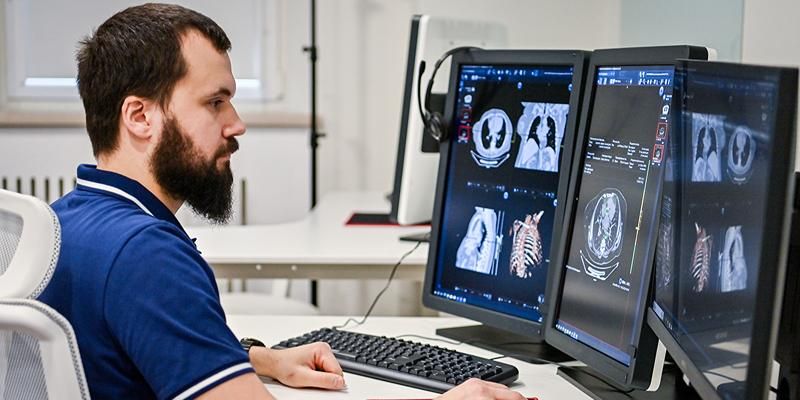
In Moscow, an AI-based solution automatically detects osteoporosis in its early stages. Osteoporosis, also known as weak bones, is a disease causing bones to become weak and brittle. The neural network can detect its signs in the early stages as it analyzes and identifies abnormal features on CT scans performed for other clinical indications, as announced by Anastasia Rakova, Deputy Moscow Mayor for Social Development.
“We consistently integrate AI-based technology into our everyday practices, such as analyses of X-ray images for various clinical indications. This approach of additional screening for finding disorders helps prevent problems in advance and avoid consequences. We have recently introduced an automated osteoporosis screening using CT scans to detect the disease at early stages when a person does not even suspect the condition, while it is developing without symptoms. That makes it possible for patients to omit special tests, thus reducing radiation exposure. Moreover, we can begin treatment earlier to minimize the risk of severe fractures,” says Anastasia Rakova.
The neural network automatically analyzes CT scans and detects signs of osteoporosis highlighting all potentially compromised regions of bone tissue with red or orange.
“Osteoporosis is a metabolic disease of the skeleton characterized by decreased bone mass and the disrupted microarchitecture of bone tissue. It is insidious as it often goes unnoticed until serious complications and injuries occur. These tools use existing images helping detect critical changes in bone tissue. On a medical image, the neural network colors abnormal areas, performs needed measurements and also creates a text description. The integrated AI-based tools are capable of simultaneously identifying up to 14 abnormalities within a single test. With this approach Muscovites who take examinations for various clinical indications will receive extra insurance coverage for one of the most subtle and dangerous age-related diseases,” says Yuri Vasilyev, Director of the Center for Diagnostics and Telemedicine within the Moscow Department of Health.
Artificial intelligence helps doctors identify health conditions at early stages more quickly and improve the accuracy of image measurements. However, a final diagnosis is always made by a human doctor who relies on test results and the radiologist’s image description.
Today, Moscow’s doctors have more than 60 AI-based tools at their disposal to detect signs of diseases in 43 clinical areas. In addition, the healthcare system employs 12 integrated solutions that are capable of identifying multiple pathologies on one medical image at a time, AI having analyzed almost two million CT scans up to date.
The experiment using innovative CV technologies in healthcare has been run by the Center for Diagnostics and Telemedicine within the Moscow Healthcare Department in liaison with the Department of Information Technologies since 2020. The project is in line with the goals of Moscow’s healthcare strategy until 2030 and aims to improve the quality and accessibility of medical services for local residents.