On the rails to the future. How the unmanned laboratory tram operates
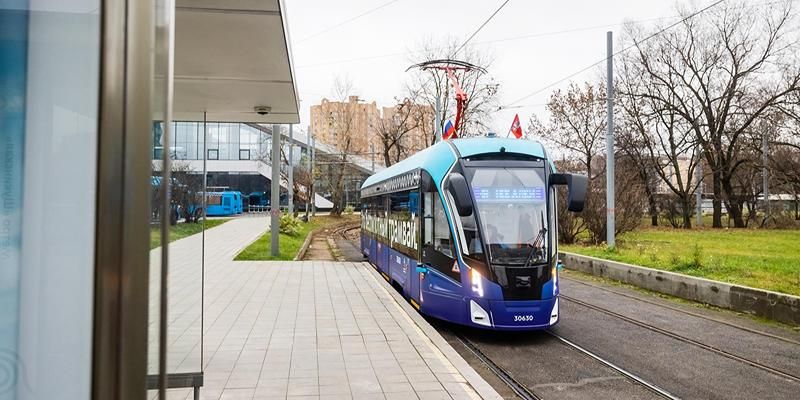
Advanced technologies have become a familiar element in all parts of Moscow’s public transport system, from infrastructure to rolling stock. Online displays at bus stops show bus schedules, Metro passengers pay for their fare with a smile, eco-friendly electric buses drive along the streets, and on route No. 10 you can see a real innovation — Russia’s first fully unmanned tram Little Lion-Moscow. It began carrying passengers in the early fall, running standard eight-hour shifts.
“Passenger safety is always one of our top priorities. Therefore, when introducing unmanned public transport, numerous and thorough tests are conducted at every stage. By the end of next year, there will be 15 unmanned trams running in the city. And according to the transport development strategy approved by Sergei Sobyanin, two thirds of the tram fleet will be equipped with unmanned technologies already by 2030,” said Maxim Liksutov, Deputy Mayor of Moscow for Transport and Industry.
To prepare for their launch, two unmanned laboratory trams are operating on the routes. A correspondent from mos.ru visited one of them and found out how these vehicles operate and what kind of research they conduct.
The most attentive tram
With its blue roof, elongated body, pantograph and large “Testing in progress” sign, it is impossible not to notice the vehicle approaching the turning circle at 2 Ulitsa Tvardovskogo Street, building 1. It’s an unmanned testing laboratory tram. It is not transporting members of the public, but doing research.
“The main task of such a tram is to collect data to enable the technological rendering of high-precision route maps, indicating all stops, traffic lights, crosswalks, U-turns, and direction arrows. We capture all the details. This data is needed so that the new unmanned trams can travel safely on city streets. For mapping purposes, we are using routes No. 30, 27, 23, 15 and 31 of the Krasnopresnenskaya tram network. We go on the line every day and work eight hours a shift,” says Roman Khikhin, senior project manager at Moscow Metro SUE’s Center for Research and Development of Unmanned Transport.

Experts had already made one high-precision map for route No. 10 before the launch of Russia’s first fully unmanned tram. It goes from Ulitsa Kulakova to Shchukinskaya metro station. Even though the map is already complete, experts continue to check the route and regularly update the data. Route 10 is still in operation today.
The front door of the laboratory tram opens and the testing driver enters the cabin. The controls here are unmanned, but he makes sure everything works correctly. The cabin has three large monitors and four cameras pointed at the road. They allow the tram to determine what or who is in front it: traffic light, car or pedestrian. And the laser sensors, or lidars, installed on the body give the laboratory tram a 360-degree view. Visually, such devices resemble flashing beacons. Two lidars are fixed on the sides of the tram, one more on the front and one on the roof.

“Lidars scan space using infrared beams. These beams are invisible to the human eye and completely harmless. The device sends a beam, catches the reflected signal and determines the position of an object or person. Lidar devices can recognize an object at a distance of up to 200 meters and determine its position to an accuracy of two centimeters. Thanks to this technology we get a three-dimensional image and see everything around the tram in all directions. However, lidar does not transmit color information, so this function is performed by cameras,” explains Roman Khikhin.
Another important technology used in the laboratory tram is radar. There are three radar devices here. They are built into the body and allow the tram to estimate the speed of all road users. Radar systems’ performance is not affected by bad weather and they can recognize a car, pedestrian, traffic light, stop and any other objects even in heavy rain and snow.


What the Little Lion can do: some highlights about Russia’s debut unmanned tramBy the end of 2030, two-thirds of the capital’s trams will be unmanned
On the road with technology
Inside the laboratory tram there are rows of seats and large windows with ventilation apertures, in the center there are multimedia screens, and wires, sensors and data receivers are fixed under the roof. At a large table in front of four monitors, a technician monitors the operation of all the systems of the unmanned tram-laboratory. The monitors display data from the cameras, lidar and radar systems.
Our tram comes to a stop and a map appears on the main screen. It reflects everything that is happening around us in real time. Stops are illuminated in blue, and cars and pedestrians in white. If there is a red light ahead, the tram tracks displayed on the map turn red and the laboratory tram stops.
“Our high-precision map has two layers. The first, lidar, is a three-dimensional image of all objects that are encountered along the path. It allows the unmanned tram to pinpoint its exact location. The second layer is a vector map. On it are marked all the regulatory elements: areas with speed limits, the places near the stops where the tram needs to slow down and then come to a stop, the points, and much more. Including, for example, large passing loops. These are sections of track where one tram has to let another tram pass. The vector map is also programmed with information about traffic rules, regulations and instructions on how to act in the different situations that may occur on the road,” says Roman Khikhin.


Each situation is practiced while the laboratory tram is running on the route. Following a map, it tracks car and pedestrian traffic and brakes if it has to give way.
As it approaches an unregulated crosswalk, the tram slows down and stops to let people cross. In this part of the route, the laboratory tram has a particularly demanding task — to predict where each pedestrian will be going and at what speed, and to predict when it is safe to move off.
Other skills of the laboratory tram include automatic switching at points. Human participation is not required. The tram knows how to choose the correct direction at intersections and move the points to the right side if needed. A special program code has been developed for this purpose. Another unmanned tram, which is already carrying passengers, also has this capability. This function will also be incorporated in future models. In the meantime, the laboratory tram is testing the operation of its systems.

“By collecting information with the help of the laboratory tram we can study sections of the track in advance and build a route. Unmanned public transport is a step into the future. It will make it possible for people to move around the city faster, stay on schedule and make tram travel predictable and safe,” explains mos.ru’s guide.
The results of all the situations and route information received during the day are uploaded to the server and processed by technicians. By mid-November, the laboratory tram had already collected about 30 terabytes of data.