What architectural masterpieces the capital’s necropolises preserve
Moscow necropolises are unique collections of works of art. There are monumental works of different styles, samples of foundry and stone-cutting, forging, as well as small architecture. Each tombstone is not just a monument, but a complex artistic statement by the author about life, death, personality and creativity.
In the 14-15th centuries in Moscow and the Muscovy the tradition of burial in city cathedrals, temples and monasteries developed. In the 16th century the main monastic burial vaults of princely, boyar and noble families appeared, such as the Novospassky and Simonov Monasteries and Novodevichy Convent. Since the 17th century the Donskoy monastery became the main place of repose where the largest preserved necropolis of Russian nobility and merchants is located. Here you can see white stone Baroque sarcophagi, columns with urns, crosses and sculptures of angels and mourners created by Classicist masters such as Ivan Martos, Vasily Demut-Malinovsky and Ivan Vitali.
One of the brightest examples of tombstones of the early 19th century was the burial of the Yakovlevs and Baryshnikovs. Under a metal canopy with a fence is the grave of Elizaveta Baryshnikova. A representative of the distinguished noble family of the Yakovlevs who had a noble origin. Her grandfather Savva Yakovlevich Yakovlev held the post of collegiate assessor and was a successful industrialist with a huge fortune. Elizaveta’s fate turned out to be tragic. After marrying a wealthy nobleman Ivan Baryshnikov, she gave him 13 children. However, at the age of 34, just six months after the birth of her last child, she passed away. Devastated by her loss, her husband placed over her grave a tombstone on a high pedestal of polished quartz, topped by a marble sculpted group of two winged putti figures with a funeral urn. Of special value is the brass high relief on the western side of the pedestal, the creation of the outstanding sculptor-monumentalist Vasily Demut-Malinovsky. The sculptural composition depicts a heartbreaking scene of farewell: the ancient Greek god Chronos carries a young woman to the afterlife, and she, turning around, sees her orphaned children clinging to her hands and clothes.


In 2022, specialists restored the monument. They cleaned all surfaces of dirt, reinforced and waxed them. The restorers also restored a lost bas-relief fragment and tinted the memorial inscription.
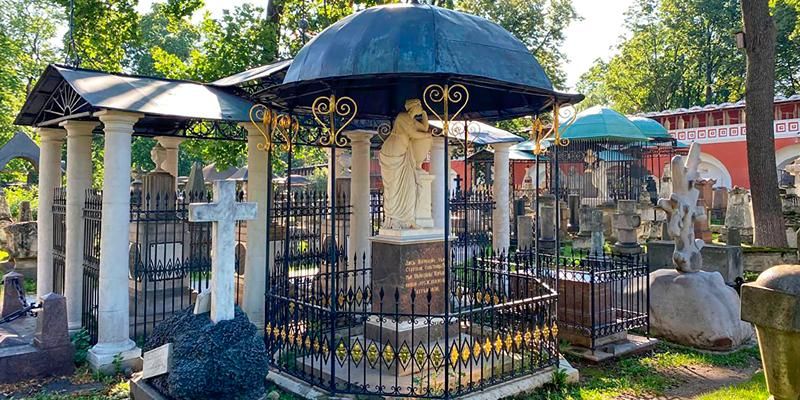
Another valuable example of monumental sculpture can be seen in the western part of the necropolis of the Donskoy Monastery. Under the canopy with the completion in the form of a dome supported by eight pillars, there is a gravestone of the burial of Marya Naryshkina, the wife of the State Counselor and writer Semyon Naryshkin. The white marble monument is a sculpture in the form of a female figure leaning with her left hand on a funerary urn. The mourner is a young woman dressed in a long chiton, up to her feet, tied with a sash, and on her left shoulder is fastened a palla cape, which wraps around her whole body and is thrown over the urn. The dome of the ciborium is topped with a gilded cross. Conservation work on the monument was completed in 2022. Specialists made a new foundation and recreated the wrought iron decorative details of the fence and ciborium.


Also, on the territory of the necropolis of the Donskoy Monastery there is a tombstone of Nikolai Frantsevich Simashko, a captain of the Guards and cavalryman. His monument is certainly eye-catching and speaks to the special place he held in the life of the community. Nikolai Frantsevich’s tombstone is about five meters high and has a form of a four-pointed cross made of gabbro, mounted on a stele, in the central part of which there is a round marble medallion with a bas-relief image of Mary mourning Jesus Christ (“Pieta”). On the pedestal there is a memorial inscription in gold leaf and the manufacturer’s branding, made in the technique of cutting-in. The site boundary has a fence of geometric floral pattern. In 2021, the restoration of the tombstone was carried out on all elements of the monument, the lost decorative element - a branch, elements of the fence were recreated.
.jpeg)
In the late 19th—early 20th century neoclassical style was widespread in architecture. A striking example of this direction is the crypt of the Knop family in the Vvedensky cemetery, a monument of the beginning of the last century, made in the form of ancient ruins. The 1910s memorial complex is a crypt surrounded by a fence that runs along the entire terrace. Although the author of the project remains unknown, some elements of the architecture were created in the famous Moscow workshop of stonecutter Ivan Pavlov, which is confirmed by a branding on one of the columns.
During the restoration, specialists strengthened the foundation, cleaned the surfaces of the walls and architectural details, restored the terrace fence and the interior of the upper part of the crypt. They also restored windows and doors, restored unique Falconier glass blocks and Luxfer prisms made according to the surviving patterns.

The Knops were prominent among the entrepreneurs of the late nineteenth and early twentieth centuries. By 1917, most of the family had left Russia. The founder of the dynasty, Johann Ludwig, along with his wife and children, died abroad. There is no exact information about who was buried in the crypt.
In 2023, a bronze sculpture of Christ was returned to the tomb’s stylobate as part of a comprehensive restoration. The copy was made during the restoration work. The original sculpture, created by the Italian master Raffaello Romanelli in Florence at the end of the 19th century, was originally located on the steps leading to the tomb. In the 1940s the sculpture was moved to the Church of the Smolensk Icon of the Mother of God in the Novodevichy Convent, and in the 1980s it ended up in the archaeological office of the Moscow Theological Academy, where it remains to this day.