Moscow’s first double-decker tunnel opens to traffic
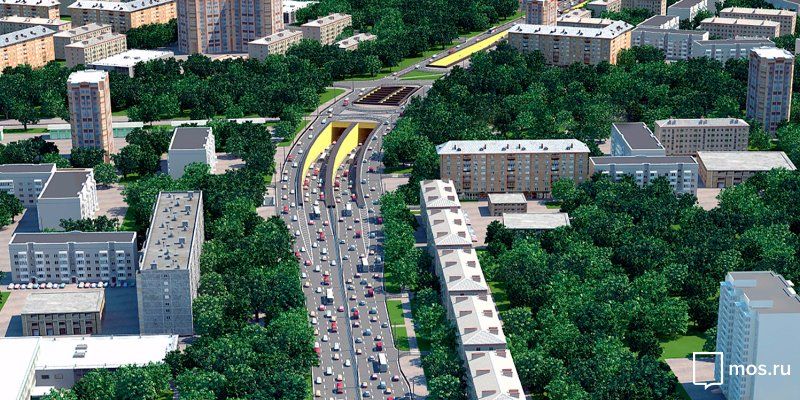
Traffic has accelerated at the intersection of Berzarina and Narodnogo Opolcheniya streets thanks to a new double-decker tunnel that has opened a year and a half earlier than planned.
Split-level road
The unique structure, the first of its kind both in Moscow and Russia, was crucial for the reconstruction of Narodnogo Opolchenia Street. The unusual design was suggested by the famous American two-barrel Winchester gun.
Instead of running side by side, opposing traffic flows will be split into two levels for nearly 200 metres and then return to a bidirectional motorway. Vehicles moving along the even-numbered side of the street go to the 786 metre lower tunnel, which extends 12.5 metres below the surface. Traffic on the odd-numbered side goes to the 542 metres upper tunnel, which is 10 metres below.
The first tunnel goes below the second one not at the deepest point, but where it almost reaches the surface, hence the difference in depths. Another reason is the placement of utility mains.
Each tunnel has three lanes. Two additional lanes on both sides of the tunnel provide access to residential areas.
Why a double-decker tunnel?
The tunnel has made it possible to remove traffic lights that slowed down traffic at the crossing of Berzarina and Narodnogo Opolchenia streets and to reduce street noise for residents of blocks of flats bordering on the traffic zone.
The double-decker design was chosen in order to move the motorway as far as possible from residential buildings. It is now 14 metres away, whereas an ordinary tunnel would have been only six metres.


Part of a large-scale project
The double-decker tunnel is part of the future Northwestern Expressway, whose construction began in 2012 on a stretch from Leningradsky Motorway to Prospekt Marshala Zhukova. As a result, the number of lanes was increased from three to five on Alabyana Street in both directions and to four on Narodnogo Opolchenia Street, plus six kilometres of side roads were built along both. Five pedestrian overpasses and one underpass have also been constructed.
The expressway will run from Skolkovskoye to Dmitrovskoye motorways through four administrative areas – Western, Northwestern, Northern and Northeastern. The 30-kilometre road will link major motorways: Skolkovskoye, Mozhaiskoye, Rublyovskoye, Zvenigorodskoye, Volokolamskoye, Leningradskoye and Dmitrovskoye. Near Dmitrovskoye Motorway, drivers will be able to exit from the Northwestern to the Northeastern expressway and also to Sheremetyevo Airport and Yaroslavskoye Motorway.
The Northwestern Expressway is slated for completion by the end of 2018. Some sections are already finished. Bolshaya Akademicheskaya Street from Dmitrovskoye Motorway to Alabyano-Baltiysky Tunnel was reconstructed and the tunnel itself was built.
Reconstruction has been completed on a stretch from Leningradskoye Motorway to Prospekt Marshala Zhukova, as well as on Vyazemskaya and Vitebskaya streets, Skolkovskoye Motorway and a stretch from the bridge across the Setun River to Ryabinovaya Street, Ryabinovaya Street itself and part of Generala Dorokhova Street from Aminyevskoye Motorway to the MKAD Ring.