Fragile heritage: a pomade jar from the 19th–early 20th century has been found in Kaloshin Pereulok

In Kaloshin Pereulok archaeologists have found an old porcelain pomade jar. This container was used for creams, lipstick or balms in the 19th–early 20th century. The valuable artifact is decorated with a special design—on the bottom there is a picture of a rooster. This is the first time such an artifact has been discovered by archaeologists.
As the reader may know, the rooster became a symbol of France during the French Revolution in the late 18th century, when the image of this bird appeared on the new 20-franc coin. The French, who considered the Gauls their ancestors, recognized the Gallic rooster as their national emblem. On the pomade jar, it acts as a kind of quality mark. Significantly, this French-inspired cosmetics jar was clearly produced in Russia, as it is made of Gzhel clay.
“Small ceramic vessels are often found by archaeologists in recent cultural layers. These artifacts are mostly white or blue in color. The jar found in Kaloshin Pereulok has a stamped design, and on the bottom is a picture of a bird. Perhaps this combination was chosen by the ceramists on purpose as a reference to the fact that the cream or pomade in the jar is of French origin. This suggests that the ceramicists chose the picture deliberately. The find has already been restored and will be included in the collection of the Museum of Moscow,” said Alexei Emelyanov, head of the Moscow Department of Cultural Heritage.
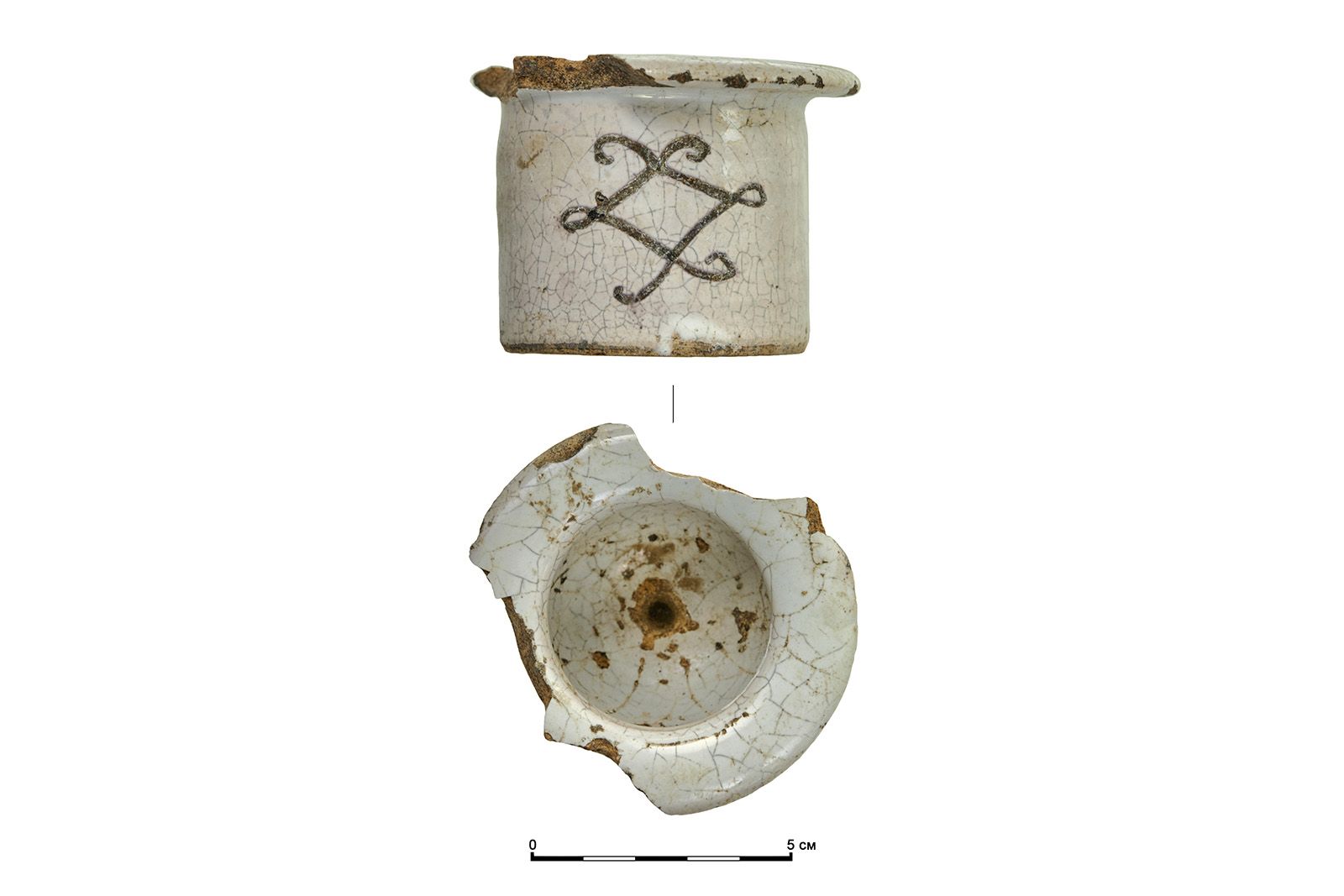
In the 19th–early 20th centuries, pomade was a hair care product that gave luster to the hair and made the hairstyle more stable. It was popular with both women and men. The main ingredient for its manufacture was pork or beef fat, or some other animal fat, to which aromatic substances were added.
By 1850, there were 11 hair fondant factories in Moscow, producing 400,000 rubles’ worth of goods a year. Containers for creams, pomades and balms were made in Gzhel from the end of the 18th century onwards. The territory around Gzhel was annexed by the Moscow principality in the 14th, and this served as a powerful stimulus for the development of pottery production in this area.
During the reign of Alexei Mikhailovich, in 1663–1666, Gzhel became the exclusive supplier of apothecary vessels. Local craftsmen made them in large quantities for supply to the capital, and Gzhel goods were recognized for their quality. Subsequently, these “suppliers to his majesty’s court” laid the foundation for ceramics production in the Russian Empire. In recognition of its production of porcelain vessels for medicines, in 1710 Gzhel volost was given the right to supply the Apothecary Guild in Moscow.
Fondant containers were somewhat different from other apothecary containers. They had thick walls and a solid rounded bottom to make it easier to scoop out the contents with a wooden spatula or fingers. The jars were made of clay and covered with an opaque layer of glaze to which tin was added. This protected the vessel from corrosion as a result of contact with acids and alkalis, thus making the vessel impermeable. The inside of the container was always white and the outside was painted.
An archaeological excavation has been conducted on a site located in the block between Arbat Street and Sivtsev Vrazhek, Starokonyushenny and Kaloshin Pereuloks. The archaeologists have found a whole collection of artifacts from the 16th–19th centuries. Tobacco pipes, some of which are glazed, various porcelain fondant jars, and painted tiles make up the bulk of the finds. Now the items are being restored and in the future will be transferred to the Museum of Moscow for permanent storage.