Six senses: how Moscow museums organize excursions for people with special needs
Museum exhibits can not only be viewed, but also listened to, touched, smelled and even felt: it all depends on which senses visitors are most used to perceiving the world through. Today, people with special health needs come to visit exhibitions in the capital. Moscow museums have prepared special programs for them, which are both accessible and understandable. Their participants feel as if they are in a 4D movie theater, in which all their senses are engaged.
On International Museum Day, which is celebrated on May 18, we tell readers about commentaries for the blind, how information is conveyed to neurodiverse visitors, and where visitors can touch museum exhibits.
Museums without sound: how bright lights and tablets help
People with hearing impairments perceive the world as a picture, and can read and communicate in Russian sign language. With this in mind, the capital’s museums have developed specially adapted programs for them.
For example, in 2023 the Museum of Cosmonautics created an inclusive project, Traveling through the Academician S.P. Korolyov Memorial House-Museum. Visitors are shown the rocket designer’s letters, photographs, books, as well as a disk phone, a KVN-49 television and even his dumbbells. And they can learn about the exhibits from a special app on their smartphones. The app provides them with background information, and allows them to zoom in on exhibits and view them in greater detail. Some objects, such as the model of the RP-318 rocket-powered aircraft, and Sergei Korolyov’s glasses and movie projector, are presented in 360 degrees.


The Battle of Borodino Panorama Museum has also developed interactive programs for fifth to ninth grade students. One of them, “Tell me, uncle…”, is dedicated to Mikhail Lermontov’s poem “Borodino”. Sign language guides tell the children about the exhibits, point out the artillerymen, and explain such terms as “gun carriage” (for cannon), “shell”, “buckshot” (a type of missile) and “redoubt” (a field fortification surrounded by a moat). Another program is the Military Council Cabin: schoolchildren are shown around a recreated peasant house of the early XIX century with icons, Russian stove and kitchen utensils from the period. The guide takes them back to the evening of September 13, 1812, when Mikhail Kutuzov decided not to fight for Moscow, a decision that affected the future course of the war with Napoleon Bonaparte.
Marina Tsvetaeva’s House-Museum implements several programs for those with impaired hearing, with the support of the Svet charity and social assistance fund, and in 2024 these were attended by about 400 people. In particular, a mobile video guide was introduced here in 2023. Visitors are given a tablet, and can point the camera at an exhibit of interest and read about it or receive information in Russian sign language. In addition, the museum regularly hosts a sightseeing tour, the Life and Work of Marina Tsvetaeva, which is conducted by Lyudmila Zhadan, a hearing-impaired guide, philologist and teacher, and the founder of an association for lovers of devotees of the Russian language.
“I am a native speaker of Russian and user of Russian Sign Language. I use my hands and facial expressions during the tour. First, I take time to get to know the group, find out the age of the visitors and ask them what they know about the subject: this makes it easier for me to understand what to pay attention to. Sometimes it turns out that we have met someone before, and this is very important: in the deaf community we appreciate someone who is “one of us” and attend to what they have to say with great pleasure,” says Lyudmila Zhadan.


Explore the museum by touch and smell
It is important for people with visual impairments not only to hear information, but also to touch exhibits, feel their texture and smell them. The Marina Tsvetaeva House-Museum also has special tactile exhibits, including a relief album with a tiflomarker (a device that sounds out information when you point it), as well as an audio guide with a commentary for the blind. During the Four out of Five Senses, visitors are invited to explore the olfactory exhibits — scents specially created for each room.


The Museum of Cosmonautics hosts an inclusive project, See Space on Earth, which includes interactive classes for blind and visually impaired children. A collection of tactile models has been developed for them, including replicas of the Vostok and Soyuz launch vehicles, the Soyuz spacecraft and the Lunokhod-1, the first mobile laboratory on another celestial body. With the help of these replicas, the science communicator tells the visitors about the structure of the equipment and the history of space exploration. Classes are held every week, and details are published on the museum’s website.
And in the State Museum of the Defense of Moscow, information about the exhibits is written in Braille. In the Museum’s excursion, The Great Feat of the Defenders of Moscow, visitors with special needs are told about the Battle of Moscow.


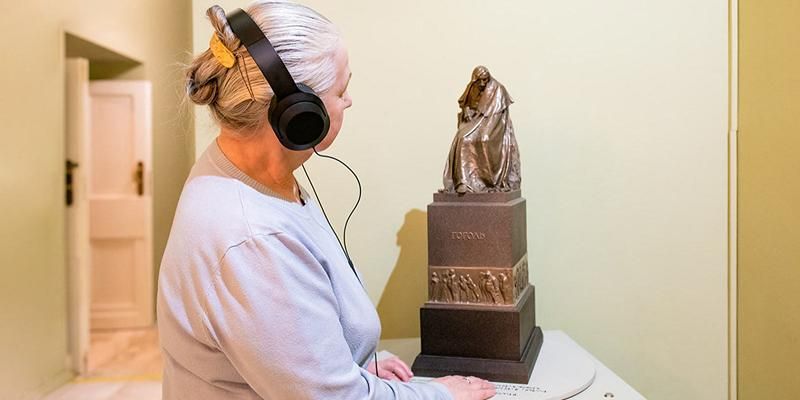
The Gogol House has multi-format publications including albums with relief graphics, Braille and QR codes leading to pages with audio information. Visitors can borrow these by asking at the museum ticket office. One of the exhibits is a tactile model of the monument to Nikolai Gogol on Nikitsky Boulevard. In addition, visitors can download a special audio guide for the blind, with a detailed description of the appearance of the exhibits.


The State Darwin Museum has an interactive educational center, Know Yourself — Know the World. This center has special computer programs that allow visitors to hear and compare the heartbeat of a humans and animals. Visitors to the museum can also touch and experience the feel of animal furs and learn to distinguish flowers by smell.One of the museum’s projects is called Seeing the Forest. Researchers have printed on a 3D printer 1/100 scale tactile replicas of trees growing in the capital and Moscow region. Among them are pine, birch, oak, poplar, and rowan trees. Blind people can feel the crown, trunk and roots.
“Each tree model has a braille description attached to it. Usually we go with visitors to the museum’s eco-trail where these trees are planted, stop near each one, study the replica, then touch the living tree — its bark, branches, and leaves, and smell its cones, seeds, and berries. Smells are not necessarily pleasant, but this is one way a sightless person learns about their environment,” says Lyudmila Atamanova, a researcher at the Department of Ecology and Nature Conservation of the State Darwin Museum.


Sometimes deaf and visitors come for a tour. In such cases, a separate visiting specialist works with each person, making various tactile gestures with their hands (tactile signing), which is how the person takes in information.
Museums accessible to everyone
Another category of sightseers that requires a special approach is people with mental peculiarities. There are projects for such people, for example, in the K. G. Paustovsky Museum. Two excursion programs, Journey through Paustovsky Country, and The Fairy Tale Will Always Live, present stories about the writer’s work, adapted for people with Down Syndrome, autism and other conditions.
The Alexander Solzhenitsyn House of Russian Culture Abroad hosts We Paint Khokhloma masterclasses in which children are introduced to the history of this folk craft, which originated in the 17 th century in the Nizhny Novgorod district of the Volga region. They also learn how to create their own Khokhloma design. And in the interactive excursion Touch Moscow With Your Hands, the children learn about the materials used to build houses in the capital, and feel the heaviness of bricks, the warmth of wood and the roughness of stone. The program “Penmanship Lesson: From Stylus to Pen” will introduce young visitors to the history of writing.The N. A. Ostrovsky Museum has created an excursion, the House at 14 Tverskaya Street, for people on the autistic spectrum. They try to promote visitors’ social involvement by encouraging them to take their own cloakroom tags or buy their own ticket.
“The main rule is to use simple words. Mentally challenged people have difficulty with metaphors, technical terms, dates, and patronymics. Information should be delivered piecemeal and only the most important information should be shared. One day there was a young man in the group who couldn’t speak or write, but he drew beautifully and worked as an illustrator. I showed him the stencil through which Ostrovsky, having lost his eyesight, continued to write, and asked him to write out his name. He succeeded, and he was happy,” says Anna Vorobyeva, first category educational methodologist at the N. A. Ostrovsky Museum.


In the near future she plans to prepare various special programs for visitors on the autistic spectrum, including Favorite Soviet Comedies, Holidays and Food from Different Countries and Let’s Play (based on tricks and games from the 19 th Century).
“There is no particular methodology for interacting with such visitors. You need to find an approach that suits each group, and love your work!” she says, summing up.
In the I.D. Sytin Apartment Museum descriptions of the exhibits have been prepared in clear language (a simplified and structured form of Russian, understandable to people with cognitive impairments) have been created for visitors with special needs. For the visually impaired there is a tactile mnemonic scheme at the entrance and a relief-graphic album with typhlomarkers. In the first room, an Istok induction system has been set up to help hearing-impaired visitors who use hearing aids. A digital portal has also been created with an audio commentary for the blind, videos in Russian sign language and texts in clear language. Museum staff have been trained to work with visitors with disabilities.
Among other things, all museums adapted for visitors with special needs have ramps and elevators for people with impaired mobility.