Russian folk fantasy. The premiere of the ballet “Stravinsky. Dolls. Dances” at the MAMT
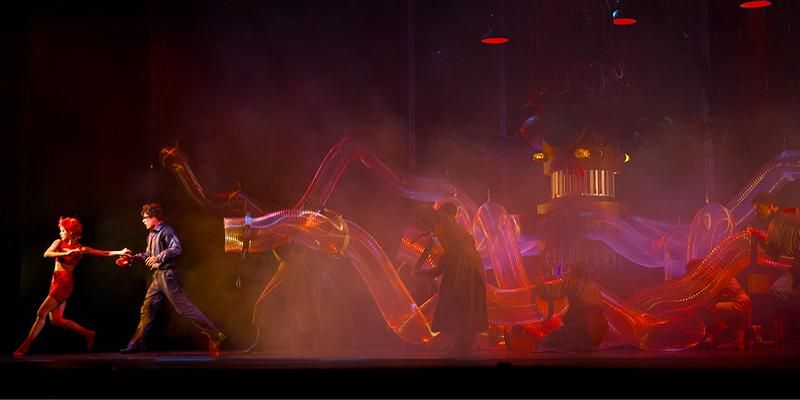
The K.S. Stanislavsky and V. Nemirovich-Danchenko Moscow Academic Musical Theater (MAMT) has presented the most anticipated ballet premiere of the season — “Stravinsky. Dolls. Dances”. This is a completely new and very bold take on Igor Stravinsky’s legendary one-act ballets. The choreography is by young stars Konstantin Semyonov and Kirill Radev, and the whole production is directed by Alexey Frandetti.
When it comes to such pillars of musical and ballet art as Igor Stravinsky and Michael Fokine, and even more so the holiest of holies, the ballets performed by Sergei Diaghilev’s Ballets Russes, it takes a certain courage and even audacity to present the material in a new way. Alexei Frandetti, a star from the world of musicals, does not lack these qualities. His directorial style is defined by a craving for spectacle and the creation of something brand new from familiar classics — just take last year’s production of “Cabaret Pushkin” on the stage of Lenkom or the undoubted hit of the Taganka Theater, “Sweeney Todd, the Demon Barber of Fleet Street”.
“Basically, everything I do one way or another is fairly experimental. Because doing things the old way and being afraid is generally no fun, clearly not in this profession. But, really, when you make a decision that you will do something in a brand new way, you just throw yourself into this cold water and swim, without thinking about what temperature it is in the pool,” admits Alexey Frandetti.


People in the world of dolls
For the MAMT, “Stravinsky. Dolls. Dances” is a great experiment and even a challenge. The S. V. Obraztsov Puppet Theater was invited to cooperate. In Petrushka, the staging company has retained the original libretto by Alexandre Benois and Igor Stravinsky’s original concept and music, but it is still fundamentally different. The familiar Petrushka is a street ballet, the drama of a marionette puppet with a human soul against the background of a noisy, endlessly moving crowd. Here there are two backgrounds, giant puppet sets that come to life and a video projection in which the puppeteer’s graceful hands arrange the puppets on the stage as if on a chessboard. On the stage, the ballet dancers are partnered by puppets created by artist Viktor Nikonenko.

“In Stravinsky’s ballets, there is a world of people and a world of puppets in a single space of the theater, on one stage, so there is one world within another world. These two streams, like reflections, enter into a kind of competition: they fight for reality, bringing the viewer to the point of confusion — where is the puppet and where is the actor? That’s why in the scenography we wanted to revitalize not only the puppet-characters, but also add life to the scenery. That’s how the giant animated puppets were born. And the hands of the creator bring this whole world to life before our eyes,” said Viktor Nikonenko.
The world of puppets is literally mixed with the world of people, the action turns into a full-fledged theater of living figures. The innovative scenography shapes the space and establishes the geometric framework. This creates the inner drama of the hero, and as a result his confrontation with the world feels even sharper. The visual solution expands the philosophical subtext of the work, and the choreography, at the intersection of classical and contemporary dance, further reveals the inner world of the characters.


Konstantin Semyonov tells us: “This is a challenge for the musicians, conductor, orchestra, and for the theater staff in general, in particular for the choreographer, who must translate this complex rhythmic structure into dance movements. Of course, we were in for a lot of surprises. For me as a choreographer, I discovered for the first time working with life-sized puppets, which completely replicate the proportions of a person. And we had the challenge of making the puppet dance indistinguishable in complexity from that performed by the ballet dancers. Of course, I did not only use modern dance techniques, as Fokine did in his production. His production was illustrative, in that he used movement to convey information, and here dance plays a more prominent role — I made it follow this complex music”.
The end of the story is well known: Petrushka has no place either in the world of men or in the world of puppets, he perishes, becomes a symbol and laughs ominously in eternity.

Russian folk fantasy
It is well known that Stravinsky’s first ballet for Diaghilev’s company was The Firebird. And a year after it, Petrushka, with its “music that smelled of soup and boots,” as the composer himself wrote, exploded onto the stage in Paris. However, the logic in the MAMT performance is subordinated not to chronology, but to the director’s concept and the requirements of dramaturgy. Reflecting on the production, Alexey Frandetti realized that Ivan, the protagonist of The Firebird, fights not only with Kashchey, but with the whole world. That’s how the idea of moving the action into modern realities was born. “Suddenly it became clear that it was much more honest to both the audience and ourselves to realize that this is a completely new libretto, which unfolds in time to Igor Stravinsky’s music. And that’s why we created a completely new modern version of the libretto for The Firebird,” the director emphasizes.
Here, too, the visual solution is quite radical: the action unfolds against the background of a projection of a large urban construction site. Instead of Kashchey’s castle, we see an apartment complex under construction, and the princesses and princes, like Ivan himself, are employees of the construction company. Kashchey appears as a strange huge machine that resembles an alien mind. A Russian folk tale turns into a full-blown fantasy.


“For me, the main challenge was to give a certain plasticity to the characters in The Firebird. A plasticity that enable Ivan and his entourage, the princesses, princes, to stand out as separate characters. The main support for me was Stravinsky’s score, which is a dream and a challenge for any choreographer. This must be a magnificent monument — a score that will be eternally avant-garde, eternally alive, with a complex internal structure, but at the same time very scenic, one could even say cinematic,” choreographer Kirill Radev reflects.
However, taking on great scores is not new to him: he has already encountered Stravinsky’s music when he worked on the opera Oedipus Rex at the Alexandrinsky Theater (which, by the way, also involved puppets). And more recently, Kirill Radev presented his version of Bolero+ at the Novaya Opera Theater with great success. The choreographer believes that tradition should not become a habit. According to him, folk tales, when viewed from a different angle, reveal themselves differently and come to life. They will always be contemporary and will provide so many opportunities for stage realization. Undoubtedly, in this production the authors have deeply explored the limitless potential of the Russian fairy tale.
This new version of The Firebird is the story of a modern young man who is trying to accomplish something in life, but is burned out by his own fantasy and the world around him. It is only in the finale that Ivan has a beautiful vision that brings the viewer back to the source material.
As one would expect from Alexey Frandetti, by giving the action such scope, the director has brought the usual format of an evening of one-act ballets to the level of a grandiose show: for ballet connoisseurs — an opportunity for great discussion and many comparisons, and for the general public, simply a breathtaking spectacle.
Tickets for “Stravinsky. Dolls. Dances” can be purchased on mos.ru.