The future of the capital: the successes achieved by Moscow school students and college students in 2024
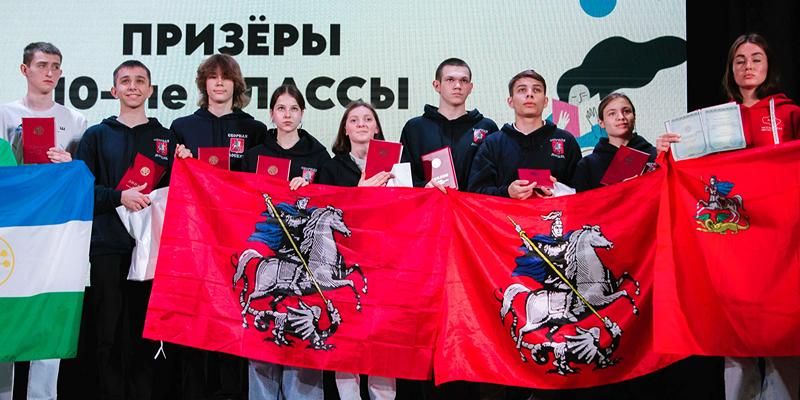
In 2024, Moscow students distinguished themselves at the All-Russian Olympiad for Schoolchildren, received high scores in the Unified State Examination (USE), won dozens of awards at international Olympiads in various subjects, and came first in the Russian national competition Big Change.
Moscow’s high school and college students led the medal lists in the Professionals vocational skills championship, outperforming more than 30 teams from cities across the country in this high-technology championship. For more about these and other achievements of children in 2024, see mos.ru.
1331 diplomas at the All-Russian Olympiad for Schoolchildren
... were awarded to the Moscow team in 2024. Moreover, 36 schoolchildren from the capital became absolute winners in this intellectual competition. The Muscovites improved on their results from last year in biology, computer science, art, Italian and German, technology and physical education. 90 schoolchildren were awarded diplomas in two subjects, and nine in three.
In recent years students from Moscow have made up more than a third of the participants in the finals of the All-Russian Olympiad for Schoolchildren and won more than 40 percent of all diplomas. In 2024, they particularly distinguished themselves in math, computer science, and the natural sciences: physics, chemistry, and biology, earning a record 357 diplomas in these subjects.


50 awards at international Olympiads
... were won by Moscow schoolchildren in 2024. Students from the capital forming part of the official national teams of Russia won 24 medals—more than half of all the awards. The students won five gold medals at the Open World Astronomy Olympiad, three gold medals each at the International Olympiad in Informatics and the International Chemistry Olympiad, and four gold, one silver and two bronze medals at the European Geography Olympiad. The Muscovites also brought back two gold and one silver medal from the International Biology Olympiad, one gold medal from the International Physics Olympiad, and one gold and one silver medal from the International Junior Science Olympiad, which took place in Romania.
Unofficially, Moscow schoolchildren joined international competitions, and in the European Geography Olympiad, in addition to the participants of the main team, a team of juniors showed their knowledge. The children demonstrated their knowledge of chemistry, physics, biology, geography, economics, astronomy and linguistics, winning 26 medals: 10 gold, 12 silver and four bronze.


400 points in the USE
... was the result achieved by Alexandra Ogloblina, a school leaver from Bauman Engineering School No. 1580, who was the only schoolgirl in Russia to achieve such a high result in the Unified State Examination. She took four subjects: Russian language, specialized math, computer science and physics and scored the maximum number of points in each of them.
For three years now, our final year students have been intensively preparing for the USE. In the second half of the year, they begin to study at special workshops on the subjects they have chosen to do exams in, completing the main program before the New Year. Thanks to this approach, in 2024, young Muscovites achieved superb results in the USE, improving on performances of previous years, for example, in physics and math. Moscow was the only region in the country to have a school leaver who gained 400 points. In addition, the number of students who failed the basic exams in Russian language and mathematics almost halved 
This year in the capital there were more school leavers who obtained the maximum possible results in several subjects. Thus, out of the more than 87,000 Moscow’s schoolchildren who took the USE, 1860 students got the highest score of 100 points in one subject, 177 got the highest score in two subjects and 17 graduates got the highest score in three subjects. Over 40 percent of school leavers gained excellent results in specialized math and physics.
The most popular subjects at the USE were informatics, social studies and English. Moreover, the number of school leavers who did not reach the minimum threshold for a pass decreased by 20 percent. Over 80 percent of those who retook the USE were able to improve their results, and 54 percent of school leavers who failed the exams retook them and scored above the minimum threshold for a pass.

.jpg)


182 Moscow schoolchildren and 48 Moscow college students
... won top places and gained prizes in the Russian national competition Big Change. The country’s largest children’s competition, whose participants create and develop socially significant projects, was organized for the fifth time in 2024. The contest was held in 12 directions on the theme Family and Family Values.
The finals at the Artek International Children’s Center in Crimea brought together 700 schoolchildren from 68 regions of Russia. 1,500 high school students from all over the country reached the finals of the competition, 182 of whom were from Moscow. In the category Fifth–Seventh Grades 50 Moscow schoolchildren distinguished themselves, and there were 132 winners among the 8th–10th grade students.
Out of 600 students from Russian colleges who participated in the Big Change finals in Nizhny Novgorod, 48 students from Moscow were winners or runners-up, receiving cash awards of 100,000, 200,000 or one million rubles. The awards can be spent on education or launching startups.

_(1).jpg)

255 medals at the national Professionals championship
... were won by high school and college students from the capital. For the second year in a row, the Moscow team became the leader in the medals table at the Professionals vocational skills championship. The capital city was represented by 389 college and high school students in the finals of the 2024 competition. In total, they won 255 medals: 166 gold, 64 silver and 25 bronze.
“The successes of Moscow’s students are a result of the ongoing comprehensive modernization of the system of secondary vocational education in the capital. We have equipped educational institutions’ laboratories and workshops with the most advanced equipment, begun cooperating closely with employers, we prioritize the continuous professional development of mentors and teachers at city schools and colleges and have increased the amount of practical training provided to students by up to 70 percent. For the second year in a row, Moscow has been the leader and demonstrated the highest level of training and professionalism in the skills most in demand in various sectors of the city’s and country’s economy, winning 255 awards,” said Anastasia Rakova.
In the championship final in St. Petersburg, the Moscow team had 63 contestants. 46 college students and 17 high school students received 47 medals in the professional skills that are in highest demand in the labor market.


The best out of more than 30 national teams
... were the capital’s school and college students at the high-tech championship. The Muscovites competed against more than 30 teams from across the country during the finals, which took place in Veliky Novgorod, and came first overall. The capital team showed their knowledge and skills in fields including Virtual Worlds, Agricultural Robots, Artificial Intelligence in Unmanned Systems and Optoelectronics.
The Moscow team won 12 medals: five gold, three silver and four bronze medals, in 11 skills competitions for college students and four for schoolchildren.


