The crown jewels of the collections. Exploring one-of-the-kind Moscow museum exhibits
Moscow’s museum holdings contain 1.8 million items, from an ancient Heraclean amphora and an 18 th-century theater chandelier to a hummingbird collection and a prototype of contemporary light organs. Read the mos.ru story of some one-of-the-kind exhibits that are currently on display or in storage.
A chandelier with lanterns and the Egyptian tableware set
The late 18 th century chandelier with four-candle lanterns, kept in the Ostankino Mansion, was made by St. Petersburg master of German origin Johann Adam Fischer. He was probably the only chandelier maker (or coppersmith) who left his signature and date on his works so that the origin could be established with certainty.
Currently, at least 12 signed works by Fischer are known in Russia and abroad, five are kept in Ostankino, including the most remarkable chandelier with a faceted glass core and a very rare soft green hue. The crystal decoration consists of rainfall pendants, garlands, suspended festoons, rosettes and rhinestones, in addition to a faceted apple at the tip. On the lower rim there is the master’s signature: INFENIT. FECIT I. A.S. FICHER. ST. PETERSBURG 1793.

The Egyptian 136-piece tableware set, one of the most valuable exhibits at the Kuskovo Museum of Ceramics, is remarkable not only for its design inspired by Egyptian culture, but also for its history. In fact, it was made in 1808 by order of Napoleon Bonaparte shortly after his expedition to Egypt. The Emperor was going to use it himself, but later presented it to Alexander I of Russia.
The set is divided into two parts, one for desserts (72 plates, 12 compote bowls, 4 sugar bowls, 2 confiture bowls, 4 ice cream bowls and 8 fruit containers) and the other for breakfast, tea and coffee (cups, saucers and a milk jug). Of particular interest are the ice cream bowls shaped as canopic jars, ritual Egyptian vessels for embalmed viscera removed from a body during the process of mummification. The drawings on them repeat the bas-reliefs of the Karnak Temple, the main and largest one in Ancient Egypt.

And an exhibit displayed at the Museum of Ceramics that you would find inconspicuous at first glance is the earliest dated piece of Russian porcelain that has survived until these days. This is a small white candy bowl that has the shape of a Chinese peach with a lid decorated with molded flowers and leaves. It bears the year of manufacture (1748) engraved on its base and the monogram of Dmitry Vinogradov (1720–1758). The founder of the Russian porcelain industry, he studied together with Mikhail Lomonosov, was the first in our country to obtain a composition suitable for making porcelain and created the earliest porcelain products at the Nevskaya Manufactory, which was later renamed to the Imperial Porcelain Factory.

The famous glass and The Mistress in the Kitchen
The Vershinin glass is an undoubted rarity of the Kuskovo Museum of Ceramics. The talented serf master Alexander Vershinin, who worked at the Bakhmetev crystal factory in the Penza Province, created a series of glasses bearing pictures of mansions and their daily routines, such as hunting, fishing and other scenes of rural idyll. They are fancy in fact as they have double walls; the narrow space between them features miniature realistic landscapes made from pebbles, moss, straw and paper. What is especially admirable is how the master managed to connect the glass walls without destroying the fragile models. Glass is processed at a temperature of about 900 degrees Celsius; the combustion temperature for paper and straw is, naturally, much lower.
Few such works have survived as only 12 Vershinin glasses, which are never identical, are known to be kept in Russian and overseas collections.
.jpg)
The Mistress in the Kitchen, a painting by the Dutch artist Cornelis Jacobsz Delff (1570/1571–1643), is one of the most valuable in the collection of the Counts Sheremetev. Cornelis Delff was among the first Dutch painters of the late 16 th and first half of the 17 th centuries to masterfully create kitchen still lifes, like those by Pieter Aertsen (1508–1575). Aertsen was a pioneer in the history of Dutch painting who depicted ordinary people as the figures of peasants on his monumental still lifes are elevated to heroic levels. Delff’s paintings feature kitchen utensils as a special leitmotif.
In the 18 th century, The Mistress in the Kitchen decorated the kitchen of the Dutch House in Kuskovo; however, centuries later it needed restoration, and the museum had to raise one million 184 thousand rubles to restore it. Lots of art lovers, including Kuskovo visitors, did that and The Mistress in the Kitchen was restored at the State Research Institute for Restoration.

Hummingbird collection and Heraclean amphora
The first European naturalists who came to study hummingbirds in the New World in the 19 th century compared them to precious stones, so unusually did their plumage shimmer in the tropical sun. State Darwin Museum boasts a whole collection of these brightly colored birds.
There is a romantic story connected with hummingbirds from the lives of the museum’s founders. More than one hundred years ago, its first director Alexander Kots gave his fiancée Nadezhda Ladygina three rare stuffed birds on her birthday. Thus, in 1911, the Kots couple laid the foundation for Russia’s biggest collection, which now contains 578 items, including hummingbird nests and even one skeleton the size of a little finger. Such exhibits are real pieces of a craftsman’s job.
Hummingbirds are displayed in the main exhibition and can also be seen from time to time at temporary displays. The collection of tiny birds was exhibited as a whole twice (2011 and 2014), when each visitor could use a flashlight on the hummingbirds to see their iridescent plumage.


Meanwhile, Paustovsky Museum contains not only the writer’s manuscripts and personal belongings, but also rare and rather unusual exhibits. Visitors can see an antique Heraclean amphora from the 4 th-early 3 rd century BC, which was presented to Konstantin Paustovsky in 1959. One of his short stories is an account of how it was found. “I spent several days in the Bulgarian fishing port of Sozopol. This city was called Apollonia in ancient times. Poet Slavcho Chernyshev gave me a Greek amphora. He said that the amphora was two and a half thousand years old. Sozopol fishermen pulled it out of the seabed with a net at winter fishing. Chernyshev used to go to sea with the fishermen at that time, and they gave him the amphora”.
.JPG)
The Paustovsky memorial office in Tarusa displays a 19 th century telescope made in England, which was presented by poet Arkady Steinberg; according to the story told by the writer himself, it had once been kept on the famous frigate Pallada. Paustovsky loved to look through it into the window of his Tarusa home onto the road, seeing someone off or expecting guests.

Chess, two pianos and a light organ prototype
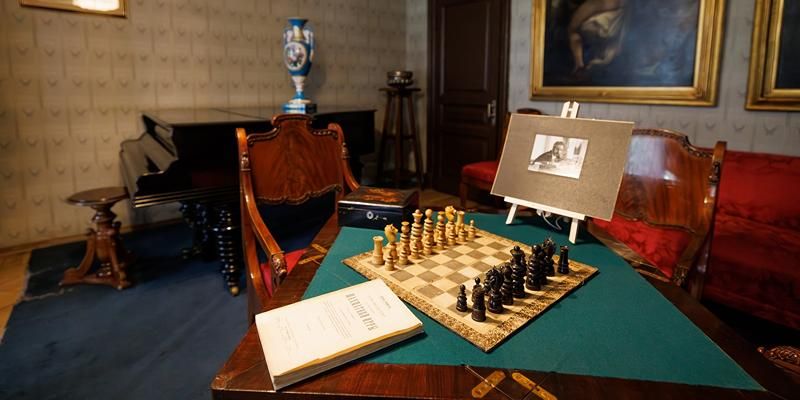
Like many of his contemporaries, Alexander Scriabin was passionate about oriental culture. The composer’s memorial museum holds plenty of related exhibits, such as interior items, Buddhist and Hinduist books and a chess set that Scriabin loved to play. In the closet, there is a small papier-mâché Japanese box for chess pieces. It is covered with glossy varnish and decorated with painting, the two sides of the red fan resembling a scarlet sunset, with sparrows and cranes in the background. Inside the box is divided into two sections — probably for black and white pieces. Yet, it is still unknown what kind of a chess set was stored in it.

The unique light and color apparatus is the pride and definitely a highlight of the museum; the composer needed it to combine music and light for the innovative poem Prometheus. The device was designed by Scriabin himself and made by his friend, engineer Alexander Moser. It was suspended from the ceiling in the composer’s office, and during the performance of the poem, his wife Tatyana Schletzer was at the console and accompanied the playing piano with lighting effects, following the Luce line in the score. The light and color apparatus was a prototype of contemporary light organs.

Scriabin’s pianos are quite remarkable, too. The composer worked on his latest compositions at a Bechstein salon grand piano, a gift from his friend and the brand’s official representative Andrei Diederichs. Now it is played twice a year — on the composer’s birthday (January 6) and on his memorial day (April 27). In the living room, there is also a Becker grand piano, which was donated by philanthropist Mitrofan Belyaev in 1895. At that time, Scriabin, a young graduate of the conservatory, was just beginning his creative career, so the instrument was always with him. Much later, his children Ariadna, Julian and Marina, who were taught by Elena Gnessina, played the piano as well. After the museum was established, it “fell silent” for over one hundred years and was only restored this year. Now it is played during musical lectures by Pavel Shatsky, the museum’s research fellow, pianist and associate professor at Moscow State Tchaikovsky Conservatory. The next meeting will take place on December 27.

The earliest printed books in Rus’
The Kolomenskoye Museum-Reserve keeps the book Apostle, which was published by Ivan Fedorov and Pyotr Mstislavets in 1564 at the Moscow Printing House. Thought to be among the earliest printed books in Rus,’ it goes in two colors (black and red) and mainly on French paper, with exquisite ornamental decorations and the headings in vyaz.
Apostle probably ended up in Kolomenskoye no earlier than the end of the 19 th century. In the 18 th-19 th centuries, it belonged to the collectors of old books and icons, the Old Believer merchants Pershins from Kovrov, who left their ownership stamp on the book. In the late 19 th century, the Pershins sold their collection due to financial difficulties. Presumably, the book was then bought at auction by Old Believers who used to live in Kolomenskoye. In 1962, three schoolgirls found it in the attic at 78 Bolshaya Street and donated it to the museum to be the central rarity and pride of its book collection. In fact, there are 67 copies of this edition remaining in the world.
