3-heart underwater prodigy: Moscow Zoo welcomes a giant octopus
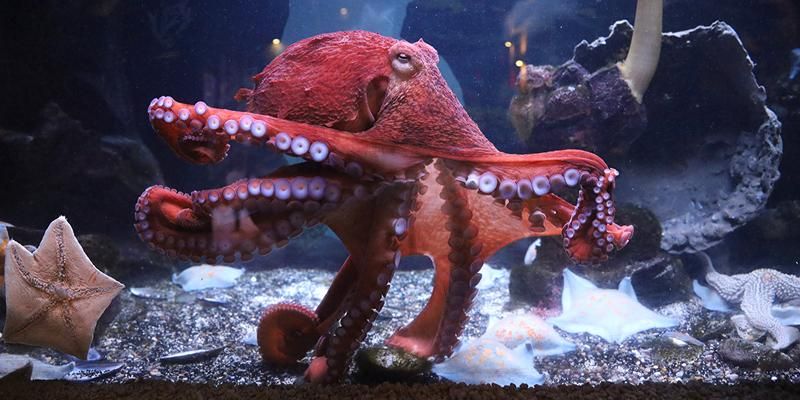
For the first time in a decade, the Moscow Zoo has got a giant octopus, so now the exhibition features the largest Cephalopoda mollusk. The male giant octopus arrived in the capital from Primorsky Territory and was quarantined for a month.
Today it can be seen in the Exotarium pavilion located in the zoo’s new part. It enjoys the most comfortable living environment, indeed. Before it moved in, they had rebuilt the aquarium to enhance it and install secure locks, since octopuses are able to open the lid of an aquarium with their dexterous tentacles. The sea water there is no warmer than +8 °C — the best temperature for northern underwater inhabitants.
The giant cephalopod has already taken some liking to its new home as it is calm and loves to eat mussels, scallops, and surf clams. To keep the octopus from getting bored, zoologists come up with activities for it; for example, they hide food in different places in the aquarium, and the smart mollusk finds it. It shares the aquarium with starfish and metridium, commonly known as plumose anemones, and it likes his neighbors very well. Zoologists note that the Moscow Zoo’s new resident feels comfortable and safe as it has ejected no stream of ink yet. Cephalopods usually exhibit this reaction when they are stressed or feel threatened.
Giant octopuses are the Earth’s most colorful and unusual animals. Their body contains a lot of copper; that is why it is colored blue. Moreover, octopuses have three hearts, one pumping blood throughout the body, while the other two provide oxygen to the blood by forcing it through the gills. Noteworthy, octopuses have brain not only in the head, but also in each tentacle, which makes them the smartest cephalopod. For example, the giant octopus is able to remember the employees who look after it. On top of that, all of the tentacles have perfect fine motor skills; so the octopus can easily open a covered bottle and pierce crab shells and mollusk shells with its beak, the only hard organ of the soft-bodied animal.
Giant octopuses change their color, depending on the situation and mood, and turn grey when in danger to make themselves less noticeable or take on a bright red-orange hue when at rest.
The underwater inhabitant moves along the seabed at high speed, as if with a jet engine. First, it sucks in water, then sharply contracts its muscles and releases it back, thus pushing itself and moving forward.
The reproduction process of these cephalopods is quite remarkable, too. Males deliver spermatophores into the female's body cavity using a special appendage called hectocotylus. Male octopuses die shortly after mating; having raised offspring, females die as well.
In the wild, giant octopuses live only a few years. In a short period, they grow from a 3-4 mm larva to an adult of 1.5 to 3 meters long, weighing 30 to 60 kilograms. These cephalopods live in the northern part of the Pacific Ocean, from Russia’s Primorsky Territory and southern Sakhalin Island to the Korean Peninsula and Japan. They can also be found near the Kuril Islands and Kamchatka, the Commander and Aleutian Islands.
The last time the Moscow Zoo was home a giant octopus, who had come from the northern shore of the Pacific Ocean in Primorsky Territory, was more than a decade ago.
The Exotarium pavilion is the Moscow Zoo’s unique space, most of its area occupied by live coral reef aquariums. The exhibition features about 100 marine species, such as sharks, moray eels, butterfly fish, lobsters, sea urchins, etc.
In total, the Moscow Zoo keeps over 1,200 species of animals, birds, reptiles and fish, some listed in the Red Data Book of Russia and the IUCN Red List. Today, its animal stock is one of the largest in the world.