Count Sheremetev’s collection. Sculptures that adorn Kuskovo Estate park
The garden sculpture of the Kuskovo Estate is a unique phenomenon in the history and culture of Russia; it is a striking example of how formal parks were designed in the middle and second half of the 18th century. The original marble sculptures of the Kuskovo Estate were made mostly by Italian artisans, but the collection also includes works by Russian sculptors.
The collection has no parallels or repetitions; the owner of the Kuskovo Estate, Count Pyotr Sheremetev, collected it for the estate for almost 40 years. The sculpture not only adorned the park, but also served educational purposes: it tells visitors about history, ancient mythology and European art. It was an essential part of landscape architecture: the statues designed the park space, highlighted key elements and created semantic groups. From time to time, the Kuskovo Estate was a kind of venue to hold crowded festivals and stage performances, and the sculpture was also part of the design and stage set.
Currently, the park contains 55 works of art: round, life-size sculptures and busts representing ancient gods, heroes of ancient Greek and Roman myths and historical figures. Find out about some collection pieces at mos.ru.
Ancient gods
Diana, goddess of the moon and forests, sister of Apollo, can be found on the right side of the Italian House. Visitors can easily recognize her by her characteristic attributes: a crescent moon on her head and a dog at her feet. The goddess patronized hunters, and the estate was famous for its hunting grounds. On Thursdays and Sundays, guests arriving at the estate could take part in the count’s hunt. Pyotr Sheremetev loved hunting with dogs and built a kennel in the Kuskovo Estate, where, according to an archival inventory, boasted a special bathhouse. The count ordered hounds from England, and the hunt was provided by staff, which included a huntsman, trough handlers, dog handlers, hound handlers and other workers.
The statue of Apollo in front of the palace depicts the sun god as a young man leaning on a lyre; he was the patron deity of musicians and poets. Surviving archival documents of Pyotr Sheremetev suggest that it was one of the first sculptures to appear in the park.

On the column next to the transverse alley there is a statue of Minerva that was erected in honor of Catherine the Great visit to the Kuskovo Estate in 1775, when Moscow celebrated the signing of a peace treaty with Turkey. The column was based on the model of those located in Tsarskoye Selo; the sculpture author is said to be Academician of the Imperial Academy of Arts Arkhip Ivanov. Legend has it that the Karelian marble for the column was donated to the estate by the Empress herself.
Many people associated the goddess of wisdom and reason, advocate for laws and civil rights, with the ruler. For instance, Great Princess Maria Feodorovna, née Sophie Dorothea Auguste Luise, Princess of Württemberg, presented Catherine the Great with her portrait in the form of a cameo depicting the Empress as Minerva.

Water characters
There are many characters representing the water element in the collection; perhaps this is due to the fact that the estate is located in an area that used to have several reservoirs, small rivers and dams.
The sculpture of the sea nymph Thetis, holding a fish-like creature in her hands, is in front of the Grotto Pavilion. Thetis is a water nymph, one of the daughters of the water god, Nereus, who, according to myths, lived in grottoes (underwater caves). The statue continues the theme of the park pavilion: its dome is topped with a stone fountain, the openwork lattices on the doors and windows resemble seaweeds; Johann Vogt used more than 24,000 shells from the Mediterranean, Red, Japanese and Black seas and reservoirs in the Moscow Region in his interior design.
The goddess of rivers, streams and lakes, Naiad, can be seen not far from the Grotto Pavilion. With her hand she is holding a vessel from which water is pouring out; the BS monogram is engraved on the statue, it is probably the author’s, which confirms the Italian origin of the sculpture.

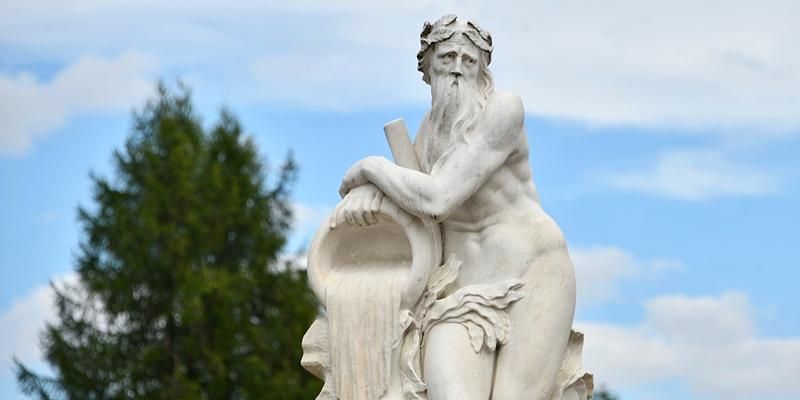
The Scamander River is an allegorical image of the river on which ancient Troy stood in the 13th-11th centuries BC. River gods were often depicted as old men leaning on an urn with water; the sculpture could be complemented by an oar, reeds or seaweed. The sculpture of the god Scamander is the largest in the Kuskovo Estate formal park; it is located in the parterre section. The sculpture also bears the BS monogram, and on the front side at the base is carved the inscription La Fleuve Scamandre.
Not far from the Dutch House and the pond there are four statues, including an allegory of the Kuskovo River, which once flowed nearby and probably gave the estate its name. It is one of the works by Russian sculptors. By the middle of the 18th century, the interrupted tradition of stone working in Russia was revived; craftsmen who had excellent skills in wood carving acquired new experience. In the artist’s view, Kuskovo deity is, like Scamander, an old man with a small vessel of water in his hands.

Metamorphoses heroes
The estate’s collection of sculptures was selected based (at least partially) on the famous Catalog sent to Russia in 1716 by a diplomat of Peter the Great. It indicated which statues could be placed in the parks and into what groups (or styles) they could be divided. One of them, the so-called Roman manner, involved paired sculptures of mythological figures, mainly from Ovid's Metamorphoses. Next to the Hermitage Pavilion there are busts of Orpheus and Eurydice. An analysis of the style, size and techniques suggests that these paired sculptures were made in the same studio.
The wood nymph Eurydice, wife of the singer and musician Orpheus, died from a snake bite. Orpheus went to the ruler of the underworld, Hades, to get his wife back. Enchanted by the sounds of the lyre, Hades allowed Eurydice to leave but on one condition: when leaving the kingdom of the dead, Orpheus was not supposed to look back. Just one step before the exit, he forgot about the warning and turned around, and Eurydice remained forever in the other world.

Another pair of sculptures are Vertumnus and Pomona. In Metamorphoses, Ovid tells the story of the courtship of the god of the seasons, the master of disguise, Vertumnus, to the goddess of fruits, Pomona. The marriage took place, and the couple together continued to provide the prosperity of the gardens of the Italian land. Pomona is depicted in the traditional manner with a cornucopia (the static nature of the figure perhaps suggests that it was supposed to be placed near the building), and Vertumnus is depicted with apples and grapes.
Collection preservation
The Kuskovo Estate looks after the sculptures carefully to preserve them. They are traditionally covered in protective cases in winter: marble absorbs moisture into microscopic pores and cracks. When the liquid freezes, it tears the stone apart from the inside, so precipitation and frost can damage the statues. That is why the sculptures in the park are prepared for winter in advance, from mid-October, and are opened when severe frosts are no longer expected.


Between 2019 and 2020, the sculptures in the Kuskovo Estate were restored. Experts were tasked with restoring 50 works. After almost three centuries in the open air, some statues lost their original form, and the marble changed color and became covered with cracks. But the experts restored the sculptures to their former glory.