Antique engineer’s compass: Archaeologists discover unique artifact
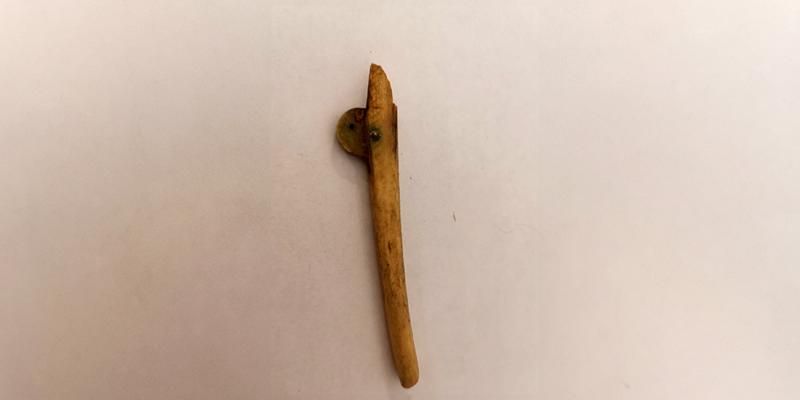
During archaeological excavations in 4 th Krutitsky Pereulok, archeologists discovered a fragment of a bone compass from the late 18 th-early 19 th century, such artifacts have never been found in Moscow before. The instrument has preserved the bone-made part of the leg with a brass mount, which holds the connecting bow. Experts have already restored the find and are now preparing it for sending to the museum stock.
“For many centuries, Moscow has remained the center of science and education. According to experts, the ancient compass could have belonged to a student or engineer who lived during the time of Paul I or Alexander I. The compass is a rather rare archaeological find, indeed. Measuring instruments have always been valuable and have been treated with great care,” says Alexey Yemelyanov, Head of the Moscow Department of Cultural Heritage.
The history of compasses goes back thousands of years. The drawn circles that survived in patterns and paintings in ancient buildings prove that the instrument was familiar to the Babylonians and Assyrians in the 2 nd-1 st centuries BC.
During excavations in Pompeii, archaeologists discovered many ancient Roman bronze compasses; moreover, they are almost identical to contemporary compasses. For example, they found compasses with curved ends for measuring the internal diameters of objects.
During excavations in Novgorod, they discovered a steel compass cutter, which was used to draw a pattern of small, perfect circles. A similar ornament was widespread in ancient Rus,’ including in Moscow, as it can found on bone items, such as combs, powder flasks, chess pieces, and also on ceramic vessels.
The word “compass” appeared in Russian during the time of Peter the Great. It was derived from the Polish cyrkul, or from the German zirkel. This ancient tool is still indispensable for architects, engineers, and builders.
The standard and most common form of compass is two legs connected together by a screw, allowing both parts to move freely on a plane. One leg is usually pointed, and the other has an attached writing instrument, most often a pencil lead.
The fragment found in 4 th Krutitsky Pereulok is probably that of a measuring compass; it has no lead and its both parts are sharpened. This is because it has a bow connecting two equivalent bone parts. This instrument was used to measure and plot straight-line segments.
The restorers carefully cleaned the artifact and treated its surface with special protective compounds. Once the restoration of the remaining items found in 4 th Krutitsky Pereulok is over, the compass will be sent to museum holdings as part of the collection. In total, the excavations in this area uncovered about 300 individual finds dating back to the 18 th and 19 th centuries, including children’s porcelain toys, dishes, various lamps, kitchen utensils, and decorative interior figurines.
4 th Krutitsky Pereulok was named after the nearby Krutitskoye metochion of the Sarskiye and Podonskiye archbishops. Founded as early as the late 13 th century, it became their permanent residency in the 2 nd half of the 15 th century. In 1571, the monastery was destroyed by the Crimean Khan Devlet Giray, but gradually it was restored during the reign of Feodor I and Michael I. The diocese was abolished in 1764.
The metochion’s name derives from the name of Krutitsy, the area on the high steep (‘krutoy’ in Russian) bank of the Moskva River. These lands had been outside the city bounds before the customs border around Moscow — the Kamer-Kollezhsky rampart-was built in the 1720s−1740s. After that, they became part of the city.
During the fire of 1812, the former Krutitsy courtyard burned down,. Later, the place was built up with private houses, which remained until 1917.