Robot Resuscitator, Smart Farm, and Smartphone ATM: The Projects Developed by Residents of the Special Economic Zone "Technopolis Moscow" and Technoparks
A CPR robot, an electronic farmer that autonomously cultivates vegetables, and an ATM that appears to hover in mid-air: these are not scenes from a science fiction movie but rather real inventions by local researchers. The creators of these innovative projects work at companies and factories within the science parks and the special economic zone Technopolis Moscow. Residents have certain benefits from Moscow Government that enable them to invest funds into innovation.
On Moscow Industry Day, celebrated on October 7, we explore how industrial clusters support inventors.
“Hovering” ATMs
One of the largest industrial sites in the city is the special economic zone Technopolis Moscow, which boasts a production area exceeding 1.5 million square meters. Over 220 companies are located across six sites — “Pechatniki,” “Alabushevo,” “Rudnevo,” “Angstrem,” “MIET,” and “Micron,” with 112 of them being residents. These residents have a decade-long exemption from property, transport, and land taxes, while the profit tax rate is just two percent compared to the standard 20 per cent. This fosters a more favorable environment for investment projects by lowering their costs.
“The special economic zone Technopolis Moscow offers comprehensive support in production. In addition to tax benefits, we receive informational support. Our company recently became a resident of the zone at the ‘Pechatniki’ site, just this September 2024, and we are already making headlines,” shares Andrei Volkov, the constructor engineer at SAGA Technologies.

The company specializes in creating a new generation of ATMs capable to recycle cash. This means that if one user deposits cash, another can withdraw it immediately without having to wait for the cash handlers to recount and replenish the machine’s vault.
The company offers over 700 different models, and one of them has become a real “star”: within four months, Andrei Volkov’s team developed a giant smartphone-like ATM upon a bank’s request, featuring a 43-inch diagonal touch screen made of tempered glass. One major challenge was to ensure that the glass was fully touch-sensitive and responsive to cards. It was also necessary to visually highlight the client’s logo. The designers incorporated the bank’s brand stripes on the side, illuminated them, and painted the machine in a silver hue that blended seamlessly with the shades of the surrounding walls, creating the effect of it hovering mid-air.

“This design was initially in development prior to our entry into the special economic zone Technopolis Moscow. Now, we are free to unleash our creativity. Until recently, Russia did not have its own ATMs; they were all imported, which led to difficulties in updating the software at certain points. The time has come to completely replace foreign equipment with domestically produced alternatives, and we intend to try our hand at it thanks to the Moscow’s support,” states the constructor engineer.
CPR robots
Medplant, a resident of the special economic zone Technopolis Moscow since 2018, has established a research and development department at the “Pechatniki” site. Here, specialists are dedicated to creating technology for emergency medical assistance. Their products include monitoring devices, tourniquets, portable syringe pumps, foldable splint kits for immobilizing limbs, and stretchers. Nearly all of their developments are innovative and aimed at replacing imported solutions.
“It is crucial that the special economic zone Technopolis Moscow allows its residents to pay a reduced profit tax rate of just two per cent, while also exempting them from property, land, and transport taxes. This enables our company to secure additional funds for investing in new projects and skilled professionals,” states Ilya Turin, head of the R&D department.

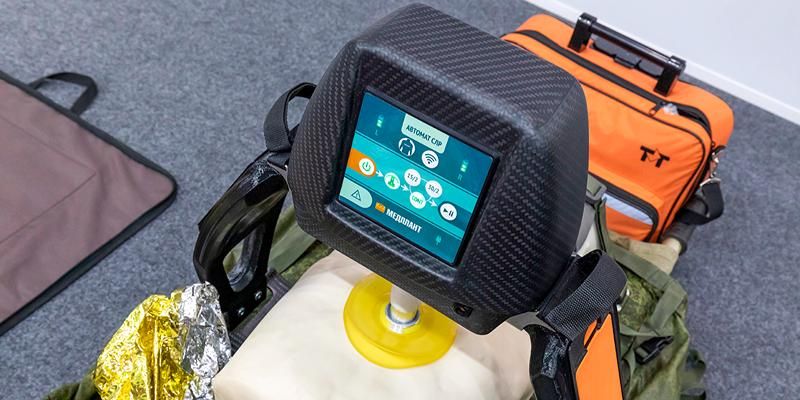
Among their inventions is a device for performing CPR, which they worked on for three years. “Typically, this massage is done manually, requiring a compression depth of five to six centimeters and a frequency of 100 to 120 compressions per minute. However, even the most experienced doctors cannot maintain that rhythm for more than two minutes, while our machine can perform CPR on a patient without pausing,” explains Turin in an interview with mos.ru.
The device consists of a support plate that the doctor places under the patient’s back, a functional block mounted on arched legs that elevate above the body, and a working part featuring a vacuum suction cup that actively decompresses the thorax. The doctor turns on the machine automatically identifying the compression point and selects one of three modes on the control panel; CPR begins. The technology adapts to different body types. “For instance, younger patients have soft and flexible bones, while the elderly have hard and fragile ones,” Turin elaborates.


The machine operates on a battery that lasts for 90 minutes. It is equipped with two batteries, ensuring that if one fails, the other will carry on with the task at hand. “There are no equivalents outside of Russia. We have already received a patent and are currently working on registering our invention so that we can offer it to all ambulance doctors in the near future,” adds the creator.
From light fixtures to electronic farms
Science park Mosgormash, located in the Nagatino-Sadovniki District, may not be as expansive as Technopolis Moscow, covering just over six hectares with 54 residents thus far. Yet, here too, industrialists find themselves on the right track: the Moscow Government supports those looking to export their products, helps them find partners and investors, and provides subsidies and grants for innovative projects.
The anchor resident of Mosgormash is LED Effect, a producer of energy-efficient LED lighting. The company boasts its own development bureau and modern equipment, all of which is completely domestic-made. The factory collaborates with other residents of the science park on mutually beneficial terms, thereby cultivating an industrial ecosystem.
Recently, the company’s specialists created a plant ecosystem — a vertical farm with LED lighting. The entire project took just one year.
“The vertical farm is compact and consists of a shelving unit. Water and nutrients are drawn from tanks into a mixing unit, where they are combined before reaching the top shelf. The liquid then saturates mats with seeds or root systems, cascading down to the next level. This continues all the way down to the bottom. In just 20 minutes, a complete watering cycle is finished. After that, the system needs to be turned off for about an hour to allow the plants to rest and absorb oxygen. You can manage it with a smartphone app,” explains Nikita Zakorvashevich, the technical director of the company.

The farm autonomously regulates both the light intensity and color. For instance, during the early growth stages, plants require less light, while the following stages require more; red light accelerates growth, whereas blue light promotes leaf development and prevents stems from stretching. “Thanks to the capabilities of the science park, we have established a showroom: we set up an experimental farm with a cultivation area of 1,000 square meters. We cultivate arugula, lettuce, and basil there. From the moment we plant the seeds, it takes only 25 days till the start of harvest,” Zakorvashevich tells mos.ru


According to the inventor, such comprehensive solutions for growing greens were previously unavailable either in Russia or abroad. The company is currently supplying its products to the largest agricultural and industrial organizations in the country, supported by Mosgormash. “We are currently working on integrating artificial intelligence into the farm, which will monitor the plants, adjust the program, and provide feedback,” Zakorvashevich shares.