Heritage rebirth. Exploring historical and new photos of Moscow
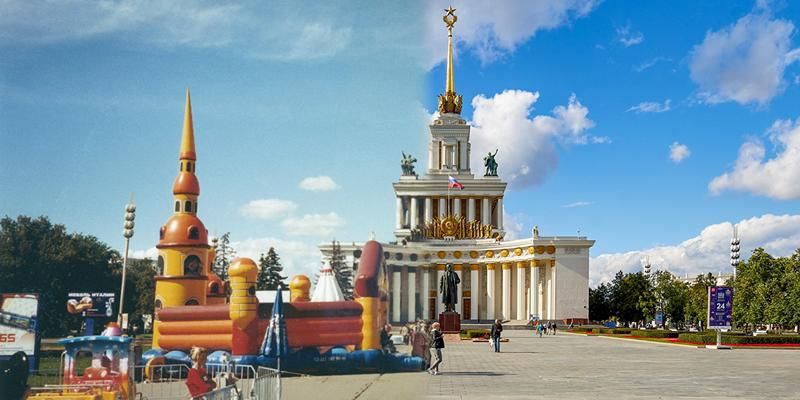
Over the past two decades, Moscow has metamorphosed into a new city with Zaryadye Park on the site of the giant hotel, squares and streets restored to their former glory, the Northern River Station and VDNKh. Street banners, illegal stalls and markets and spontaneous parking lots are a thing of the past.
For City Day, a mos.ru reporter has explored historical photos together with the local historian and editor-in-chief of Moscow Heritage, Filipp Smirnov. Read on to discover how the capital has changed.
From overwhelming advertising and triple-decker parking to green promenades
Just over 30 years ago, Moscow looked a different city with narrow sidewalks, huge markets and unauthorized stalls near metro stations. With the growth in the number of private cars in the 2000s, there was also the rise of triple-decker parking.
There were banners everywhere: on the streets, roads, houses. They increased sales but turned the capital into a continuous advertisement. It has become a kind of an ads newspaper newspaper 
In 2010, the city announced its intention to remove banners from the city center, and in 2011, it began removing outdoor adverts from the façades of buildings.
“The banners with their information overload have been removed. They no longer obscure monuments and landmarks. In 2015, overhead power lines were put underground so that they would not litter the space,” adds the mos.ru source.
Kuznetsky Most in photographs from the 1990s looks like a bazaar: a row of shops stretching right along the roadway. This street was among the first to become pedestrian during the improvement works in 2012. Experts have managed to preserve historical paving stones: they were cleaned and returned to their place. Now it is a modern space that still recalls the old Moscow street filled with horse-drawn carriages.


Nikolskaya Street flooded with parked cars was turned into a pedestrian street a year later. Asphalt was replaced with granite. It is one of the most elegant streets in Moscow: LED lights hanging over it create a festive feel at any time of year.


Tverskaya Street was one of the key transport arteries of the downtown and was not suitable for a leisurely stroll. In 2016, it got a pedestrian area. Sidewalks were widened by narrowing traffic lanes and overhead wires were hidden in collectors. The street got linden alleys that were removed in the 1990s and historical lights recreated using drawings from the Moscow Lights Museum.


There were also dozens of stalls crowded together on Novy Arbat. A lot of space was used for parking cars. In 2016, the southern side that used to host book-shaped buildings, shops and cafes was transformed into a promenade. The parking lot was optimized with trees planted.


The embankments also got a makeover. Krymskaya Embankment was the first location to be reborn in 2013, being transformed from a busy highway into a long pedestrian route. Slides intended for skateboarders and cyclists, a dry fountain with multi-colored lighting and art pavilions attract Muscovites from all over the city. The wave shape of the walkways and bike lanes, benches and the roof of the vernissage building was inspired by the Black Sea and the Sea of Azov with Crimea lying between.


In 2017, Yakimanskaya Embankment got a 15-meter-wide promenade area with benches to admire the Vodootvodny Canal instead of narrow sidewalks.


Historical look of a square and a landscaped park instead of a long-term construction project
A small island next to the monument to Vladimir Mayakovsky washed by streams of cars is what Triumfalnaya Square looked like several decades ago. After reconstruction in 2015, it became a spacious landscaped pedestrian area with granite pavement. In addition to the monument, another symbol appeared near the square: large swings for children and adults.


With Belorussky railway station, Belorusskaya metro stations of the Circle and Zamoskvoretskaya lines and Tverskoy overpass, Tverskaya Zastava was likely to be a location for spontaneous trading and parking. This is how it is captured in the 1990s. In 2017, the square was returned to its former greatness with a new park and a parking area, a restored monument to Maxim Gorky and a traffic circle for trams.


Paveletsky Station Square was a major long-term construction project in the capital. In the late 1990s, a shopping center was expected to be built there, but work was halted due to a lack of investment (specialists only managed to dig a pit and build walls). In 2021, the shopping center was built underground with a surface landscaped park covering about three hectares with a fountain and an open-air amphitheater. Above the entrances to the center are elegant oval-shaped glass roofs and canopies.


“This is a unique shopping center in terms of architecture, which does not damage the old square. Paveletskaya is a successful reboot project. After being restored, the Bakhrushin Theater Museum ensemble became more distinctive and fits harmoniously into the renovated space,” the Moscow expert emphasizes.
Zaryadye Park instead of a giant hotel and Khodynskoye Pole Park instead of an airfield
Gorky Park,the first Soviet park of culture and leisure and the major Moscow park for decades, was filled with stalls and rides in the 1990s. Buildings and sculptures fell into disrepair, while entrance fees were mandatory.
“In 2011, the complex reconstruction work started: the park got renewed paths, lawns, flower beds, recreation and sports areas and the largest artificial ice rink in Europe. The park was extended to the areas of Vorobyovy Gory, Vorobyovskaya Embankment, Krymskaya Embankment and Neskuchny Garden. That was just part of the transformation. The plans include improving the Pushkinskaya Embankment and opening new beach recreation areas,” shares Philipp Smirnov.


In the 1990s, Sokolniki also fell into disrepair. In 2012, the park gained a second wind: the unsafe rides were removed, the pedestrian areas were updated, an ice rink, an alley of arches, sports grounds, and an open-air swimming pool were opened. In addition, the Astronomers’ Garden and the large rose garden were restored and a 35-meter Ferris wheel was installed.


In the second half of the 20 th century, one of the oldest historical area of the city, Zaryadye, was burdened with the massive Rossiya Hotel. It held the title of the world’s largest hotel by the Guinness World Records. The hotel was doomed: 10 years after its opening, in 1977, it was damaged in a fire, and in the 1990s, it needed reconstruction, but no investors could be found. The hotel did not fit into the historical architecture and was eventually demolished.
In 2017, Zaryadye Park, covering an area of 10.2 hectares, was built. It is divided into five landscape zones (forest, steppe, meadow, tundra and dry subtropics) with characteristic soil composition and plants. The park visitors can see 16 th-century houses, cool down in an ice cave, walk around the Florarium aeroponic greenhouse and take a virtual flight over Russia and Moscow in the Media Center pavilion. The symbol of Zaryadye is the River Overlook Footbridge offering a view of St. Basil’s Cathedral, the Kremlin’s Spasskaya Tower and the high-rise building on Kotelnicheskaya Embankment.


The capital’s first air hub appeared in the last century on Khodynskoye Pole, but with the opening of Vnukovo, Domodedovo and Sheremetyevo airports, it outlived its usefulness. In 2003, the last plane took off from it, and then the airfield turned into a cemetery of rusty vehicles. Since 2018, the area has been revived: a park with man-made hills has been built with one of them housing a panoramic view area with round swings, and the other featuring a mirror maze, a skate park, a pond with an island, a trampoline center and a dry fountain.


Rebirth of VDNKh and the Northern River Station
VDNKh has come a long way from the All-Union Agricultural Exhibition in 1939 to a modern center of leisure, culture and education. The 1950s and 1960s saw its boom: the Friendship of Peoples, Stone Flower and Golden Spike fountains were constructed, the pavilions were rebuilt, and a triumphal arch was installed at the main entrance. Then VDNKh was falling into despair. The destruction peaked in the 1990s, when exhibitions were closed, exhibits were sold and pavilions were rented out for warehouses and stores.


“The new starting point was 2014. Hundreds of illegal buildings and stalls were removed. Over the course of 10 years, 38 VDNKh’s historical pavilions and other buildings, the Moskvarium, the Slovo Museum of Slavic Writing, the Crafts Park, the Technograd Innovation and Educational Complex and a landscape park have been opened. Work is currently underway at six cultural heritage sites. It has something to suit every taste: visitors can explore the achievements of domestic cosmonautics in the Cosmos Pavilion, learn national motifs in the decor of the Kazakhstan Pavilion or visit the skating rink,” the local historian notes.
The Northern River Station, the port of five seas and one of the main symbols of Moscow, has also been restored to its former grandeur. In the 1990s, the scheduled routes were cancelled, the building was occupied by offices and shops and later closed due to its disrepair. In 2018, the façades with sculptures and old clocks, the spire with a star, the wide central staircase and interiors were restored. The park got its historical look and layout back with new infrastructure, a comfortable promenade and waterfront recreation areas being created.


The Northern River Station is a trendy location with a rooftop observation deck offering a view of the Khimki Reservoir, river electric boats departing from the pier, waterfront children’s and sports grounds, areas designed for dance masterclasses and yoga classes and a Nordic walking route. Artists from the Music in the Metro project give concerts at the station; the building also hosts wedding ceremonies.