Finding inspiration and traveling back in time. Let us have a walk around the writers’ village of Peredelkino
Indeed, summer is the best time for taking long walks and discover new things. Cover a couple of tens of kilometers to go away from downtown and visit the writers' village of Peredelkino to walk under the pine trees, learn about the bygone age and touch the heritage of Soviet literature. Located near the same-name MCD-4 station in the Novomoskovsky Administrative District, its low wooden houses used to be home and point of inspiration to 20th century men and women of letters, including Korney Chukovsky, Boris Pasternak, Bulat Okudzhava, Bella Akhmadulina, Evgeny Yevtushenko and others. Today the village is a creative center for visitors to learn about the literature heritage, to work and relax.
On the eve of the 12th anniversary of the Troitsky and Novomoskovsky Administrative Districts, our mos.ru journalist has taken a drive to Peredelkino to find out what the writers’ town is all about and which attractions it offers to its visitors.
Searching for inspiration and a secret room
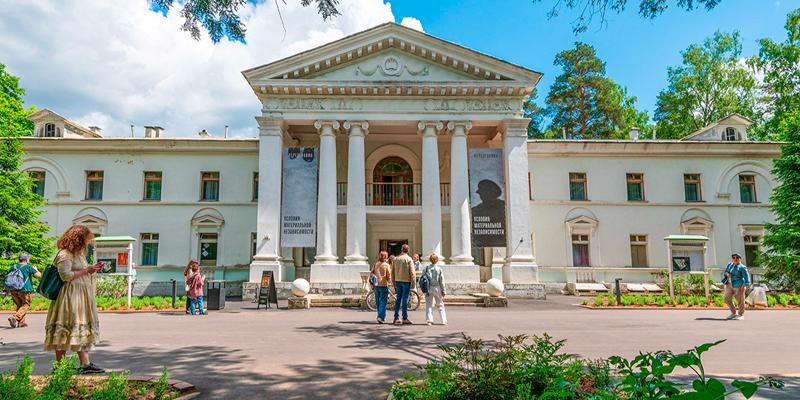
A walking tour around Peredelkino traditionally starts from its most significant place — the historical House of Creativity. Its two-story white-columned building with wooden windows and a large veranda above the main entrance is a good example of the Stalinist Empire style. It can be accessed if taking a walk along the path from Serafimovich Street.


At the main entrance we were met by Natalya Kazantseva, a tour guide of the Peredelkino House of Creativity, who threw open the large doors and got us inside into the hall, where prominent 20th-century writers used to gather under the arch of the marble staircase, or, sitting in leather chairs, used to play chess, drink tea and discuss news. From the stairs we turned right and went along a stretched out hallway past the rooms, which now house a display with stories of writers who used to live in the village.
“They started to build the House of Creativity in 1955 as a place where writers could meet and live. There were rooms on two floors. It was actually like a hotel, but writers still worked here. They sent applications and came to stay for three weeks. Later, many of them recalled that one could walk through the hallways of the House of Creativity and not hear a sound. The only thing that broke the silence was the clatter of typewriters,” says Natalya Kazantseva.

One of the ground-floor rooms, where the writers lived, has retained its original interior, with a small sofa, a wardrobe, a nightstand, a floor lamp and a work desk, just as it used to look almost 70 years ago. As a joke, poet Arseny Tarkovsky, who often stayed here, called the rooms of the House of Creativity his “native pencil cases”.


From the historical building we went into the neighboring house with rows of panoramic windows nicknamed by the writers the glass because of the architectural solution.
“This is an annex to the House of Creativity. It was built in 1969. It had no rooms as the building was conceived as a place for creative meetings. The dining room was on the ground floor; parts of the kitchen stoves can still be seen today. They have been preserved and serve as decoration for the co-working area. On the first floor there was a cinema hall, a billiard room and a library,” she says.


Accompanied by the guide, we climbed the steps to find ourselves in a space that was virtually charged with creativity. There are soft sofas in the middle of the hall; a picturesque view opens from the panoramic windows, and it seems as if every corner keeps the memory of generations.


Today life is in full swing there, too, as it is a creative residence for art lovers to hold literature sessions and lectures.
The first-floor library is marked by an amazing atmosphere, as it stores antique and rare books. Pull the spine of a book to move on the rack — voilà! a small wooden door entering the Cabinet of Curiosities. We went inside to see a real treasury of the bygone age with walls covered with notes, letters, postcards and maps, stacks of books rising as high as the ceiling.
“The Cabinet of Curiosities holds artifacts that writers brought from different corners of the world. There are items that used to belong to Maximilian Voloshin, to give an example. Time seems to freeze in this room, taking its visitors into the past. Here you can endlessly explore the artifacts and find something new for yourself every time,” adds the guide.


Chukovsky's bonfires and Pasternak's favorite cherries
Peredelkino’s story still unwinds outside the House of Creativity as walking along the paths you can see, in particular, a large brick building where writers used to live, too, whereas today it is a hotel for everyone.

“But the most exciting thing about Peredelkino is certainly the writers’ dachas. The history of the village is connected with them. According to a legend, the concept of the writers’ town was inspired by Maxim Gorky. He noticed that overseas writers lived in dachas, where they got inspiration and could create. Joseph Stalin approved the idea, and it was decided to create a residence for writers near Moscow,” Natalya Kazantseva says.
They chose an area in the forest between the Izmalkovo and Lukino estates for the future artistic village. The construction project kicked off in 1934 and there were 26 houses built there as soon as by late 1935. The dachas were rented out to writers for long periods of time, and only when someone died did the house and the surrounding land pass to another owner. For example, Korney Chukovsky settled in a building on Serafimovich Street in the village of Peredelkino in that way. The house of the famous children's writer is recognizable due to its yellow façade and green roof; today it is a museum.

Near the path leading to the writer’s house, there is a Tree of Wonder, which seems to have stepped out of a children’s book to bring the immortal lines “it is covered not by leaves, not by flowers, but stockings and shoes grow on it like apples” to life. Another attraction at Korney Chukovsky’s dacha is the clearing behind the house. Almost 70 years ago, it was used to set up a bonfire, while renowned writers, artists, musicians and neighborhood children were sitting around. The legend says that they were allowed to join the meetings only for a fee of 10 cones, which were then thrown into the fire to heat the samovar tea pot.
We should also mention Korney Chukovsky’s famous library with more than 10,400 books. Built by the writer next to his house, today it is Chukovsky City Library No. 266. Its reading room holds a collection of books written by contemporary authors. Many writers who used to stop by donated their autographed books.


Leaving Korney Chukovsky’s dacha we turned left and went out to Pavlenko Street to see a shaded ship-like wooden house behind a low green fence. This two-story building with large windows was home of Boris Pasternak, and today it houses a museum, too.
“It is worth paying attention not only to the ship-like building, but also to the land plot itself. Many years ago, Pasternak planted cherry and apple trees opposite the house, and he also loved to plant potatoes. The museum's curators still honor this tradition. Potatoes are grown in the garden in front of the house. Indeed, Pasternak felt a connection to nature, and there is even a legend that the day after his death all the cherry trees he had planted in the garden bloomed at once,” says Natalya Kazantseva.


We cannot ignore the dachas of other writers either. For example, Bulat Okudzhava’s house on Dovzhenko Street still has a special atmosphere. Built in the 1950s, it is not very large, and taking shelter from the summer sun under a grapevine or a bright tent in the courtyard, one can imagine how the famous author spent his time.
.jpg)
.jpg)
.jpg)
.jpg)
“Other buildings attract visitors to Peredelkino, too. There is a house belonging to artist Zurab Tsereteli, to name a few. His majestic sculptures rise above the fence and captivate anyone who is passing by,” Natalya Kazantseva says.
Zurab Tsereteli’s house and museum can be found on Lermontov Street. The map of the artistic village also represents the dachas of playwright Leonid Leonov, writer Isaac Babel, poet Robert Rozhdestvensky and Valentin Kataev who wrote well-liked The Seven-Petal Flower.

Getting closer to nature
The village of Peredelkino keeps literature and history, indeed, but it is also a nice place for recreation, says Natalya Kazantseva, as there you can swing in a hammock with a book, walk the winding paths between the trees, or sit by the water.
“Next to Serafimovich Street there is a small but very beautiful Lilya’s Pond. It got its name in honor of Lilya Brik, who used to live in Peredelkino and loved to spend time on the bank,” she explains.
Not far from the pond there is another remarkable place — the Archi-Forest, a piece of contemporary art created by Nikolai Polissky for good reason. The fact is that there were large old spruce trees that used to grow there, but were then killed by bark beetles; they were cut down so that other trees would not be affected. And above the stumps, they erected flame-shaped structures of woven hazel and bird cherry trunks, as a touch of decor.
.jpg)
.jpg)
.jpg)
.jpg)
.jpg)
“Today Peredelkino is a multifaceted space. On the one hand, this is the cradle of writers; here they drew inspiration, worked and created their artworks, and on the other hand, it is a seat of power where everyone can immerse themselves in an atmosphere of creativity,” said Natalya Kazantseva.