From agricultural records to IT technologies: how VDNKh pavilions have changed

Since its establishment, the main national exhibition space has been keeping track of the country’s outstanding economic, technological, scientific and cultural achievements. Over the decades, its pavilions have changed their purpose and names to reflect the progress and development of society. VDNKh spokespersons have always eagerly talked about achievements and new discoveries; today it still follows the tradition. Muscovites and tourists coming there to learn the latest developments of Russian scientists and engineers, or gain knowledge on history and arts.
From the feat of collective farmers on Earth to star traveling
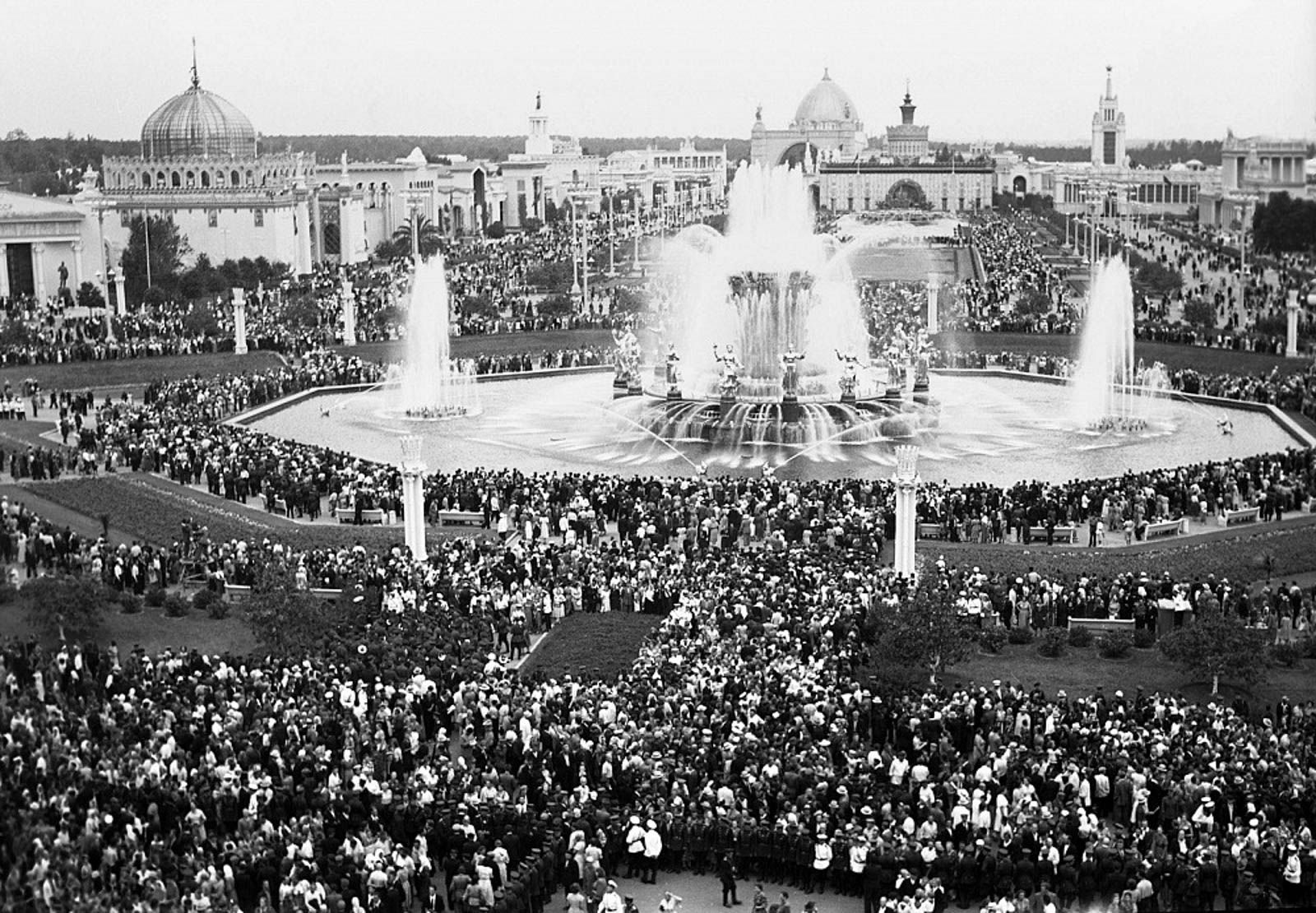
The All-Union Agricultural Exhibition (VSKhV) was opened in Moscow in the summer of 1939 to show what feats in the agricultural sector the nation had accomplished during the 20 years of Soviet power. Tourists were clued in about agricultural tools and technologies available at that time, viewing agricultural equipment produced at the factories, the best breeding stock, unique weaving items, in addition to fishing, hunting, forestry products, etc. Visitor were welcome at 87 sites, including industry pavilions (Mechanization, Grain, Sericulture, and Gardening), pavilions of the union and autonomous republics (Armenian SSR, Bashkir ASSR, or Belarusian SSR) and those pertaining to regions of the Soviet Union (Far East, Leningrad and Northeastern RSFSR, and Soviet Arctic).
The exhibition’s largest structure was the Mechanization Pavilion, shaped as a huge two-level hangar displaying agricultural machinery. On the lower level, there were four halls, one of them dedicated to the tractor industry, another to agricultural engineering, the third focusing on the automotive industry, and the fourth unveiling the use of chemistry and aviation in agriculture. The upper level housed agricultural machines that were moving slowly on ring conveyors.

The first exhibition attended by more than 3.5 million people lasted almost three months in 1939. In August 1940, it welcomed visitors again. In the summer of 1941, the exhibition also opened, but was interrupted by the Great Patriotic War. After the war, the Soviet Union government decided to recreate the All-Russian Agricultural Exhibition. Within six years, the site near Yaroslavkoye Motorway was widely reconstructed and most of the pavilions were rebuilt. A new exhibition of agricultural achievements opened in the summer of 1954.
However, in the second half of the 1950 s, the country had to demonstrate success in other sectors in addition to agricultural achievements. So, in 1956, another exhibition space with a focus on industry and manufacturing was arranged in the VSKhV area. Consisting of 12 pavilions, such as Mechanical Engineering, Machine Tool Building, Geology, Oil and Chemistry, Light Industry, Nuclear Energy for Peaceful Purposes, and Medical Industry, it displayed the most advanced developments of Soviet scientists and engineers. There were also exhibits with ‘odd’ names, for example, Oil & Fat and Food Industry or Bast Industry.
The most prominent industrialization and manufacturing achievements were highlighted in sci movies and documentaries, which were screened at the pavilions’ cinema halls. Reference literature was also published for professionals. The exhibition spaces housed more than 30,000 machines, devices, tools, models, and mock-ups, while a model of the USSR-made Tu−104 airliner exhibited at Industry Square inspired a particular excitement.
For the opening of the industrial exhibition, Pavilion No. 34 Mechanization was renamed Mechanical Engineering and got significantly more displays. Visitors could witness Volga and Moskvich, the most beautiful state-of-the-art passenger cars, or a gargantuan 426-ton hydraulic turbine for Soviet hydroelectric power stations. Meanwhile, Pavilion No. 62 known as Atomic Energy for Peaceful Purposes demonstrated achievements of Soviet nuclear energy. Its central hall accommodated a highlight of the display — a 100-kilowatt operating nuclear reactor using uranium-235, which was immersed in a five-meter pool of water to protect visitors against radiation. The pavilion also displayed measuring instruments, a collection of uranium ores, radiological protection equipment and models of research thermonuclear facilities.
In 1959, the All-Union Agricultural Exhibition was renamed the Exhibition of Achievements of the National Economy (VDNKh). In the early 1960 s, industrial focus was prevailing; so, the republic-dedicated pavilions were abandoned. The buildings were renamed and repurposed; for instance, the Lithuanian SSR pavilion was renamed Chemistry, Latvian SSR pavilion turned Physics, Belarusian SSR was replaced with Electrical Engineering, Moldavian SSR becoming Standards, Kazakh SSR renamed Metallurgy, Armenian SSR pavilion given the name of Health, and Ukrainian SSR — Agriculture.
In the 60 s of the 20 th century, space exploration began to play a special role throughout the world as in 1961 the first human, Soviet cosmonaut Yuri Gagarin, flew into Earth orbit, and in 1966 the USSR launched the first artificial satellite into lunar orbit. VDNKh also kept pace with the times, having renamed its Mechanical Engineering pavilion Space in 1967. It hosted stands dedicated to the development of rocket technology for visitors to view models of artificial Earth satellites, lunar rovers, and life support systems for astronauts, in addition to the original Vostok spacecraft descent module. In 1975, the Space pavilion displayed docked copies of the Soyuz and Apollo spacecraft; at the same time, it hosted an exhibition highlighting successes of the Soviet automobile industry, with USSR-made trucks and cars, as well as spacecraft displayed in the same room until 1991.
Keeping traditions and promoting new inventions
In the 1990 s and early 2000 s, VDNKh experienced a period of decline, as lots of pavilions were used for other purposes. The revival started in 2014, when it was transferred under the management of the Moscow municipality. Over the past decade, it took titanic scientific and restoration effort as almost all pavilions have been restored to return their original façades and interiors; so, today VDNKh is a visual Soviet history exhibit, which also displays the most recent technological and cultural achievements of our country. There are also new exhibition areas and unique museums, while visitors are informed using the latest digital technologies.
In 2022, VDNKh Pavilion No. 5 was occupied by Urban Economy Museum inviting both adults and children to take exciting tours to learn about technologies and services that make urban life more comfortable. Related information is available through touch screens, holograms and video walls with three-dimensional re-enactments. Visitors can also scrutinize the city’s 13-meter scaled model cluing in about underground utilities arrangement, or create a light show on the Bolshoi Theater’s façade, or take a virtual bicycle ride along the Moskva River embankments. The museum has a unique exhibit — a simulator cabin of a multifunctional utility vehicle for anyone to try ‘wheeling’ to clean local streets at different times of the year, while video programs broadcast on the screen pushing the driver through time and space. If selecting the Summer program, the cleaner will have to collect garbage and sweep the sidewalks, whereas ‘in winter’ the car driver will have to remove snow and do road anti-icing. At the end of the game, everyone will be able to see their score.


Those interested in space are certainly welcome in Pavilion No. 34. Now it accommodates the Cosmonautics and Aviation Center, Russia’s biggest space museum, featuring unique aircraft, military&industrial exhibits, rare archival documents, photographs and video materials that trumpet space achievements.
It consists of three sections: KB-1. Space Boulevard displaying full-size spacecraft mock-ups, KB-2. Design Bureau with space research highlights, and KB-3.Cosmodrome of the Future, which offers some futuristic and sci-fi forecasts.
There is also a 5D movie theater Space Sphere, for visitors to watch a six-minute film and take a virtual flight into space, learn the history of the first flights into extraterrestrial space, take a ‘moon ride’ on board a special SUV and build a space home of the future. Vivid impressions will be enhanced by the capabilities of dynamic seats, which will tilt, vibrate, rise and fall as the story goes on.


Meanwhile, the history and later-day achievements of the domestic nuclear industry are shown in the new Atom pavilion, Russia’s largest exhibition and educational complex dedicated to the history of the nuclear era. In the Soviet Atomic Project section, visitors are told about how Sarov became the city of nuclear scientists, while Contemporary Nuclear Industry demonstrates the possibilities of using nuclear technology not just in energy, but also in medicine, food processing, and water desalination.


The permanent interactive Smart City exhibition tells about how the capital’s technological and digital projects make the life of every Muscovite more comfortable and convenient. Visitors are to learn more about the city’s key electronic projects, including mos.ru solutions, Digital Twin, EMIAS, intelligent transport system, feedback ecosystem, etc. Opened last year, the VR movie theater invites to plunge into the past, take a virtual journey and see how the iconic spaces of Moscow, in particular, VDNKh, have changed over years. The pavilion regularly hosts masterclasses, quizzes, quests, programming workshops, courses in 3D modeling, robotics, etc.


Since November last year, VDNKh has hosted the Russia International Exhibition and Forum, a grandiose event that has brought together representatives of 89 Russian regions, federal ministries, corporations, and public organizations. Visitors are to gain insight in state-of-the-art technological developments, latest scientific discoveries, and key industrial, social, sports and cultural achievements. Multiple Russian regions can be explored in one day to see their particular specifics, get a broader knowledge of the national history and feel pride of the home country and involvement.
The exhibition and forum involve 67 VDNKh facilities with the total area of 265,000 square meters; the exhibition will stay open until July 8, 2024.