‘We are good, but they are even better.’ Russian classics on the fair ladies
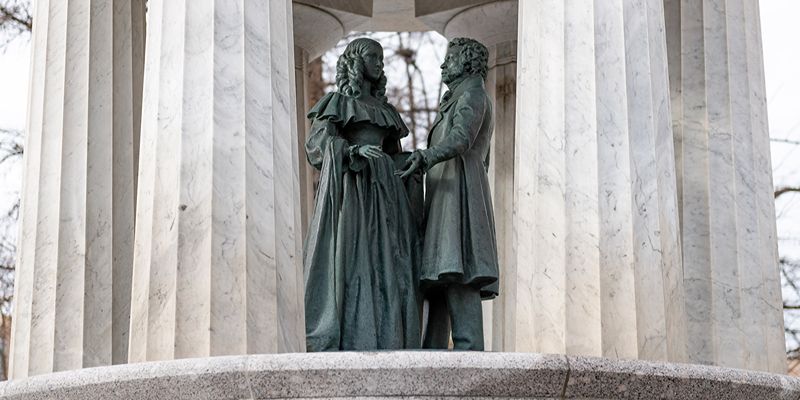
Renowned Russian classics often had a sharp tongue as well as very specific, ambiguous, and sometimes contradictory ideas about women (of course, a lot can be explained by the time they lived in — women were not always admired and complimented). The world has not stayed the same — some views have changed, fortunately.
Let us revise the letters, diaries, and works of the famous writers, recall the stereotypes that women had to overcome on their way to equality, and celebrate the day of solidarity for women in their struggle for equal rights and emancipation.
Alexander Pushkin on pretty women
‘A pretty woman, of course, is free… to be free. My God, I am not going to lecture you, but still, you should respect your husbands; otherwise, nobody would want to be one. Do not belittle this craft too much; our world needs it.’ (Fragment from the letter to Anna Kern dated August 21 (?), 1825.)
Alexander Pushkin, the famous ladies’ man, wrote so to his friend Anna Kern, who, at that point, had been the wife of General Ermolai Kern for several years, a man 35 years older than her. However, she did not love her spouse and was not particularly covert about it. Anna Kern met Pushkin in 1819 in St. Petersburg, at the house of her aunt Elizaveta Olenina. Anna charmed the amorous poet and was one of his many muses, along with Ekaterina Bakunina, a court lady and artist; Amalia Riznich, the daughter of an Austrian banker; Countess Elizaveta Vorontsova; and others. Pushkin was yet to meet the love of his life, Natalia Goncharova, whom he would later compare to an angel and Raphael’s ‘Bridgewater Madonna.’

Later, Pushkin and Kern would often see each other at Trigorskoye estate, where she came to visit her relatives; the poet’s estate in Mikhailovskoye was located nearby. However, suspecting her niece of having an affair with Pushkin, the mistress of Trigorskoye Praskovia Osipova sent Anna Kern off to her husband in Riga. That is how their correspondence began. In his letters, Pushkin remained ironic and playful, as if he was teasing his friend a bit. In the same letter, he wrote, ‘Tell me, however, what did he do to you, this poor husband of yours? Might he be jealous by any chance? Well, I swear to you, he would not be wrong; you do not know how to or (which is even worse) do not want to be merciful.’
In another letter sent to her, the poet mused, ‘Should pretty women have a personality? They should have pretty eyes, smiles, hands, and feet.’
Mikhail Lermontov on contradictions
Mikhail Lermontov’s heart was broken more than once during his short life. He fell in love a lot, for example, with Agafia Stolypina, the daughter of the memoirist and former adjutant of Suvorov, as well as with the future memoirist Ekaterina Sushkova, who did not reciprocate his feelings right away. In 1837–1839, Lermontov wrote the first Russian psychological novel, ‘A Hero of Our Time’, which is rich with complex and difficult love affairs. Cadet Grushnitski, one of the characters in the novel, has the following to say,
‘Women! Women! Who can understand them? Their smiles contradict their glances, their words promise and allure, but the tone of their voice repels... At one time, they grasp and divine in a moment our most secret thoughts, at another, they cannot understand the clearest hints... Take Princess Mary, now: yesterday her eyes, as they rested upon me, were blazing with passion; today they are dull and cold.’

In this passage, Grushnitski asked for help from the nobleman, officer, and womanizer Grigori Pechorin, so that he would help him win the love of Princess Mary. Back then, Grushnitski was not yet aware that Pechorin had his own plans for her. Meanwhile, Pechorin has a rather curious opinion about women,
‘What will not a woman do in order to chagrin her rival? I remember that once a woman loved me simply because I was in love with another woman. There is nothing more paradoxical than the female mind; it is difficult to convince a woman of anything; they have to be led into convincing themselves. The order of the proofs by which they demolish their prejudices is most original; to learn their dialectic it is necessary to overthrow in your own mind every scholastic rule of logic.’
Pechorin is in many ways similar to Lermontov — both in biographical details (they were military men and fought duels) and in character, as many critics pointed out. Among them was Vissarion Belinsky, who wrote that Lermontov and Pechorin shared ‘a rational, cooled view of life and people.’
Vissarion Belinsky on love, age, and society
Belinsky also spoke about women — and very respectfully. In a letter to his friend and colleague Vasily Botkin, dated March 13, 1841, he wrote,
‘A wife is not a mistress but a friend and companion for life, and we must accustom ourselves in advance to love her even when she becomes an elderly woman and when she turns really old.’

In a letter that the same year, Belinsky shared his thoughts about the fair sex with another friend, the Active State Councilor and chamberlain, Nikolai Bakunin. He grieved that, while yearning for love, he could not love a woman for more than a year, no matter how beautiful she was or how much she loved him.
‘There was a time when a woman was a deity to me, and it was somehow strange for me to think that she could condescend to love a man, even if he was a genius; and now, she is no longer a deity, but simply a woman, no more and no less, a being at whom I cannot help but look with some kind of superiority, which is based not on my personality but only on my title as a man. We are good, but they are even better.’
In a letter to Vasily Botkin dated September 8, 1841, discussing the evolution of society, Belinsky wrote,
‘A woman will not be a slave, neither to society nor to a man, but, like a man, will freely indulge in her inclinations without losing her good name, this monster — a conditional concept. There will be no rich, no poor, no kings and subjects, but there will be brothers, there will be people.’
Although this passage was more likely related to the ideas of love, family, and matrimony, perhaps Belinsky, as fierce as he was, foresaw the changes that were about to transform the world in the next century.
Anton Chekhov on maidservants
In 1892, Anton Chekhov moved from Moscow to Moscow Region to Melikhovo estate, located near Lopasnya village (now the city of Chekhov). He lived in Melikhovo for seven years and completed over 40 works, including the play ‘The Seagull’, the short stories ‘The House with a Mezzanine’ and ‘The Man in the Case’, the novella ‘Ward No. 6,’ and many others.
‘I will start building the house in April. A two-story house,’ he reported in a letter dated August 24, 1893, to his friend, publisher Aleksey Suvorin. ‘I will live there alone, without maidservants. Women are unclean and talk too much about their hard work.’
Knowing Chekhov, one of the most ironic persons of his time, this statement can be a kind of generalization or a joke, neither the kindest nor the most insightful, of course.
Chekhov wrote to Aleksey Suvorin in March 1895, debating marriage, ‘I will marry one day. But to a wife who, like the moon, would not stick around me all the time. I will not endure the happiness that lasts from morning till next.’
Eventually, he changed his mind and decided against living completely alone; the writer found a life companion — in 1901, he married Olga Knipper, the prima of the Moscow Art Theater (and the marriage turned out to be about what he imagined). However, Chekhov preserved his irony; in his letters, he could address his lover and later wife as ‘little turkey’, ‘Hungarian horsey’, ‘my blanket’, or ‘lovely kisser.’

Leo Tolstoy on grand endeavors
Leo Tolstoy was infamously hot-tempered and very judgmental, including in matters of marriage and gender relations, even after living side by side with such an outstanding woman as his wife Sophia for almost 50 years, who was also his comrade and closest assistant (and later became the keeper of the classic’s legacy).
In the afterword to the novella ‘The Kreutzer Sonata,’ he wrote that love and marriage are a kind of worship to oneself and therefore are a fall from grace and into sin. The writer was against “equality” for ladies. But Sophia, though idolizing her husband, not only did not share such an opinion, but was extremely unhappy with it.
‘If men knew all women as husbands know their wives, they would never argue with them or value their opinion,’ he wrote in his diary on April 12, 1908.
Moreover, Tolstoy believed that women could not properly engage in teaching, medicine, or art. In his diary, one can also find the following entry:
‘A woman does a great thing: she gives birth to children, but she does not give birth to thoughts; a man does. A woman only follows what has been introduced by a man and what has already been propagated, and further spreads it. Thus, a man can only nurture children but not give birth to them.’
In general, Leo Tolstoy’s position remained unchanged for many years, one might say, until his death. Once he wrote: ‘For 70 years, I have been lowering and lowering my opinion of women, and I still have to lower it. The woman question! — How can it not be the woman question! Only it should not be about women governing all aspects of life, but them not ruining it any more.’
Needless to say, Sophia was outraged.

Alexander Kuprin on female heroism
In 1911, Alexander Kuprin published his novella ‘The Garnet Bracelet.’ It is based on a real story that Kuprin heard from his wife, Elizaveta; she had discovered it through a prominent St. Petersburg official, Dmitry Lyubimov. His wife, Lyudmila, was stalked by an unknown man; he was writing letters to her and giving her presents. Several times, he even managed to get into her apartment. However, unlike the hero of the novella, the exposed poor excuse for a lover did not commit suicide but did a more prosaic thing: he married another.
Kuprin, who fell in love many times and got married twice, was just as passionate about women but much more respectful. He believed that the cornerstone of any relationship should be mutual feeling. In ‘The Garnet Bracelet’, for example, one can find the following lines,
‘Almost every woman in love is capable of sublime heroism. Don’t you see, from the moment she kisses, embraces, gives herself, she is a mother. Love to her, if she does love, is the whole meaning of life — the whole universe!’