Songs in sign language and musical saw. Highlights of the new Music in the Metro season
The Moscow Metro has long ceased to be only a means of transport as it is a real city underground with exhibitions, tours and film premieres, where you can enable a QR code to download an e-book, or drink coffee. Or, get to a musical show.
In late January, after the start of the 6 th Music in the Metro season, our mos.ru journalist talked to performers to know more about their repertoire they were going to offer to Muscovites. We will tell you what a song performed in the sign language is, where to listen to the sounds of a steelpan and a musical saw, how to delve into folk traditions on the way to the office or school, and how the project helps young performers to make their way to success.
Steelpan-performed Katyusha and a musical saw show
Launched in 2016, the Music in the Metro project streamlines all musical performances in the metro, the performance venues arranged in passageways or in metro lobbies. In the 6 th season there are 43 of them, including the ones at the Mayakovskaya, Polyanka, Teatralnaya and Taganskaya stations of the Circle Line, in addition to those recently opened at Rizhskaya, Maryina Roshcha, Klenovy Bulvar, Kakhovskaya, Prospekt Vernadskogo, Michurinsky Prospekt, Novatorskaya, Kuntsevskaya (BCL), and Likhobory (MCD-3). Performances are also held at the Northern Gates International Bus Terminal.
The venues are distinguished by volume levels, that is, low, medium and high. Performances are in fact given at times with a lower passenger flow to avoid rush hours — 10:00 a. m. until 5:00 p. m. and 8:00 p. m. until 10:00 p. m. on weekdays, and 10:00 a. m. until 10:00 p. m on weekends. The timetable is available on the project’s website.
To join the Music in the Metro project, there is a cast of performers. Best performers in different genres are selected by professionals. The repertoire is not limited to common guitars or violins. Going from one station to another, passengers can listen to sounds of button accordion, saxophone, balalaika, cello, drum, flute, accordion, harp, or piano, though there are more rare instruments, such as sitar, hang, medieval bagpipes, and sarod, as well. Musicians play anything what they really like — songs of known writers and composers, folk songs, pop, jazz, blues, rock, folk, and instrumental hits.
The 6 th edition introduces 285 performers — some of them are already well-known to Muscovites — including singer Alisa Dimitriadi, balalaika player Antonina Sinitsina, violinist Alexander Demidov, the Echo of Streets band, and saxophonist Alexandra Fox. The Singing Steel group, who play steel-made instruments, such as a steelpan (also known as the Caribbean drum) and a musical saw, have joined the project for the second time. Performer Irina Sidorova says the duet team’s name was chosen intentionally.
“When I hit the drum with my sticks, it makes sounds similar to those of wind instruments. And my teammate uses a bow for his saw, and it seems to sing like a human voice. Passengers stop and wonder how steel stuff can sound so unusual. We tell them about our instruments. The Music in the Metro project offers an opportunity to convey something new to the public,” she says.


The Singing Steel duet performs shows at the Ploshchad Revolyutsii, Okhotny Ryad and Teatralnaya stations, playing the Four Seasons by Antonio Vivaldi, Ave Maria by Johann Sebastian Bach and Charles Gounod, some hits of The Beatles and the Russian traditional Kalinka song.
Moms choir and songs in sign language
Each season, the project engages new musicians, and so it is now. In the metro, you can listen to exotic ethnic music and light rock by SolntselunA team, some rock hits performed by the cover group called Where is Stas?, or collective singing of Moms Choir for the first time.
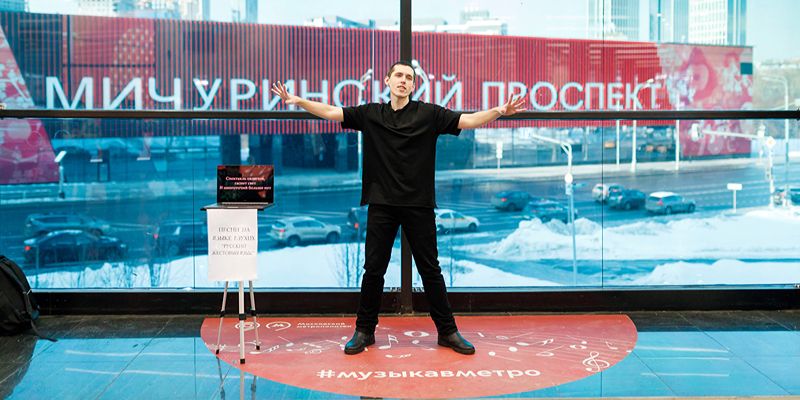
Another newcomer of the project is Dmitry Areshchenkov who “sings” songs in the sign language. He is a student at the Bauman Moscow State Technical University (BMSTU) where he has met many hard of hearing guys. So, Dmitry Areshchenkov began to learn the Russian sign language to be able to “talk” to them and found out that it could be used to “sing” songs.
“Talking and singing in the sign language are different, like rap and vocals. In the former case, the hands “speak” briefly and quickly. Whereas, when they are “singing”, movements get wide, smooth and emotional. Sometimes passengers think that I am dancing,” he explained.


The musician prefers to perform at the Kurskaya station as he appreciates visual contact and there is a long passageway where passengers can see his hand movements from afar. In addition, loud music is allowed here and floor vibrations help the deaf to catch the rhythm. For those who are not lacking or deprived of the sense of hearing, Dmitry Areshchenkov has an explanatory plate and a laptop to show song word-for-word transcripts. For example, an expression of feelings needs an explanation, but most words can be understood intuitively. The performer tries to select songs mentioning some things, such as the sea shown with waving or the sky — his hands moving over his head.
“Many still avoid dealing with the deaf and feel embarrassed by the sign language. I would like to show them how beautiful this language is. But few will go to a concert performed by a singer in the sign language. And the Music in the Metro has opened the doors for me to a public audience. It is nice when passengers, having become interested in my work, begin to ask questions whether it is difficult to master the sign language and where they can learn it,” Dmitry Areshchenkov says proudly.
“Reading begins with the ABC, while culture starts from folk traditions”
Dmitry Areshchenkov is not the only one who puts into his performances something more than just entertainment. The Necklace (Ozherelye) folk group, who are the Music in the Metro two-year repeat participants, introduce metro passengers into the world of folk traditions. They joined the project because they felt “cramped” in local cultural centers, explains Elena Zhukova, the group’s artistic director and performer. Now, they can choose comfortable sites and perform as often as they have an inspiration for.
“We love to sing so much! Even when we get together, we sing rather than talk. In the metro, we can share our love of music with thousands of people and tell them about the wealth of the folklore of our country. Reading begins with the ABC, while culture starts from folk traditions,” Elena Zhukova says.


They perform songs native to Central Russia, namely, the Smolensk, Bryansk and Ryazan regions, that our ancestors used to sing during needlework, wedding rites, and agricultural work, each time wearing traditional regionally-specific costumes.
“We stand at stations like museum exhibits. We sing without musical instruments, just using our voices. And the metro’s noise does not matter; we can be heard everywhere. More often we choose the sites at Kurskaya and Taganskaya, since there we can have enough room for our big team. After concerts, passengers ask us about our costumes and folklore. And people from the regions often suggest that we are their countrymen. When they learn that we are Muscovites, but so cordially perform songs of their small homeland, they feel amazed,” Elena Zhukova says, laughing.
Music in the Metro as a step in the career for young talents
Dmitry Areshchenkov is an engineer student at BMSTU, but he still does not know whether the sign language singing will remain only a hobby or will grow into his favorite work. The Music in the Metro project proved to him that people love him, despite the specific genre. The feedback is also important for another project participant, Nicole Koroli. The 16-year-old has already participated in musical TV shows and in the Street Artist project. She started singing when she was six and can perform songs in Russian, English, Armenian, Moldavian, French and Korean, preferring covers of Whitney Houston, Mariah Carey, and Polina Gagarina.
“Now, I am preparing for the main state exam; it is difficult to combine music and classes, but I try because I love singing. It is the first time that I have joined the project. This is a big job — to sing in front of a huge audience. When you sing for the audience, you immediately feel what they like and what they do not like. It is important for a singer to read the reaction. Singing in the metro, I develop myself as a musician,” Nicole Koroli is convinced.


Her first public concerts were hard to her, but she has overcome shyness, so now she feels at ease and self-confident on the stage.
“My dream is to enter the Gnessin Moscow Special School of Music and become a singer. The Music in the Metro project helps me make my plans become a reality,” she said.