From growing to baking microchips: how Zelenograd produces Troika Travel Cards
The Moscow-made Troika Travel Card is already more than 10 years old, over 50 million cards issued since 2013. Scientific achievements, titanic efforts and sophisticated technology have been invested into this small and simple-looking piece of plastic.
“By order of Sergei Sobyanin, the Troika Travel Cards are totally produced locally in the capital. Now the production processes do not depend on external factors. Importantly, both the Troika Travel Cards and related chips are 100 per cent Russian development, thus ensuring the reliability and safety of our passengers,” said Maxim Liksutov, Deputy Moscow Mayor for Transport.
mos.ru journalists visited Mikron plant in Zelenograd and found out the path taken by the country’s main travel card before getting to a metro ticket office.
Growing one’s own microchip
Since the Soviet times, Zelenograd has been the capital of domestic microelectronics; Mikron plant, one of the industry’s flagships, was created at the Research Institute of Molecular Electronics in 1967 for mass production of electronic components. Today, both enterprises are part of the Element Group, Russia’s major microelectronics center, as this is it that concentrates all the key Troika Travel Card production stages, including the most difficult of them, such as growing microchips, or microcircuits. Previously, travel cards were based on foreign microchips, but since 2019 Mikron has been developing domestic microcircuits, and today the Troika Travel Cards are produced only with the Russian stuff.
The Moscow Department of Investment and Industrial Policy notes that Mikron is located in Technopolis Moscow Special Economic Zone (SEZ). The SEZ resident status entitles awardees to multiple tax benefits as they are exempt from paying property, transport and land taxes for 10 years and also enjoy the income tax rate of mere 2 per cent instead of 20 per cent, thus, having spare funds to be spent to enable their business growth.
The plant looks like a small town, its buildings connected by covered walkways, making it quite tricky in terms of sense of locality. The focal site is the crystal workshop, where they grow microchips on silicon wafers, this being the most complex process of manufacturing the Troika Travel Cards.
The three-month production cycle begins with a silicon wafer with 99.99 per cent purity of silicon as the starting material.
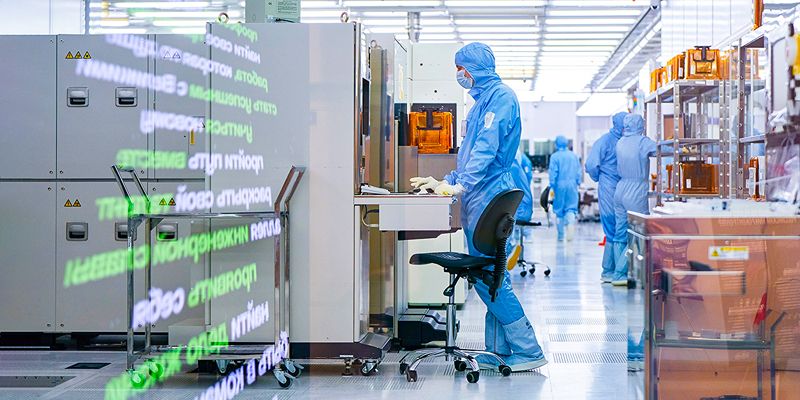
What is happening behind the transparent glass resembles a sci-fi film scene as employees, fully dressed in protective suits and masks, manipulate state-of-the-art equipment and mysterious containers in a sterile environment under artificial lighting.
“These are sealed SMIF containers that can hold up to 25 silicon wafers. The employees load them in a special “clean room”, where the level of sterility is 100 times higher than in an operating room, and do not open them until the entire microcircuit application cycle is over. All the processes are as automated as possible; only robots work with the plates,” explains Marat Bildanov, deputy head of the workshop for production management, Mikron Joint Stock Company.

Sophisticated technologies, such as chip production, require a special environment. Floor and ceiling filters used in the workshop clean the air non-stop, while the room is equipped with sensors for measuring temperature, humidity, oxygen levels, lighting and pressure, the indicators monitored online by operators in a separate room.
Each SMIF container has an ID and a radio frequency tag for the staff to track the wafers along the processing route. Production of a Troika microcircuit involves 33 photolithography stages (a key process that is critical for the structure of the entire layer), while the creation of one layer can last up to 12 hours, the whole process of making a microchip taking three to four months.
“Growing a microchip can be compared to building a multi-story building, only the layout differs on each floor. All layers must be the same in size and be strictly compatible to each other. This is written in the algorithms and set by the program, and the working server consolidates data from all pieces of equipment, displaying the current position of each plate and the progress of its passage along the processing route,” Marat Bildanov says.
One silicon wafer serves as a carrier for tens of thousands of microchips, tiny chip cells resembling window screens. The work goes on around the clock. On top-end equipment, the wafers go through many stages, such as photolithography, chemical milling, ion alloying, chemical-mechanical polishing, liquid cleaning, plus dielectric and metal layer deposition, some performed in a diffusion furnace at 1,200 degrees Celsius, equivalent to a temperature of erupting lava. Each stage results in testing to check conformance to pre-set parameters.
At the end of the process, the plates with microchips are covered with a protective nitride layer to have uncovered only the areas intended for connecting conductors. After the final test is over, the wafers are put back into shipping containers to move to the next stage.


Sergei Sobyanin on the new production launches of the Technopolis Moscow SEZTechnopolis Moscow tops national SEZ ranking
Core with a copper antenna
Cards are completely assembled at the second stage (in the neighboring building) by Mikron Security Printing (MSP), a joint venture of Mikron and the Moscow Metro, the latter being a 50% shareholder. The most important process is packaging the microchips into COB modules to enable a contact between a microchip and the antenna and protect it against damage. The production line of MSP, a resident of Technopolis Moscow SEZ, is the first-ever in Russia for the COB
(Chip on Board) packaging, which was launched at the end of last year. A special robot transfers microcircuits from the plates to a fiberglass substrate that resembles a honeycomb. Using a needle, the robot first applies quick-drying adhesive with precise and quick movements and then uses a vacuum suction cup to detach the chip and mount it on the substrate board, the operator watching the process on the monitor.
“During a day, the robot can transfer about 100 thousand microchips onto the substrate, each of them is thinner than a human hair. Then, using a special silver wire and ultrasound, the two contacts of the microcircuit are welded and soldered to the substrate to couple them up. The next step is to apply a protective sealant like epoxy resin to the substrate in order to protect the microcircuit against external damage,” says MSP production manager Dmitry Terentiev.

So that the backing fits inside a plastic card, it needs to be made twice as thin. This process is performed by a grinding machine, the COB modules further tested on the board to check electrical signals. Modules that fail the test are marked accordingly. After the dinking die (cutter) divides the substrate into separate modules, unusable ones will be sent for recycling, good modules to be packaged in vacuum packaging. To avoid damaging the microchips, the workshop staff wears antistatic gowns, footwear and gloves, and even the furniture has an antistatic coating.
Blank sheets, also known as inlays, are tested and laminated with a heat press; the workshop produces about 50 thousand blank cards every day.


Selecting a design concept
So that the Troika Travel Cards get durable and look like we know them, they should be covered with a printing shell which is made in a printing house and actually consists of two layers of plastic.
The travel cards are designed by the Moscow Department of Transport and Road Infrastructure Development. In addition to standard blue-colored, horse-bearing Troikas, there are also cards with theme-specific designs to pay homage to a famous person or an important event; they are limited editions (for example, a commemorative Troika Travel Card is to be released for the 300 th anniversary of the Russian Academy of Sciences). More than two thousand types of such Troika Travel Cards have been sold since 2013.
They return from the printing house to the plant to get personalized settings. Cards come from the conveyor belt to the encoding wheel where it takes three seconds for special heads to stuff individual codes into the microchip memory; after that a Troika will return to the belt to get a unique ID number, barcode and QR code onto its back. The wheel moves fast so as to process 19 thousand cards per hour, individual codes entered into the Moscow Metro database to avoid counterfeiting and set out the cards’ lifecycle, including topping up the balance, number of available trips, benefits or restrictions.
Personalized Troika Travel Cards are counted, packaged and sent to the metro office.
The Troika Travel Cards are becoming increasingly popular, indeed, and have left global analogs in the dust. In addition to Moscow, they can also be used in more than 25 regions countrywide, and this year they will be switched to new-gen Russia-made chips with tripled memory and a more advanced security system.


