Invent, test and find customers: how Moscow helps developers innovate
Science is the cornerstone for Moscow’s growth, while innovators create and boost technologies that improve its standard of living. However, it is not enough to come up with a solution as it should be tested in the real world and gain customers; that is why developers are both scientists and entrepreneurs nowadays. Moscow has 19,000 businesspersons engaged in science, its innovation ecosystem including 48 technoparks.
The municipality really backs inventors by providing grants and subsidies, holding technology competitions and even launching a piloting program. On the occasion of Russian Science Day, which is celebrated on February 8, our mos.ru journalist has talked to awardees about whether it is difficult today to do both science and business and what is Moscow’s role in driving innovation.
Business for science
New technology has a long way to go before it becomes part of everyday life. That is why the Moscow Government provides comprehensive support to inventors as innovators are free to choose those options that suit best for their projects. Sometimes backing is needed in early stages. Some innovators admit that it is more difficult for them not to engage in the laboratory, but to bring their brainchild to consumers. After all, when running any business, one needs to address legal issues, raise investment, promote products and build a customer base, all of those issues going beyond science, indeed.
Tatyana Skoruk, a developer of medical devices, faced this problem, so she contacted a state budgetary institution, Small Business of Moscow, to apply for aid. They offer free courses and a training program in entrepreneurship and also provide consultations and online services for entrepreneurs to streamline their businesses.
“I’ve always been focused on technology and production processes. But when I took a two-month course called Upgrade Your Business with a Mentor, I was able to bring my business to a new level. I in fact launched an advertising campaign on social media and found some extra sale options. The mentor inspired me; thanks to him I was able to promote my innovation,” shared Tatyana Skoruk.

She is talking about a breathing simulator that was launched in 2023. Designed to restore performance and endurance in humans, it generates air similar to mountain air, simulating a rise to a height of 1,500 to 8,000 meters (for comparison, Everest is 8,849 meters high) as with short-term hypoxia—a lack of oxygen— our body experiences a safe level of stress, which triggers the process of cell regeneration. In addition, the exercise machine helps relieve stress; it will be good for the prevention of heart attacks and strokes and can generally improve health. It is user-friendly as you need to breathe through the device for six minutes, rest for four, and so on for an hour, one course lasting 15 days. The domestic development is several times cheaper than its foreign counterparts; moreover, it is compact and easy to use both at home and while traveling.


The promotion strategies developed by Tatiana Skoruk have already borne fruit. Previously, her company produced 100 breathing machines per year and after she completed the mentoring program the outputs increased up to 1,000 devices.
“Today, to do science, you do not necessarily need to work for an academic institution, that is, to join ready-built teams or projects. You can develop your own technology and do what you are interested in. And the municipality will help in implementing the intent,” concluded the inventor.
Path of technology from a lab to real life
Any invention should be tested in the field. To help scientists bring their technology to people, the Moscow Agency of Innovations has launched a piloting program, which is really beneficial for all stakeholders, as businesses have the opportunity to test their solutions at local sites (e.g., hospitals, universities, banks or construction companies), while hosting entities can benefit from free pilots of advanced technologies. The city is actively introducing innovation into the lives of Muscovites.
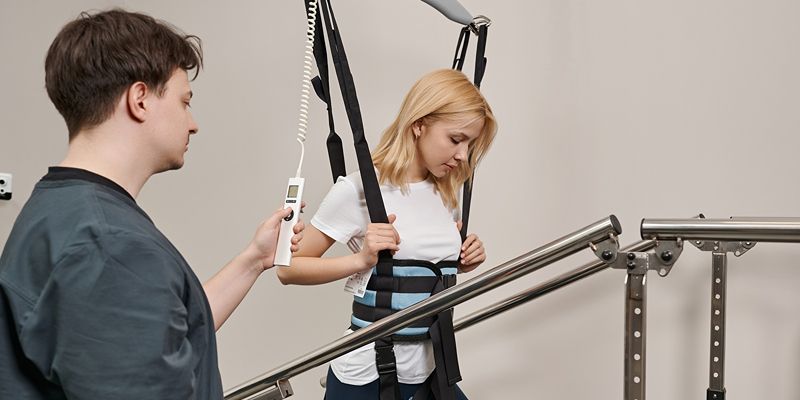
It is especially important to arrange a test drive for medical developments, explains Aleksey Ostashev whose company has developed an overhead hoist for transporting patients indoors.
“There are strict rules at medical institutions; you can’t just come in and set up your equipment. But they are interested in cutting-edge technology for the treatment and rehabilitation of patients. This program makes it possible for them to try a new product before buying. The Moscow Agency of Innovations acts as an intermediary between manufacturers and sites. Its employees do a research to include the most promising projects in the program. Clinics trust their recommendations. As a result, we do not fight against closed doors, but cooperate with each other,” says Aleksey Ostashev.

The overhead hoist he has developed is intended for patients with reduced mobility and can be used to move anyone to any point where rails lead (for example, from the bedroom to the bathroom), lift above the bed (to change bed linen), or put in a wheelchair. This makes the work of nurses and the patient’s rehabilitation easier since the process does not cause pain.
Unlike its analogues, it is capable of weight compensation in situations when patients are advised to start rehabilitation, but muscle atrophy makes it difficult for them to perform exercises. The system in this case takes on part of the human weight. For example, a weight of 100 kg can be reduced to 50 kg so that it will be easier for the patient to do exercises.


The invention was tested at the Morozov Children’s Hospital back in 2021; after testing the hospital bought the hoists worth almost five million rubles.
“After that, other clinics began to contact us, because they had feedback from doctors at the Morozov Hospital. The system is installed at the Botkin Hospital and in homes of people with reduced mobility. We’ve sold 157 pieces in all. The piloting program showed us that we are moving in the right direction,” the innovator emphasized.
Grants and subsidies for project development
Sometimes inventors do not have enough money to launch a startup or develop a project. So, the municipality offers grants and subsidies to cover costs of equipment, staff training, patenting and import substitution. The Moscow Innovation Cluster (MIC) is responsible for financial support for businesses. It includes the Lomonosov cluster located in the technological valley of Lomonosov Moscow State University, which serves as a platform for interaction between academia, businesses and the local government and has brought together developers in biomedicine, pharmaceuticals, environmental studies, robotics, IT, and nanotechnology.
The MIC has provided RUB 14 million of grants and subsidies to a resident company that introduces technologies for surfacing and spraying metal, ceramic and metal-ceramic protective coatings restoring and strengthening parts of gas turbine, compressor, processing, printing and other equipment. The customers include companies operating in energy, oil&gas, metallurgy, shipbuilding and aircraft manufacturing, etc. Applied on the Worker and Collective Farm Woman monument (VDNKh) and Zhivopisny Bridge, the coatings have already proven their anti-corrosion effect.
.jpg)
.jpg)
.jpg)
.jpg)
.jpg)
The developer, CEO Lev Baldaev, says the company’s goal is to replace foreign solutions that are unavailable today and develop new unrivaled products.
“With the help of our technologies, we apply coatings to imported equipment, restoring worn parts, after which they do not need to be taken abroad for repairs, and also to domestically produced elements so that they last longer. With financial aid of Moscow, we bought new equipment, opened an assembly shop and created additional jobs. Increasing capacity is also important for the city itself; without its help, we would grow slowly and the industry would have suffered,” explained the developer.

Science competitions
Sometimes it is not developers who are chasing customers, but customers who are looking for developers. Therefore, the Moscow Government organizes technology competitions in order to find innovative solutions in a particular area, this being another opportunity for scientists to publicly present their creations. The New Tech 2022 competition was won by a company offering technologies used to treat and process natural gas and APG at fields. In 2023, it had a portfolio of contracts worth RUB 284 million.
In addition, the capital hosts the Auto Tech Challenge competition aimed at finding innovative solutions for the domestic automotive industry. In 2022, one of the winners, a producer of power electronics for light electric vehicles, such as controllers, motors, control modules and displays, was a Lomonosov cluster resident. in 2022, it launched a small-scale production line and produced 100 devices.