Gogol, the Iliad, Dal’s Dictionary and other books on Mikhail Bulgakov’s shelves
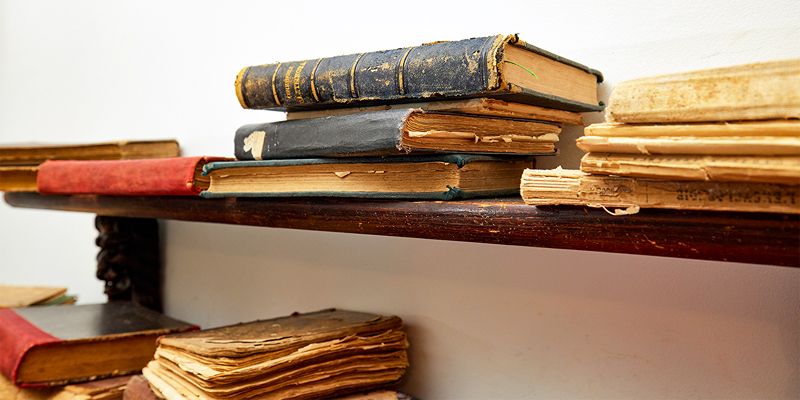
The Scientific and Educational Center of the Bulgakov Museum invites you to the Worried for the Books exhibition. There, the guests will be able to find out what Mikhail Bulgakov’s library was like. Maria Kotova, the Project Supervisor, shared with mos.ru which authors he was particularly fond of, what books his friends gave him, and which ones he bought himself.

Bulgakov’s library in Moscow
Mikhail Bulgakov moved to Moscow in September 1921. He stayed at 10, Bolshaya Sadovaya Street; there, in a room of communal apartment No. 50, the Odd Flat, his sister Nadezhda lived for some time with her husband, philologist Andrei Zemsky. The future writer faced a difficult task-to start life from scratch. After giving up his medical practice in Vladikavkaz, he no longer wanted to be a doctor; Bulgakov dreamed of becoming a writer (and that one day his writer’s craft would earn him money). The future author of The Master and Margarita took up any job: a reporter for the Commercial and Industrial Bulletin, or a letter processor in the Gudok newspaper.
Money was sorely lacking. As Bulgakov himself wrote, he came “with no money, with no belongings to Moscow to stay there forever,” and described life in the capital at that time as “a frenzied struggle for existence and adaptation to new living conditions”. However, nothing could stop him from building up his collection of books. When in possession of money, Bulgakov would go and spend it at second-hand bookshops. The famous bibliophile Emmanuel Tsippelzon recalled one of such visits to a bookstore: “August 28, 1930. Bulgakov came over. He bought three volumes of Nikitenko, two volumes of Zasodimsky, and a beautiful copy of the Iliad translated by Gnedich”.
But the times that Tsippelzon recalls were, one might say, “lavish”. In November 1921, almost immediately after moving to Moscow, Bulgakov wrote to his mother Varvara:
“I’m writing this in order to show the conditions under which I have to carry out my idee-fixe. Which is to go back to the norm in three years, concerning an apartment, clothes, food, and books. Whether I can succeed, we’ll see”.
By the way, in the same letter, Bulgakov asks his sister to find for him all possible sources regarding Nicholas II and Grigory Rasputin; at the time, he cherished the idea of “creating a grandiose drama in five acts by the end of 1922.” Most of all, the writer needed the diary of a member of the State Duma, Vladimir Purishkevich; this book could not be found in Moscow, apparently, even at second-hand bookshops.
Interestingly, one of the first purchases for a new home was a bookshelf made of dark wood, varnished, decorated with mermaids. It is currently on the museum’s display.

“Please do not borrow the books”
Mikhail Bulgakov’s first wife, Tatiana Lappa, recalled that when he divorced her, he took with him only the books: “And he took nothing but books. I packed them for him myself. He asked for my help. I came down myself, we came down together to put them in the [cart]. He left without a word about where he went. And I didn’t ask”.
The writer had a passion not only for fiction, but also for dictionaries, reference books, and encyclopedias. In the apartment on Bolshaya Pirogovskaya Street, where he moved in 1927, there was a complete collection of Brockhaus and Efron’s dictionary, Dal’s Dictionary and a lot more. In February 1930, he wrote to his brother Nikolai in Paris:
“On March 15 th, the time for the first payment to the financial inspection (income tax for last year) will come. I believe, unless some miracle occurs, there won’t be a single item left in my small and damp apartment (by the way, I have been suffering from rheumatism for several years). I don’t care about the junk all that much. Chairs, cups, to hell with them. I’m worried for the books! I’ve got a lousy library, but still I’ll be dead without books! When I work, I work very seriously; I have to read a lot”.

Mikhail Bulgakov’s property was not seized, and the writer’s library was saved. He was overprotective about it and would not give books even to his friends. Actor Viktor Stanitsyn recalled a sign on the shelves: “A bibliophile is someone who’s too fond of reading other people’s books,” and the writer’s second wife Lyubov Belozerskaya told about another strict sign: “Please do not borrow the books”.
Gifts from friends
A special part of the writer’s library included books gifted to him with dedicated inscriptions. For example, in 1924, Yuri Olesha, a friend and Gudok colleague, gave Bulgakov a collection of his poems with the following message:
“Dear Misha, I will never write abstract lyrical poetry. Nobody needs it. A poet should write feuilletons so that poetry can be of practical use to people who receive a salary of seven rubles. Don’t get cross, dearest Misha, you are good with comedy (just like Mark Twain). In a year, I will give you another Chisel. Lots of love, your Olesha 30/VI-24”.
Later, Mikhail Bulgakov received a gift from the writer and translator Vikenty Veresaev; he gave him the Homeric Hymns, published in 1926, that Veresaev translated from Greek himself. The inscription says, “To Mikhail Bulgakov with great hopes for him”. This book is a part of the Mikhail Bulgakov archive at the Russian State Library; a similar edition is displayed at the exhibition.

By the way, in the 1930 s, Bulgakov worked with Veresaev on a play about Alexander Pushkin; they had quite serious disagreements, and Veresaev even demanded to remove his name from the title page. The play was finished all the same; however, during Bulgakov’s life it was never staged.
Favorite writer
Bulgakov’s contemporaries recalled that he had several favorite writers, but the most important among them was Nikolai Gogol. This is not surprising at all; the fantastic and the unusual always attracted Bulgakov. Konstantin Paustovsky wrote,
“No wonder Bulgakov’s favorite writer was Gogol. Not the government-interpreted Gogol that we brought through life with us from the gymnasium, but a tameless visionary who is able to scare people either with his delight, or sardonic laughter, or a fantastic imagination that makes the blood run cold”.
Gogol’s influence cannot be ignored in Mikhail Bulgakov’s prose, from his very first literary experiments to The Master and Margarita (considering both humorous and mystical components of his many works). Even the main character of the novel, the Master, resembles Gogol: “Cautiously looking into the room from the balcony was a clean-shaven, dark-haired man of approximately thirty-eight, with a sharp nose, anxious eyes, and a wisp of hair hanging down on his forehead”.
Bulgakov’s library contained not only books by Gogol himself, but also numerous articles and monographs devoted to his life and work. The Worried for the Books exhibition displays Valerian Pereverzev’s The Work of Gogol (1928) which belonged to Bulgakov.

Besides, in Bulgakov’s apartment on Nashchokinsky Pereulok, there was a secretaire that, according to legend, belonged to Gogol. The legend also says that after Bulgakov’s death in 1940 his widow Elena planted a stone from the Gogol’s tomb on her husband’s grave. So far, the only evidence of the stone’s origin can be found in the story by the workshop director at the Novodevichy Cemetery, but the fact that the tombstone has become an important cultural symbol is undeniable.
The tragedy of Batum
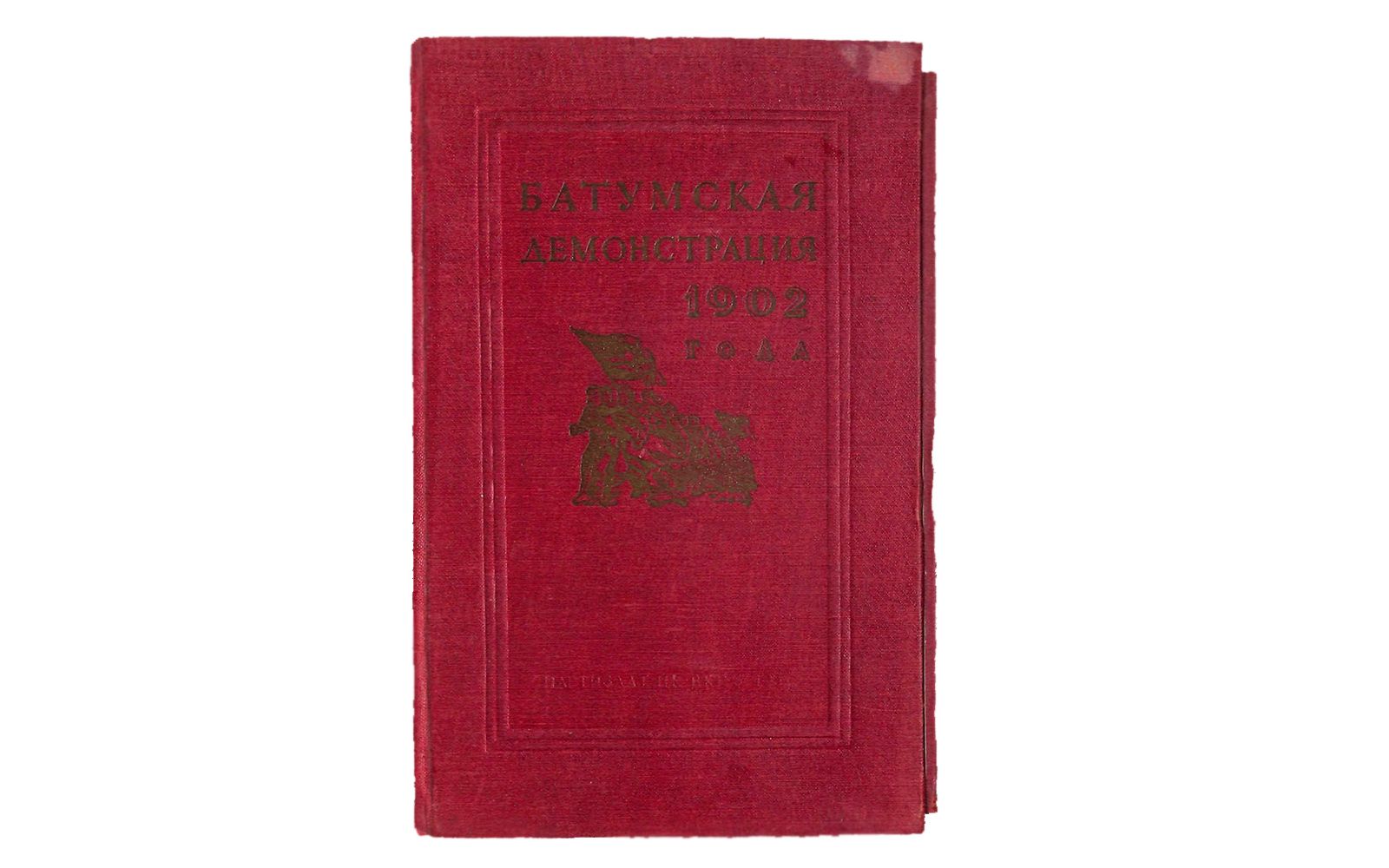
Mikhail Bulgakov’s library has not been preserved in its entirety, but individual volumes with notes that he liked to leave in the margins in red and blue pencil can still be viewed today. In the archive of the writer there was a book, Batumi Demonstration of 1902 (1937); a similar edition is presented at the exhibition.
Bulgakov acquired it when he decided to write a play about Joseph Stalin’s youth. The book became the most important source in the work on the play he called Batum. In June 1939, the author even signed a contract with the Moscow Art Theater; the latter was very interested in the play and planned to stage it as soon as possible.
But suddenly Batum was banned. There is a version written down by Bulgakov’s wife, Elena, that high-ranking names opposed it (perhaps even Stalin himself): one cannot portray a person like Joseph Stalin as a “romantic hero” and “put him in fictional positions”.
For Mikhail Bulgakov, this news was a severe blow. The writer never recovered from it.