Knight’s move: How the Mikhail Botvinnik Chess School students win Russian and international competitions
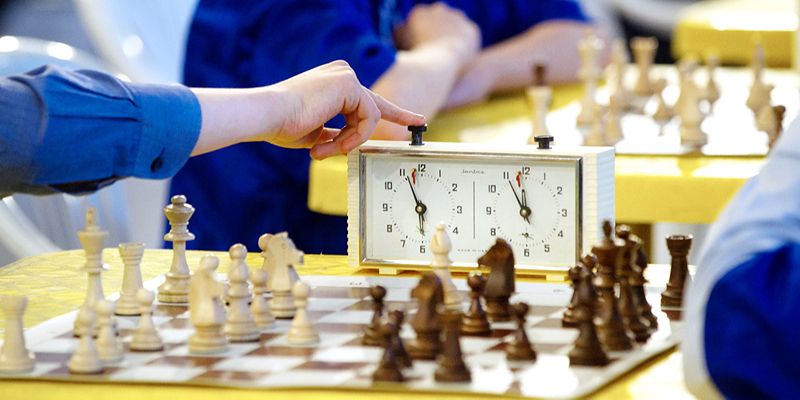
You can win the title of national or even world champion at any age. To prove our point, we will tell you about students at the Mikhail Botvinnik Junior Sports School at the Moscow Pioneers Palace. 2023 was a breakthrough year for them: young chess players won 35 awards at Russian and international competitions. The path to success is challenging but exciting. Experienced mentors guide the children. The school employs 20 teachers from different generations: international masters and grandmasters, FIDE masters and certified coaches. Under their guidance, more than 500 students learn chess.
Read on to find out what methods are used to teach children to be chess masters, how to become a world champion at the age of eight and why children love this sport — mos.ru.
King of chess
Roman Shogdzhiev, a student at the Mikhail Botvinnik Junior Sports School, is eight years old. The boy started playing chess three years ago. His parents brought him to the sports club, he tried to play and fell in love with this game. As a promising player, he was invited to attend the Mikhail Botvinnik Chess School. The school helped him develop the skills, become more confident and successful.

Already in 2023, Roman Shogdzhiev became a world chess champion in the under-8 category (boys). In addition, the player won gold medals in the under-9 and under-11 categories. Roman took part in a world competition for the first time in 2022 and fell just short of becoming a champion. A year later, he returned to the competition to win the cup.

“I was not nervous before the competition and I thought that I would beat everybody. I was confident of winning the competition,” says Roman Shogdzhiev.
And that was what he did. Although the world championship, which took place in Sharm el-Sheikh (Egypt), consisted of 11 rounds, and in the course of round 10 it was clear that Roman Shogdzhiev scored the most points and was second to none. The boy went home with the cup and a medal, and most importantly, the title of the world champion.
All of Roman’s classes are online, including at his general education school. This approach allows him to devote six hours a day to playing chess, focus on the skills and combine sports with his lessons.
Three coaches train the champion at once: from the Moscow Chess Federation, the Kurchatov School and the Mikhail Botvinnik Junior Sports School. The latter is characterized by in-depth training, thoughtfulness and expertise. They see talented children at an early age and help them develop the skills of champions.


“In addition to practice, we listen to interesting lectures. The coaches clearly explain new topics. Most of the students are my friends. They are good chess players with whom I can discuss different positions,” shares Roman Shogdzhiev.
The boy is not going to rest on his laurels. He has ambitious plans to win world championships in all senior age categories and the Asian Youth Chess Championships.
Roman Shogdzhiev is going to devote his life to this sport and become a world famous chess player. Inspired by the skill of Norwegian Magnus Carlsen, he also emphasizes that he does not copy anyone but plays in his own unique style.
Queen’s move
12-year-old Diana Preobrazhenskaya started playing chess eight years ago, and she has been studying at the Mikhail Botvinnik Chess School since September 2023. School classes are held three times a week: two online and one offline.
“During online classes we solve problems and take a closer look at different positions. Our coach tells us how to move and when to use strategies. During school classes we play the game. I like the positions and tasks our mentors set, the topics they select, and I also enjoy participating in competitions with our team. This is how I make new friends,” shares Diana Preobrazhenskaya.
.jpg)
In 2023, she won a top award — she became the world classic chess vice-champion in the under-12 category. Winners from Russian competitions are eligible to take part in international championships.
“Before the international championship, I felt nervous, every day I focused on the game and prepared for the competition with a new opponent. I was analyzing the moves the player made at the beginning of the game, and also took a closer look at the style in order to predict my opponent’s moves,” says the chess player.
After the award ceremony, she had mixed feelings: it is always nice to be the winner, but she wants more. Her short-term goal is to become a world champion, and in the future she wants to become a grandmaster.
To practice her skills, Diana Preobrazhenskaya plays chess every day and monitors the time it takes to play one game. She spends from a few seconds to 20 minutes to solve one problem.


In addition to chess and school, the girl participates in athletics and plays the piano. It is hard to combine all this. Due to long competitions, she often has to catch up on her studies. But chess is her priority. She plans to devote her life to this sport.
How world champions are made
Children at the Mikhail Botvinnik Junior Sports School start learning chess at the age of five or six. But there are also four-year-old students. At first, they spend two to three hours a week to play chess. Then, the amount of time increases, the topics become more complex, and the tournaments become more challenging. Teenagers aged 15–16 devote to chess 12 hours a week.


Classical, blitz, rapid and other types of chess are taught in the school, and children can choose what they really like. But Moscow teachers focus on classical chess, where a player can think carefully, choose a strategy and make the right decision.
The secret of their success is a special teaching methodology that has been developed over several decades.
“We had a very good Soviet chess school. Founded in 1936, the Mikhail Botvinnik Junior Sports School has adopted many best practices. We have also added modern technologies and computer analysis. By combining old and new methods, we have got the opportunity to bring up champions,” says Stanislav Fokin, Head of the Mikhail Botvinnik Junior Sports School.

In addition to Roman Shogdzhiev and Diana Preobrazhenskaya, there are many talented students whose wins the school and the city are proud of. They are Egor Korelsky, the world blitz chess vice-champion in the under-12 boys category, Victoria Merkulova, the strongest Russian chess composition player in the under-15 girls category, 13-year-old Lev Zverev, the Russian rapid chess champion in the under-19 category, as well as Nikolai Averin, David Akhmedov and Nikolai Vasilkov.
Mentors help their students develop their perseverance, concentration, efficiency, logical thinking and other skills. All this contributes to good academic performance, admission to universities and harmonious personal development.
Additional classes help the students gain enough knowledge and improve their skills to play chess: the school regularly holds lectures and masterclasses. Recently the students have had a lesson on attacking the king. A program to develop the strategic thinking of a chess player will start soon for children to learn to plan their moves across the entire board.


According to Stanislav Fokin, when a child is ready to play, anxiety will not confuse them during competitions. “If you have a background in chess, you will still find the best move. Coaches treat the needs of each student individually talking a lot with them. Sometimes, the children feel nervous, but our daily work is to help them overcome their fear,” he says.